Eye Health and Vision Issues in Guinea Pigs
Guinea pig eyes are large, bright, and positioned on the sides of their head, giving them a wide field of vision to watch for predators. While generally robust, their eyes are susceptible to a range of issues, from minor irritations to conditions that can cause blindness. Understanding what's normal and what's not is key to protecting your pet's sight.
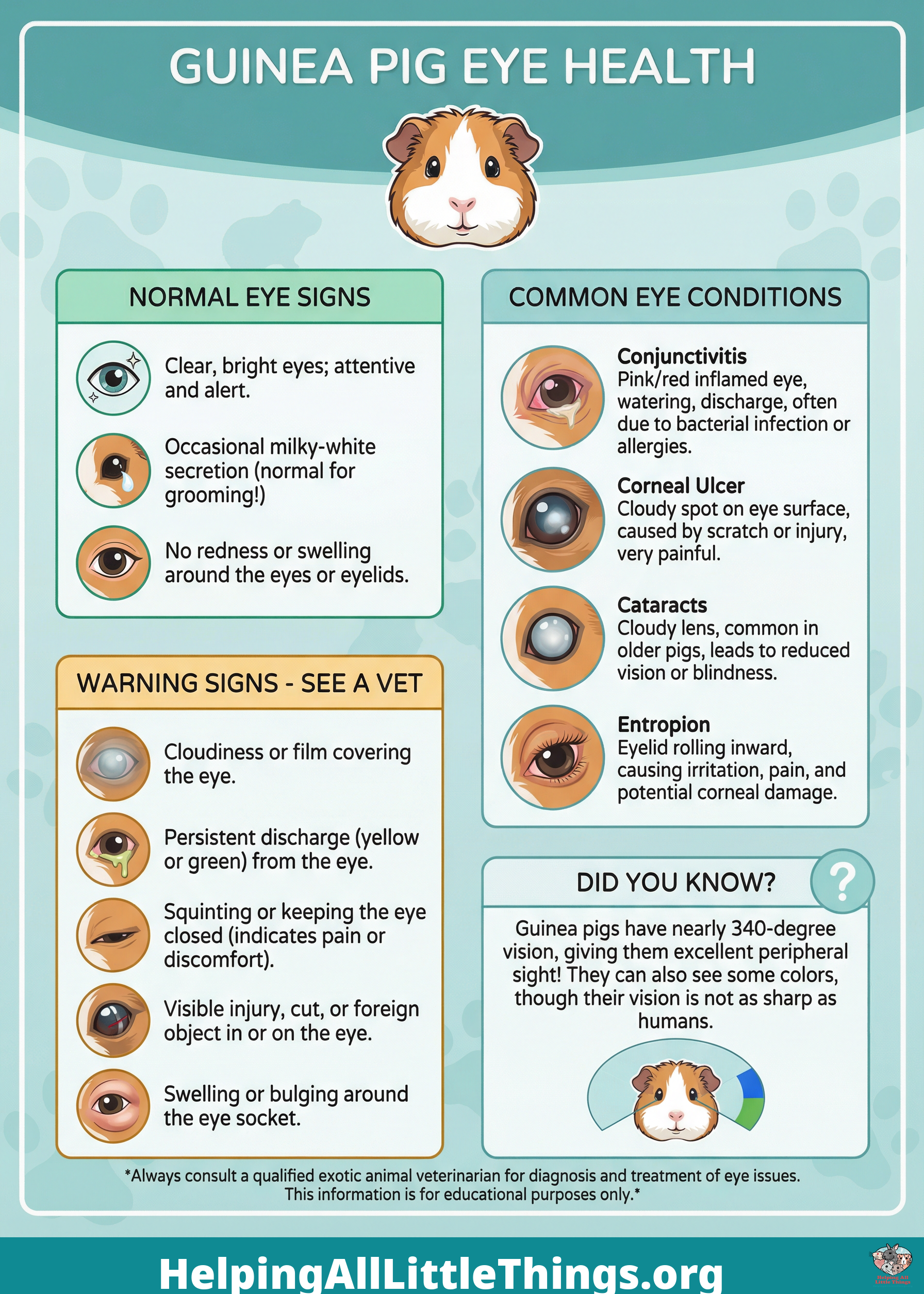

Normal Guinea Pig Eyes
First, it's important to know what's normal. A healthy guinea pig's eyes should be:
- Clear, bright, and alert.
- Free of discharge, redness, or swelling.
One unique and often alarming feature for new owners is the milky white fluid guinea pigs secrete from their eyes. This is a normal grooming fluid. The guinea pig will express it from the corner of the eye, then use its front paws to groom its face. Seeing this occasionally is not a cause for concern [1].
Common Eye Problems in Guinea Pigs
Several conditions can affect a guinea pig's eyes. Any sign of pain or change in appearance warrants a trip to an exotic pet veterinarian.
1. Hay Poke Injuries
One of the most common — and most preventable — eye injuries in guinea pigs is a hay poke. Guinea pigs spend a large portion of their day foraging through hay, and the stiff, sharp ends of timothy hay or orchard grass can easily jab directly into the eye. Because guinea pigs have large, prominent eyes positioned on the sides of their head, they have almost no ability to blink or recoil in time to protect themselves.
Hay pokes are especially common in guinea pigs that eat from hay racks positioned at face height, or who burrow nose-first into a pile of loose hay.
- Signs: Sudden squinting or holding one eye shut, pawing at the face, excessive watering from one eye, or visible redness. In some cases you may actually see a piece of hay protruding from the eye or lodged in the corner.
- What to do: Do not attempt to remove a deeply embedded piece of hay yourself. If the hay is sitting loosely in the corner of the eye, you can gently flush the eye with sterile saline (plain, preservative-free saline or a commercial eye wash). If the guinea pig is still squinting or the eye looks cloudy after flushing, treat it as an emergency and get to a vet the same day.
- Prevention: Consider using a hay feeder that positions hay above the guinea pig's head so they pull it downward rather than diving face-first into it. Avoid very fine, dusty hay cuts, which tend to have more sharp loose ends.
A hay poke that is not treated promptly almost always leads to a corneal ulcer (see below). The two conditions are closely linked — hay poke is the cause, corneal ulcer is the result.
2. Corneal Ulcers (Scratches on the Eye)
A corneal ulcer is a scratch or abrasion on the surface of the eye (the cornea). Hay pokes are the single most common cause, though a scratch from a cagemate, a rough piece of bedding, or even the guinea pig's own claws during grooming can also cause one.
- Signs: Squinting, keeping the eye closed, excessive tearing, a cloudy or bluish-white spot on the eye's surface, or visible discomfort when the area around the eye is touched.
- Treatment: This is very painful and requires immediate veterinary attention. The vet will likely use a fluorescein stain (a harmless orange dye that glows under UV light) to confirm the ulcer's size and location, then prescribe antibiotic eye drops to prevent infection and support healing. Pain relief is also typically provided. Left untreated, a corneal ulcer can lead to permanent scarring, vision loss, or the loss of the eye entirely.
3. Conjunctivitis (Pink Eye)
Conjunctivitis is the inflammation of the pink tissue surrounding the eye. It can be caused by a bacterial infection, an allergic reaction to dusty bedding, or other irritants.
- Signs: Red, swollen eyelids; a watery or thick, pus-like discharge.
- Treatment: A vet will determine the cause and prescribe appropriate antibiotic or anti-inflammatory eye drops.
4. Cataracts
Cataracts are a clouding of the lens inside the eye, which can lead to partial or complete blindness. They often appear as a white, opaque area in the center of the eye.
- Causes: Cataracts can be genetic, develop with old age, or be linked to diabetes.
- Management: There is no cure for cataracts in guinea pigs. However, blind guinea pigs can live full, happy lives. They adapt well as long as their environment is kept consistent and safe. Avoid rearranging the cage, and speak to them before picking them up to avoid startling them.
5. Entropion
Entropion is a condition where the eyelid rolls inward, causing the eyelashes to rub against the cornea. This is very irritating and painful.
- Signs: Squinting, excessive tearing, redness, and potential corneal ulcers from the constant rubbing.
- Treatment: In some cases, temporary sutures can be used to roll the eyelid back out. In severe or persistent cases, a minor surgery is required to correct the defect.
6. Pea Eye
"Pea eye" (or fatty eye) is a condition where the conjunctival sac, the pink tissue in the corner of the eye, protrudes. It looks like a small, pinkish-red lump.
- Causes: It can be caused by genetics, irritation, or can be idiopathic (have no known cause).
- Treatment: If it is not bothering the guinea pig, it is often left alone. If it becomes irritated or inflamed, a vet may prescribe eye drops or, in rare cases, recommend surgical removal [2].
When to See a Vet
Any of the following signs indicate a problem that requires veterinary attention:
- Cloudiness, film, or a visible spot on the eye.
- Persistent discharge (clear, white, yellow, or green).
- Squinting, holding the eye shut, or pawing at the eye.
- Redness or swelling of the eyelids.
- A visible foreign object (like a piece of hay) in the eye that you cannot gently flush out with saline.
Eye problems in guinea pigs can progress quickly. What seems like a minor irritation can become a serious infection or lead to vision loss if not treated promptly. Always consult a guinea pig-savvy veterinarian for any eye-related concerns.
References
[1] Guinea Lynx. (n.d.). Guinea Pig Eye Health. Retrieved from https://www.guinealynx.info/eyes.html
[2] VCA Animal Hospitals. (n.d.). Disorders of the Eye in Guinea Pigs. Retrieved from https://vcahospitals.com/know-your-pet/disorders-of-the-eye-in-guinea-pigs