Eye & Vision Issues in Guinea Pigs
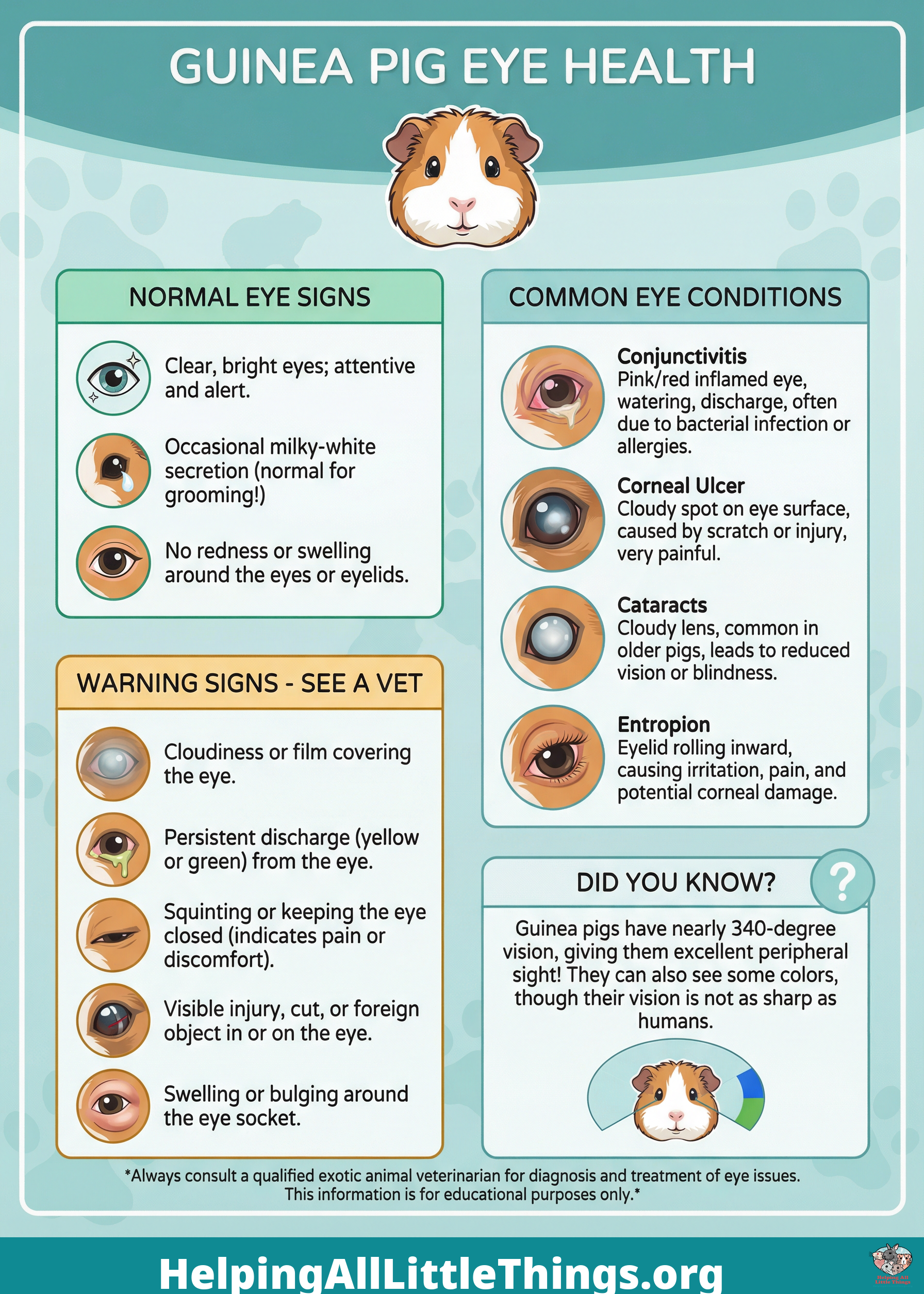

Eye problems are common in guinea pigs and can range from minor irritations to indicators of more serious underlying health issues. A healthy guinea pig's eyes should be bright, wide, and clear. As they are prey animals, their large eyes, set on the sides of their head, give them a wide field of vision to watch for predators.
Common Eye Conditions
-
Fatty Eye (Lipid Keratopathy):
- Cause: This is a common, benign condition where milky-white or yellowish fatty deposits build up in the cornea (the clear surface of the eye). It is not fully understood why it occurs, but it may be linked to genetics and a diet high in fat and cholesterol.
- Signs: A hazy, white, or fatty-looking film on the surface of one or both eyes. It does not appear to be painful and usually does not significantly affect vision unless it becomes very advanced.
- Action: While there is no treatment for the condition itself, a veterinary visit is important to get a correct diagnosis and rule out other problems like cataracts or ulcers. A diet review to ensure it is not too high in fat (e.g., from excessive sunflower seeds) is also a good idea.
-
Pea Eye (Conjunctival Prolapse):
- Cause: This condition occurs when the conjunctiva, the pink tissue lining the eyelid, swells and protrudes from the lower eyelid, looking like a small pink pea in the corner of the eye.
- Signs: A visible pink or red mass in the corner of the eye. It is generally not painful but can be alarming to see.
- Action: A veterinarian can diagnose pea eye. In some cases, anti-inflammatory eye drops may help. If the prolapse is severe or becomes chronically irritated, surgery may be required to correct it.
-
Corneal Ulcers and Injuries:
- Cause: This is one of the most common eye emergencies. A scratch on the surface of the eye, most often from a sharp piece of hay, can cause a painful corneal ulcer.
- Signs: The guinea pig will be in obvious pain, holding the eye shut, squinting, and tearing excessively. The eye itself may look cloudy or bluish.
- Action: This is an emergency. An untreated ulcer can become infected and lead to the loss of the eye. A vet will apply a stain to the eye to see the ulcer and will prescribe antibiotic eye drops and pain medication.
-
Cataracts:
- Cause: A cataract is a clouding of the lens inside the eye. It is most often an age-related change in older guinea pigs. It can also be linked to diabetes, though this is less common in guinea pigs than in some other species.
- Signs: A white, opaque appearance deep within the center of the eye. It leads to progressive vision loss.
- Action: Most guinea pigs adapt very well to the gradual vision loss associated with age-related cataracts. No treatment is typically required, but a vet visit is needed for a proper diagnosis.
-
Microphthalmia (Small Eye):
- What it is: Microphthalmia means one or both eyes are abnormally small from birth. It is a congenital (present-at-birth) condition, not something a guinea pig develops over time. In guinea pigs, it is strongly associated with the roan coat gene: breeding two roan guinea pigs together can produce "lethal white" offspring with severe microphthalmia or anophthalmia (absent eyes), deafness, and digestive defects. Even in heterozygous roan guinea pigs, the rate of microphthalmos and cataract is statistically higher than in other breeds.
- Signs: One or both eyes appear visibly smaller than the other, or are sunken. There may be secondary keratitis (corneal inflammation) if the small eye is not adequately covered by the eyelids.
- Action: A veterinarian should assess whether the eye is comfortable and whether the corneal surface is protected. Many guinea pigs with a small eye live comfortably with monitoring and lubrication. A painful or repeatedly ulcerated eye may need to be removed. Do not breed roan × roan guinea pigs. See our full guide: Microphthalmia in Small Pets
The Normal Milky-White Discharge
It is normal for guinea pigs to secrete a milky-white fluid from their eyes. They use this fluid to groom their faces. You may see them wipe their eyes with their front paws and then clean their fur. This is a normal, healthy behavior and should not be confused with an infectious discharge, which would be thicker, yellowish, and accompanied by redness or swelling.
Prevention
- Be Careful with Hay: When adding hay to the cage, try not to poke your guinea pig in the eye.
- Provide a Safe Environment: Ensure there are no sharp objects in the cage that could cause an injury.
- Good Diet: A proper diet high in hay and Vitamin C supports overall health, including eye health.
Any time your guinea pig is holding an eye closed, has a cloudy eye, or has a discharge that is not the normal milky grooming fluid, it's time for a visit to an exotics-savvy veterinarian.