Dental Disease in Chinchillas
Dental disease is one of the most common and serious health problems in pet chinchillas. Because their teeth grow continuously throughout their lives, any disruption to normal wear can quickly lead to painful overgrowth, misalignment, and secondary complications. Understanding the causes, warning signs, and management options is essential for every chinchilla owner.
Understanding Chinchilla Teeth
Chinchillas have open-rooted (elodont) teeth, meaning all 20 teeth — incisors and cheek teeth — grow continuously at a rate of approximately 6–8 cm per year.1 They rely on a high-fiber diet, particularly unlimited grass hay, to naturally wear the teeth down through the grinding motion of chewing. When this wear is insufficient or uneven, the teeth become overgrown or misaligned, a condition known as malocclusion.
Unlike rabbits and guinea pigs, the cheek teeth (premolars and molars) of chinchillas sit deep in the jaw and cannot be easily examined without sedation and specialized equipment. This means dental disease is often well advanced before it is detected.2
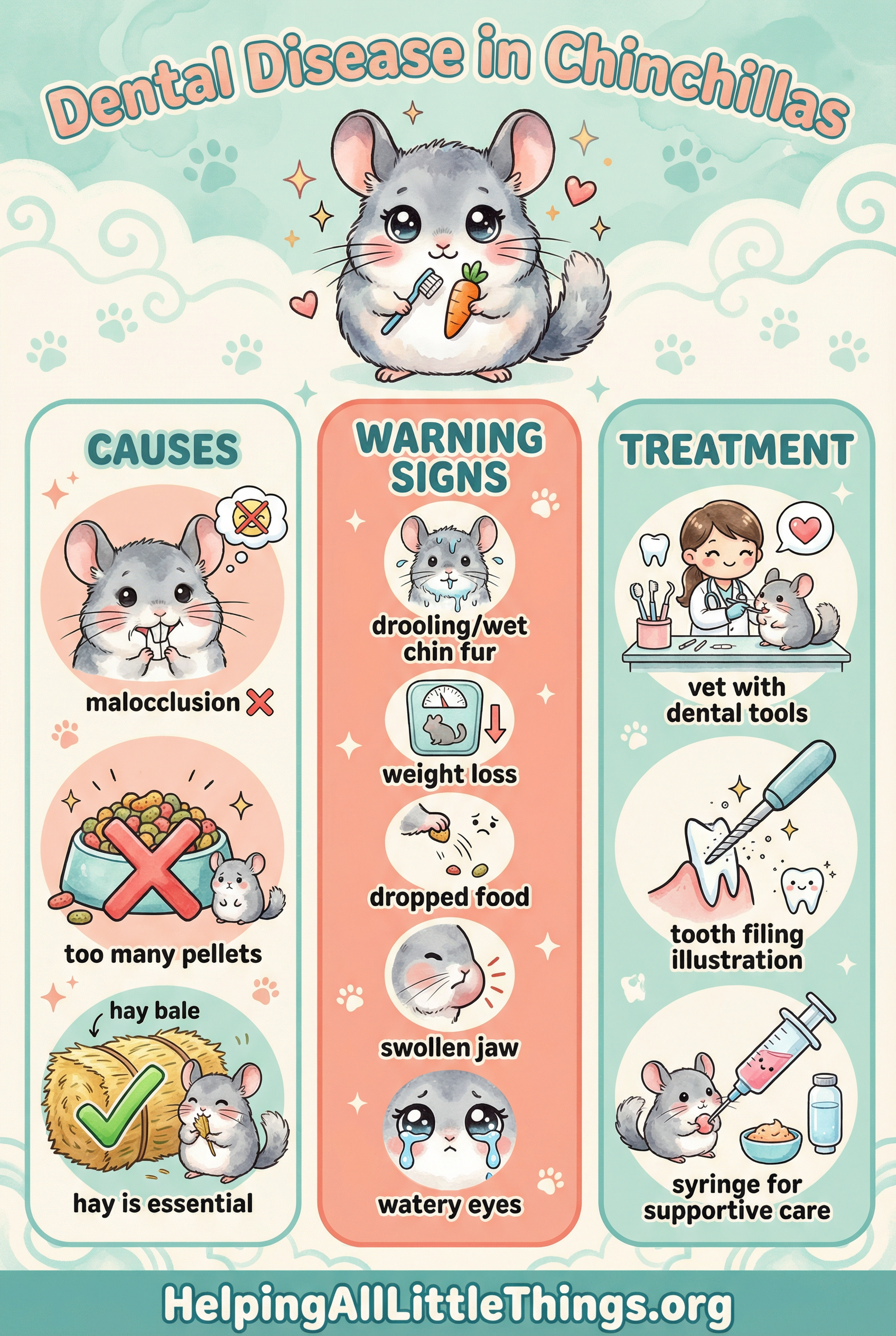

Causes of Dental Disease
Several factors can contribute to dental disease in chinchillas:
Malocclusion is the most common cause. When the upper and lower teeth do not meet correctly, they cannot wear each other down evenly. This leads to the formation of sharp spurs and spikes on the cheek teeth, which can lacerate the tongue and cheeks.3
Dietary deficiencies play a major role. A diet too high in pellets and low in hay deprives the teeth of the long-fiber grinding action they need. Pellets are eaten quickly with minimal jaw movement, while hay requires prolonged chewing that naturally files the teeth.2
Genetic predisposition is increasingly recognized as a factor. Some chinchillas inherit a jaw structure that predisposes them to misalignment, and selective breeding for certain traits may have inadvertently increased the prevalence of dental disease in captive populations.3
Calcium and phosphorus imbalances can affect bone density and tooth root development, potentially contributing to root elongation and jaw abnormalities.1
Warning Signs
Dental disease in chinchillas can be subtle in its early stages. Watch for:
- Wet or matted chin fur ("slobbers") — caused by excessive drooling from mouth pain
- Dropping food or chewing on one side
- Reduced appetite or complete refusal to eat
- Progressive weight loss despite food being available
- Swollen or asymmetrical jaw
- Watery or runny eyes — caused by pressure on the tear ducts from elongated tooth roots
- Lethargy and reduced activity
Dental disease can progress rapidly. If your chinchilla is losing weight or has a wet chin, seek veterinary attention immediately — do not wait to see if it improves.
Diagnosis
Diagnosis requires a thorough oral examination, which in chinchillas almost always requires sedation or general anaesthesia to properly visualize the cheek teeth. Skull radiographs or CT scanning are the gold standard for assessing root elongation and bone involvement, and are essential for planning treatment.13
Treatment Options
Treatment depends on the severity of the disease:
| Severity | Treatment |
|---|---|
| Mild overgrowth | Tooth trimming and filing (burring) under anaesthesia |
| Moderate malocclusion | Repeated burring every 4–12 weeks plus supportive care |
| Severe root elongation | Tooth extraction; surgical debridement of abscesses |
| Terminal disease | Palliative care or humane euthanasia |
Supportive care is critical during and after treatment. Syringe feeding with a recovery formula (such as Oxbow Critical Care) helps maintain weight and gut motility. Pain management with appropriate analgesics (e.g., meloxicam) is essential.2
Tooth trimming is not a cure for malocclusion — it manages the condition and reduces suffering, but the underlying misalignment remains. Owners should be prepared for ongoing, lifelong management.
Prevention
While genetic malocclusion cannot be prevented, good husbandry significantly reduces the risk of diet-related dental disease:
- Provide unlimited grass hay (timothy, orchard, or meadow) as the primary diet — it should make up 70–80% of food intake
- Offer only a small daily portion of high-quality pellets (1–2 tablespoons per day)
- Avoid sugary treats, seeds, nuts, and dried fruit entirely
- Provide wooden chews and safe gnawing materials to encourage jaw use
- Schedule annual veterinary check-ups including a dental examination
For more information on feeding your chinchilla correctly, see our article on Chinchilla Nutrition and Diet.