Hamster Habitat
A hamster's cage is its entire world, so creating a safe, spacious, and enriching environment is the most important responsibility of any owner. The right habitat prevents stress, boredom, and escape attempts, allowing your hamster to thrive.
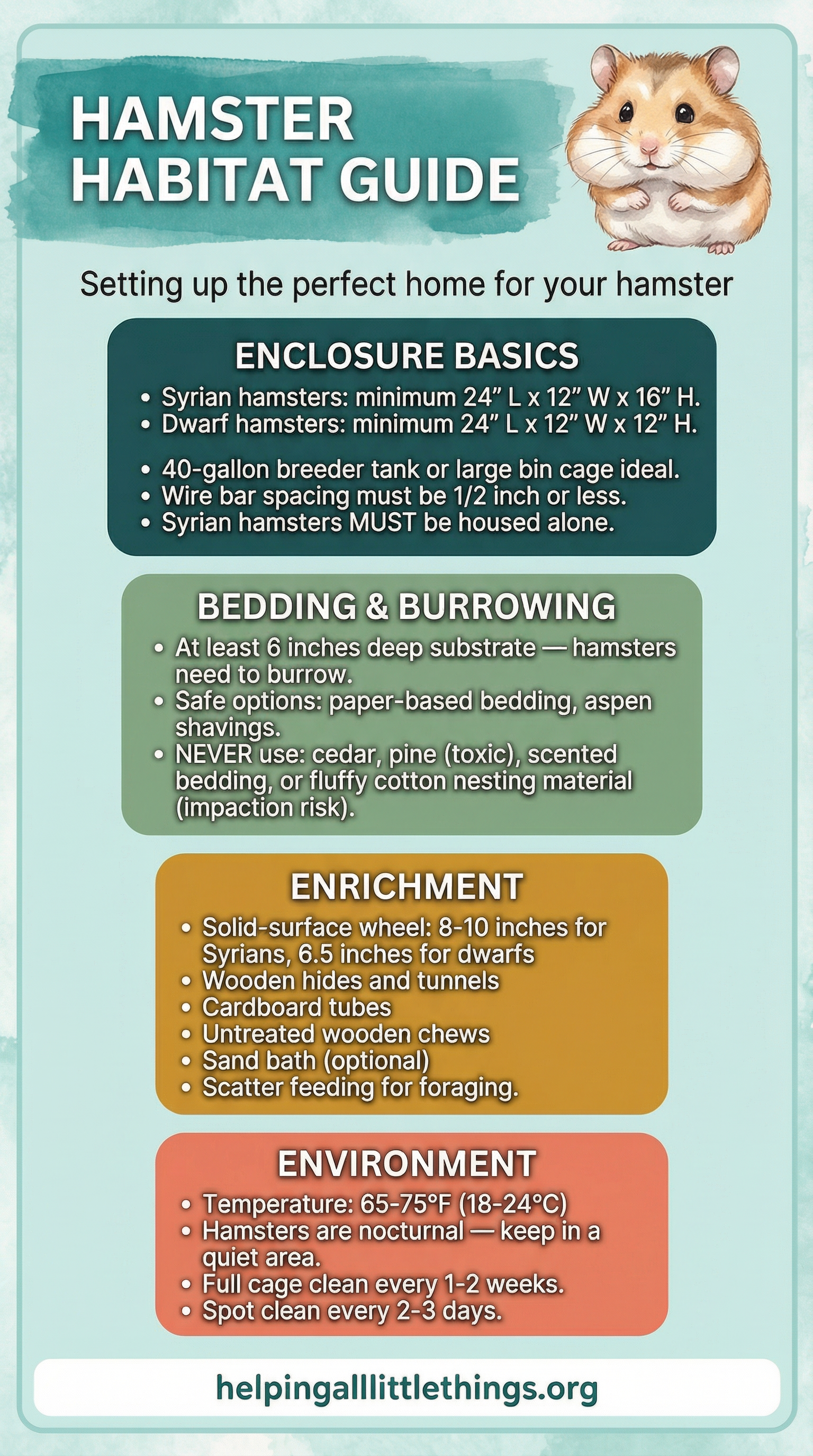
Share this infographic:

Enclosure: Bigger is Always Better
Forget the small, colorful plastic cages often marketed for hamsters. These are inadequate and stressful. Hamsters need a large, uninterrupted floor space.
- Minimum Size: The absolute minimum continuous floor space is 450 square inches for dwarf hamsters and 600 square inches for Syrian hamsters. However, we strongly recommend at least 800+ square inches.
- Good Options:
- 40-gallon breeder tank or larger aquarium with a mesh lid.
- Large DIY bin cages (e.g., from a 100+ quart storage bin).
- Large commercial cages like the Prevue 528.
- Bar Spacing: If using a wire cage, bar spacing must be 1/2 inch or less for Syrian hamsters and 1/4 inch or less for dwarf hamsters to prevent escapes.
Bedding and Burrowing
Hamsters are natural burrowers and require deep bedding to feel secure.
- Depth: Provide at least 6-10 inches of bedding across the entire enclosure.
- Safe Bedding Types:
- Paper-based bedding (Kaytee Clean & Cozy, Carefresh)
- Aspen shavings
- Unsafe Bedding: NEVER use cedar or pine shavings (toxic oils), scented bedding, or fluffy cotton/kapok material (can cause fatal intestinal blockages).
Enrichment: A Busy Hamster is a Happy Hamster
- Wheel: This is non-negotiable. Provide a solid-surface wheel (no mesh or bars). Syrian hamsters need a 10-12 inch wheel, while dwarf hamsters need a 6.5-8 inch wheel. A wheel that is too small will cause painful spinal curvature.
- Sand Bath: A shallow dish of heat-treated sand (children's play sand or reptile sand, not dust) is essential for grooming.
- Hides: Provide multiple hides, such as wooden houses, ceramic hides, and cardboard tubes.
- Chews: Offer a variety of chews like Whimzees, apple wood sticks, and cardboard to keep their teeth trim.
- Foraging: Scatter-feeding their food instead of using a bowl encourages natural foraging behavior.
Environment
- Temperature: Keep the room between 65-75°F (18-24°C).
- Location: Place the cage in a quiet area away from direct sunlight, drafts, and loud noises. Since hamsters are nocturnal, they need a peaceful place to sleep during the day.