Is a Hamster Right for Me and My Family?
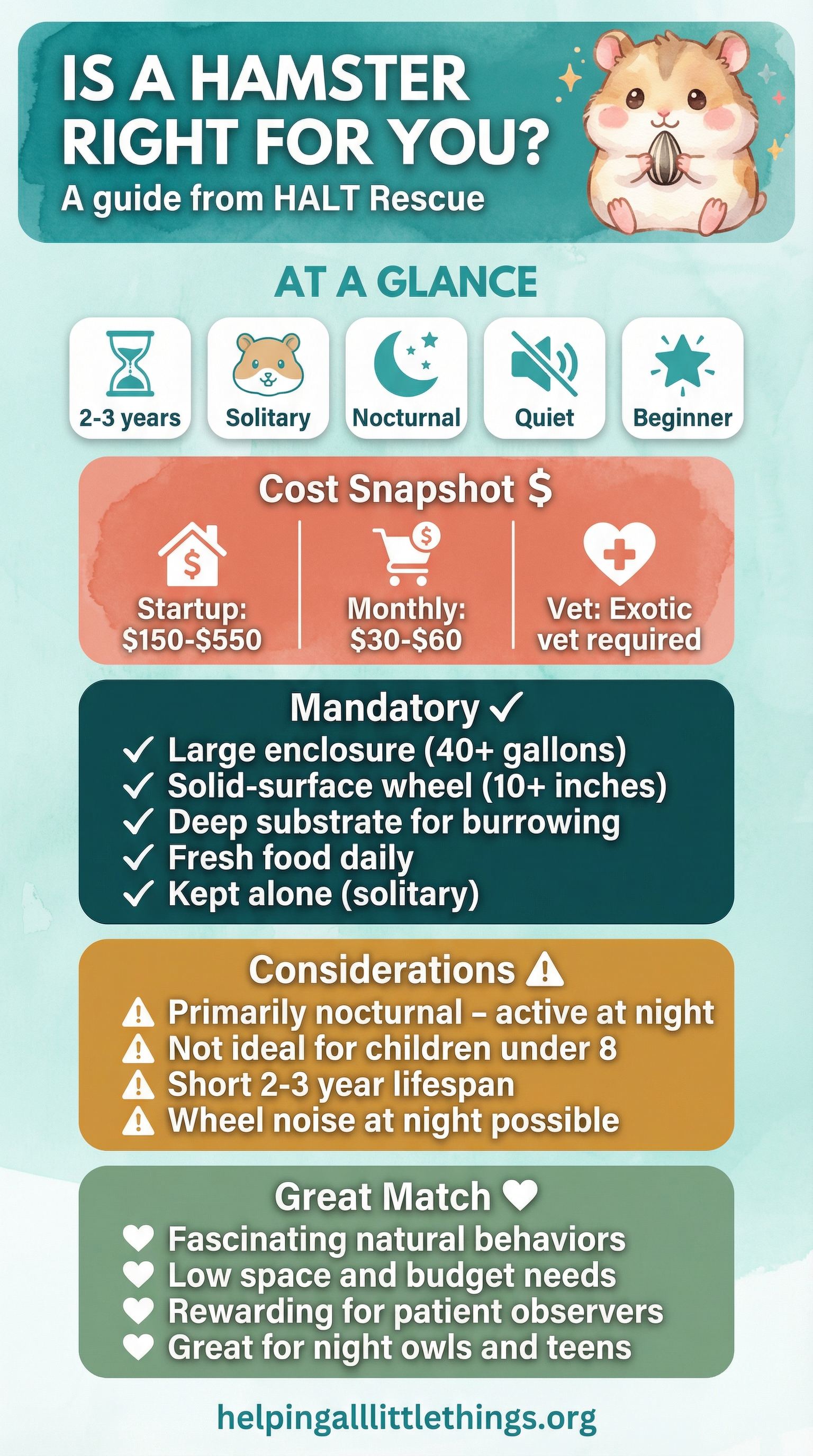

Hamsters are often purchased as a first pet for young children, but the reality of hamster ownership frequently surprises families who aren't prepared. They are fascinating, complex animals — but their nocturnal lifestyle and stress-prone nature make them a better fit for older children, teenagers, and adults than for the toddler-and-primary-school crowd.
The Basics
Hamsters typically live 1.5 to 3 years, depending on species. Syrian hamsters (the large "golden" hamsters) tend to live toward the longer end; dwarf species are often shorter-lived. This brief lifespan can be emotionally difficult, particularly for young children who may not be prepared for the loss.
Hamsters are solitary animals and should be housed alone. Syrian and Chinese hamsters are strictly solitary and will fight to the death if housed with another hamster after weaning. While dwarf species (Roborovski, Campbell's, Winter White) are sometimes described as social, HALT's recommendation is to house all hamsters individually — fatal fighting between previously bonded pairs is well-documented across all dwarf species, and the vast majority of Campbell's and Winter Whites sold in the US are hybrids with unpredictable social compatibility.
What They Need Every Day
- A large enclosure — the minimum recommended size is 775 square inches of floor space (roughly 40 gallons), with at least 6 inches of deep substrate for burrowing, which is a critical behavioral need
- A solid-surface wheel at least 10–11 inches in diameter for Syrian hamsters (smaller for dwarfs) — mesh or barred wheels cause injury
- Fresh food daily alongside a quality seed mix and lab blocks
- Enrichment — tunnels, hides, and foraging opportunities to support natural behaviors
Note that hamsters are primarily active at night. If you are hoping for a pet that is awake and playful during the day, a hamster will likely disappoint. They are typically asleep until evening, and their wheel can be audible at 2am.
The Cost of Hamster Ownership
| Category | Estimated Cost |
|---|---|
| Startup (enclosure, wheel, substrate, supplies, adoption fee) | $150–$550 |
| Monthly ongoing (food, bedding, substrate) | $30–$60/month |
| Veterinary care | Exotic vet required; wet tail, tumors, and dental issues are common |
The startup cost is higher than many people expect, largely because the enclosures commonly sold in pet stores are far too small. A proper hamster setup requires a large tank, bin cage, or IKEA Detolf-style enclosure with adequate depth for burrowing.
Think Twice If...
- Your child is under 8 years old. Hamsters are fast, fragile, and easily stressed by rough handling. They are not ideal for very young children, and a drop from even a short height can be fatal.
- You are hoping for a daytime pet. Hamsters sleep most of the day and should not be woken during their rest period — doing so causes significant stress and can lead to biting.
- The short lifespan will be very hard on your family. Losing a hamster after 18 months to 2 years is common, and it can be genuinely heartbreaking.
- You live in a small space with thin walls. Wheel noise at night is a real consideration.
Great Match If...
- You are a night owl, teenager, or adult who is home in the evenings and can enjoy watching your hamster's natural activity
- You find joy in creating enriching environments and watching natural burrowing and foraging behaviors
- You have limited space and budget but want to provide excellent care for a solo animal
- You appreciate a pet that is interesting to observe even if it is not highly interactive in the traditional sense
A Note on Hamster Handling
Hamsters can become wonderfully tame with patient, consistent handling — but this takes time and must be done on the hamster's schedule (evenings, when they are naturally awake). Forcing interaction during the day is stressful for the animal and increases the likelihood of biting. With the right approach, many hamsters become comfortable being held and will even seek out their owner's hand.
Have questions about whether a hamster is right for your family? Reach out to us — we're happy to help.