Understanding Guinea Pig Coat Color Genetics
Guinea pigs are known for their stunning diversity of coat colors and patterns, from solid black to intricate brindles and dalmatians. This variety isn't random; it's the result of a fascinating and complex world of genetics. Understanding the basics of coat color inheritance is not only interesting for curious owners but is also critical for responsible breeding and rescue advocacy to prevent serious genetic health problems.
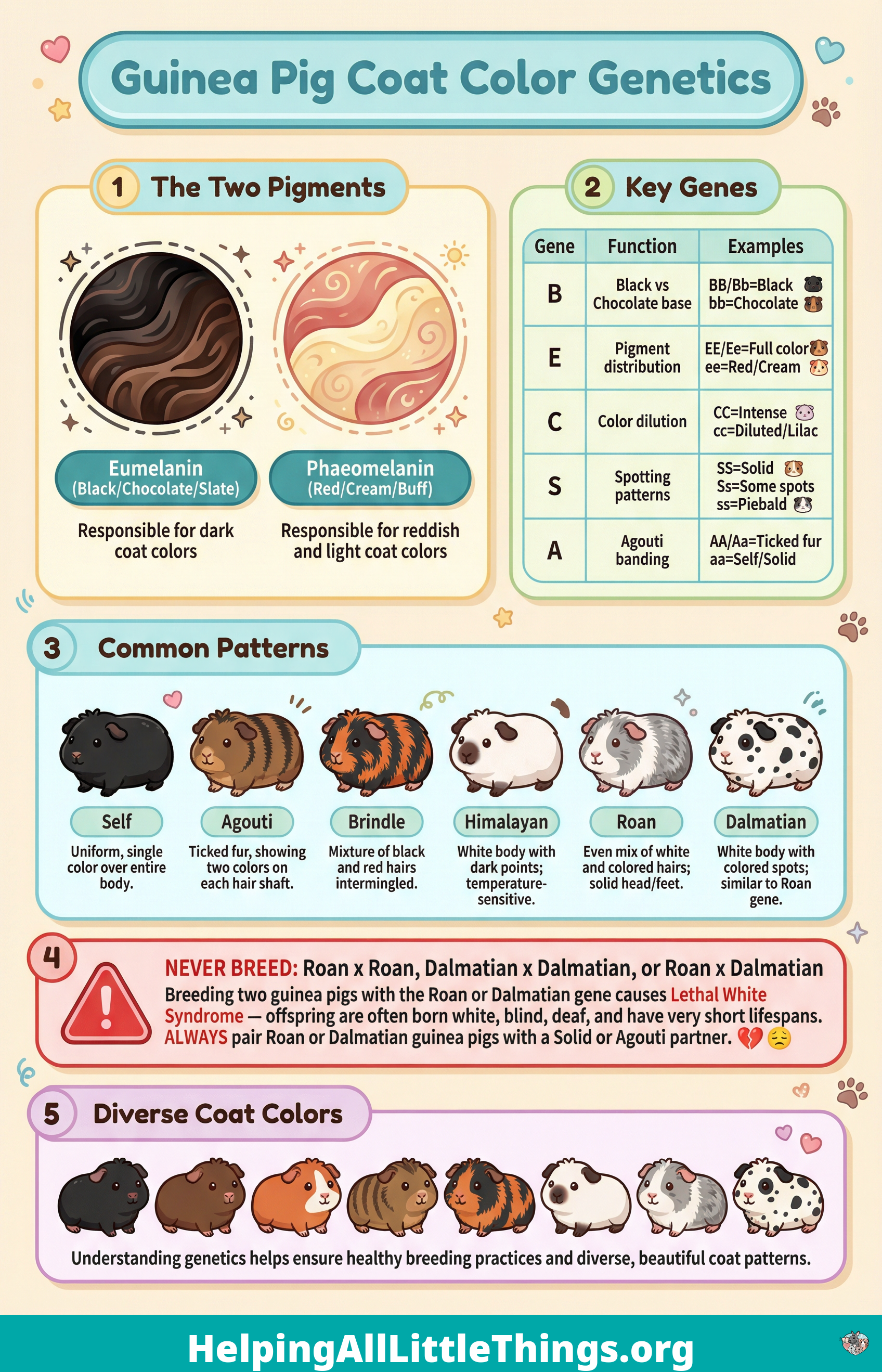
The Building Blocks: Eumelanin and Phaeomelanin
At its core, every guinea pig coat color is built from two primary pigments:
- Eumelanin: This is the black-based pigment. Depending on various genetic modifiers, it can appear as black, chocolate, or lilac/slate.
- Phaeomelanin: This is the red-based pigment, responsible for colors like red, orange, cream, and buff.
A third possibility is a complete lack of pigment, which results in white fur. This isn't caused by a "white" pigment but rather by genes that block the production or expression of eumelanin and phaeomelanin [1].
Key Genes That Define the Coat
Several genes, each with different versions (alleles), work in combination to control which pigments are produced, where they appear on the body, and how intense they are.
| Gene Series | Name | Function |
|---|---|---|
| B Locus | Black | Determines the shade of eumelanin. The dominant allele B produces black, while the recessive b allele results in chocolate. |
| E Locus | Extension | Controls the extension of dark pigment. The dominant E allele allows for full color expression (e.g., black, agouti), while the recessive e allele restricts dark pigment, leading to a red-based coat [2]. |
| C Locus | Color | This is the albino series, which controls pigment intensity. The full color allele C is dominant. Recessive alleles in this series can dilute color, creating cream and lilac, or result in a complete lack of pigment (albino) or the temperature-sensitive Himalayan pattern. |
| A Locus | Agouti | Controls the pattern on the hair shaft itself. The dominant A allele produces agouti coloring, where each hair has bands of different colors. The recessive a allele results in a solid, or "self," color. |
| S Locus | Spotting | Controls the presence of white patches or spots. The dominant S allele produces a solid-colored animal, while the recessive s allele allows for white spotting (piebald). |
| Rn Locus | Roan | The dominant Rn allele is responsible for the roan and dalmatian patterns. This gene is incompletely dominant and is linked to lethal white syndrome. |
The Danger of Roan and Dalmatian Genetics
The most critical concept in guinea pig genetics for any owner, breeder, or rescuer to understand is the danger associated with the Roan (Rn) gene. This gene creates the beautiful roan (white hairs intermingled with a solid color) and dalmatian (spots on a white background) patterns.
However, this gene is what is known as a recessive lethal when two copies are inherited. A guinea pig only needs one copy of the Rn allele to show the roan/dalmatian pattern. If two such guinea pigs are bred together, their offspring have a 25% chance of inheriting two copies of the gene (RnRn).
This RnRn combination results in a condition known as "lethal white syndrome." These pups are born pure white with pink eyes but suffer from severe and heartbreaking deformities [3, 4].
- Dental Issues: Malformed or missing molars and incisors, making it impossible to eat properly.
- Sensory Deficits: They are often blind and deaf, with underdeveloped or missing eyes (microphthalmia).
- Internal Abnormalities: Severe digestive system problems are common.
- Shortened Lifespan: Most lethal white pups die shortly after birth or must be humanely euthanized.
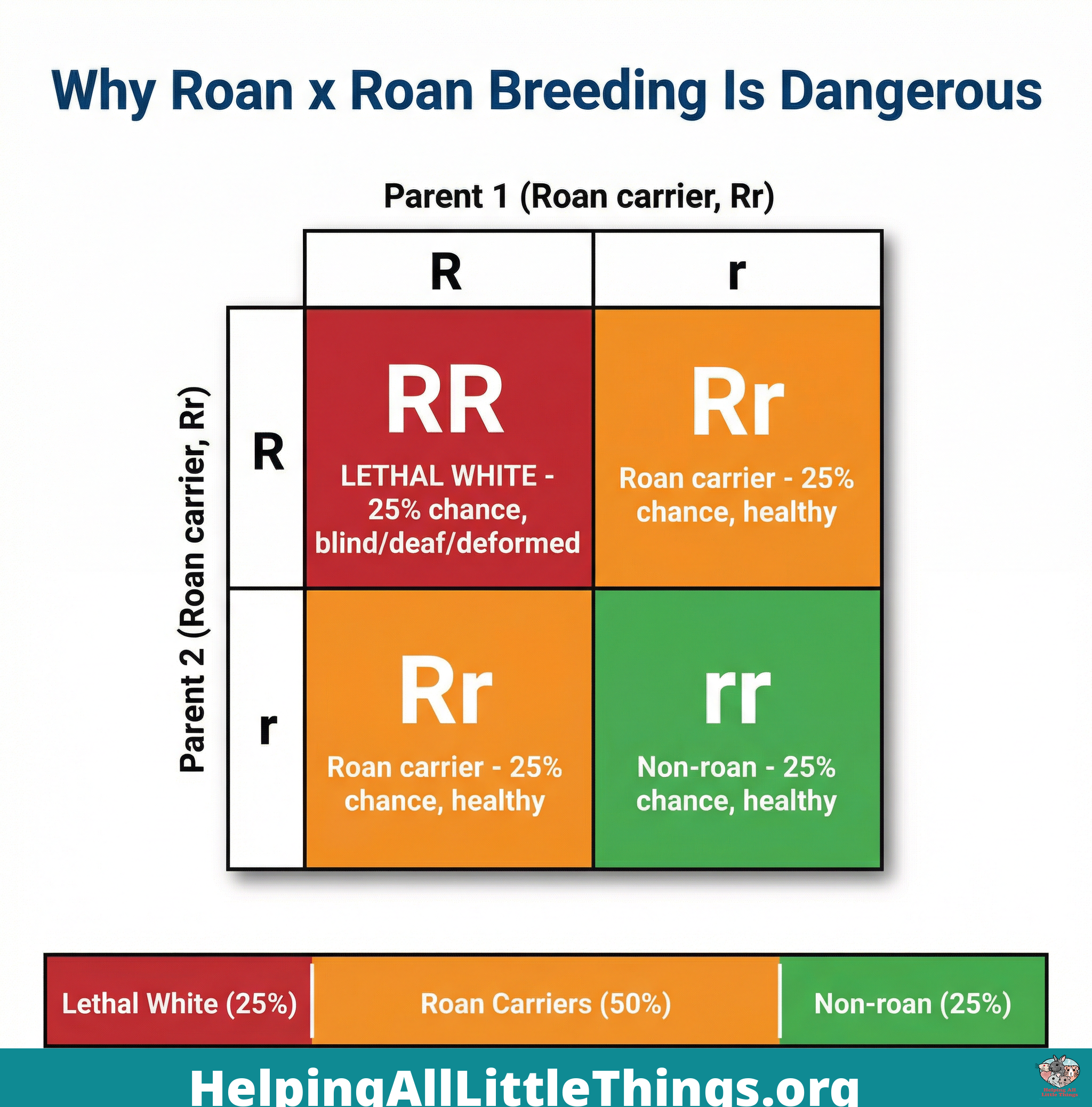
For this reason, you must NEVER breed a roan to a roan, a dalmatian to a dalmatian, or a roan to a dalmatian. Responsible caretakers will always pair a roan or dalmatian guinea pig with a solid-colored (non-roan, non-dalmatian) partner to ensure no lethal white pups are produced.
For a more in-depth look at this condition, please see our article on Lethal White Syndrome.
Why It Matters
While the genetics are fascinating, the practical application is about animal welfare. Understanding these principles helps everyone:
- Rescues and Adopters: Identify potential carriers of the roan gene to prevent accidental lethal pairings.
- Educators: Promote responsible pet ownership and adoption over breeding.
- Owners: Appreciate the beautiful diversity of guinea pigs in rescues and understand the history behind their pet's unique appearance.
By prioritizing education and responsible practices, we can ensure the health and safety of these wonderful animals.
References
[1] Wright, S. (1927). The effects in combination of the major color-factors of the guinea pig. Genetics, 12(6), 530–569.
[2] OMIA - Online Mendelian Inheritance in Animals. (n.d.). OMIA:001199-10141: Coat colour, extension in Cavia porcellus. Retrieved from https://omia.org/OMIA001199/10141/
[3] Guinea Pig Pros. (2023). Understanding Roans, Dalmatians, and Lethal Guinea Pigs. Retrieved from https://guineapigpros.com/articles/f/understanding-roans-dalmatians-and-lethal-guinea-pigs
[4] Royal Veterinary College. (2020). Lethal White Guinea Pigs. Retrieved from https://www.rvc.ac.uk/Media/Default/Beaumont%20Sainsbury%20Animal%20Hospital/documents/Guinea-pig-lethal-whites-factsheet-RVC-March2020.pdf