Dangerous Plants for Small Pets: A Regional Guide
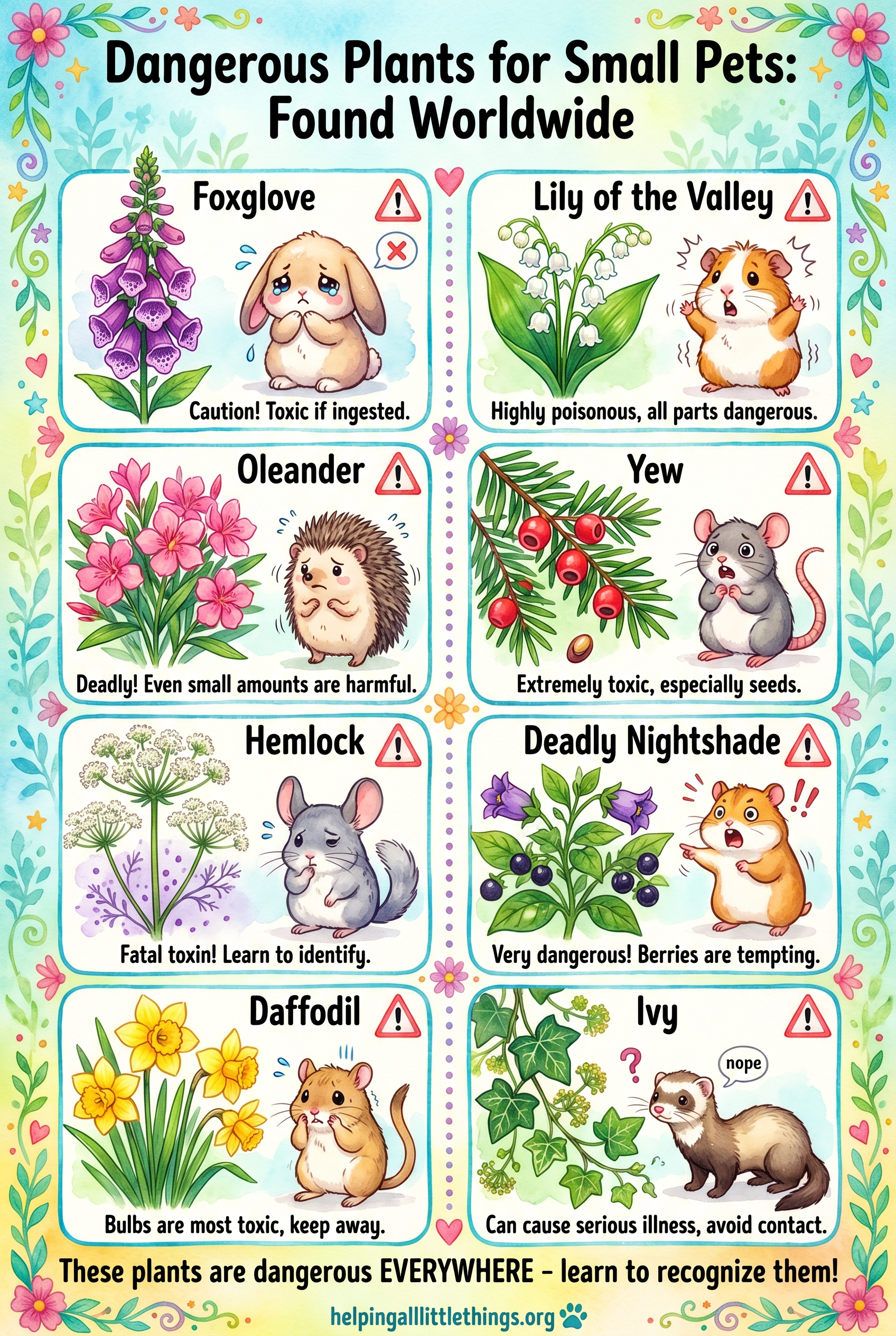
Small mammals are naturally curious, and many will nibble on almost anything green within reach. Unlike dogs and cats, rabbits, guinea pigs, and other small herbivores have no vomiting reflex — they cannot expel a toxic substance once ingested. This makes plant poisoning particularly dangerous: by the time symptoms appear, significant organ damage may already have occurred.1
This guide organizes the most important toxic plants by world region so that wherever you live, you can identify what is growing in your garden, yard, or local environment and keep your pets safe.
If you suspect your pet has eaten a toxic plant, do not wait for symptoms. Contact your veterinarian or an emergency animal poison hotline immediately.
- USA/Canada: ASPCA Animal Poison Control Center — (888) 426-4435
- UK: Animal Poison Line — 01202 509000
- Australia: Animal Poisons Helpline — 1300 869 738
How to Use This Guide
Each regional section lists the most commonly encountered dangerous plants for that area, organized by habitat (garden, wild/foraging, houseplant). For each plant, we note the toxic component, the species most at risk, and the key identifying features to help you recognize it in the field.
A note on identification: Plant identification can be difficult, and many toxic plants closely resemble safe ones. When in doubt, do not allow your pet to eat any plant you cannot positively identify. Use a plant identification app such as iNaturalist or PlantNet as a starting point, but always confirm with a local expert or your veterinarian.
🌍 Global: Plants Dangerous Everywhere
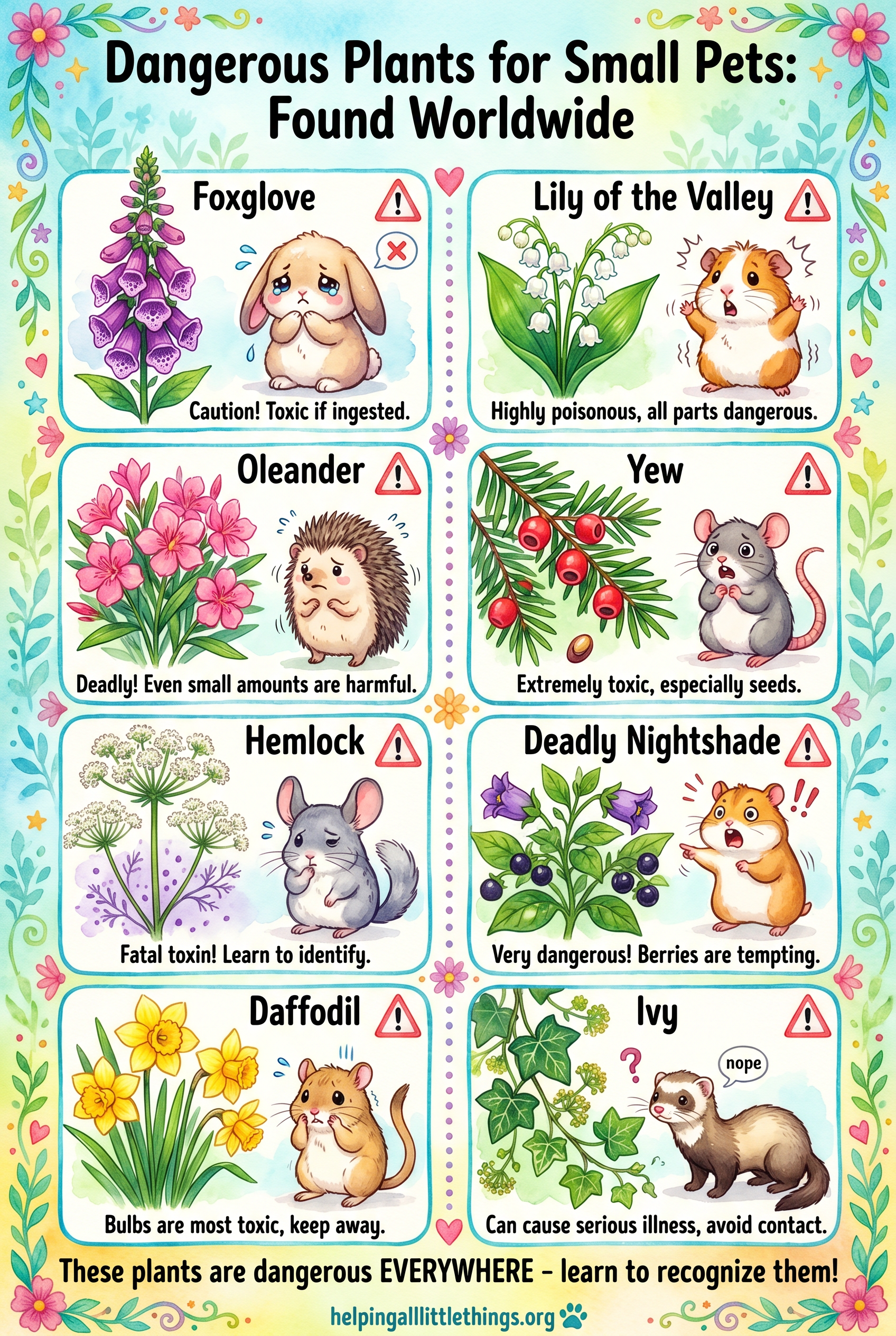
The following plants are found worldwide — in gardens, homes, and wild spaces across every inhabited continent — and are toxic to virtually all small mammal species.
| Plant | Toxic Parts | Key Danger | Identifying Features |
|---|---|---|---|
| Foxglove (Digitalis purpurea) | All parts | Cardiac glycosides; can cause fatal heart failure | Tall spike of tubular purple/pink/white flowers with spotted interior; large, soft, hairy leaves |
| Lily of the Valley (Convallaria majalis) | All parts | Cardiac glycosides; highly toxic even in small amounts | Small, bell-shaped white flowers on arching stems; broad, smooth, paired leaves |
| Oleander (Nerium oleander) | All parts, including smoke from burning | Cardiac glycosides; ingestion of even a few leaves can be fatal | Evergreen shrub with long, leathery leaves; pink, red, or white flowers |
| Rhododendron & Azalea (Rhododendron spp.) | All parts | Grayanotoxins; affects heart and nervous system | Large shrubs with showy clusters of funnel-shaped flowers in pink, red, purple, or white |
| Yew (Taxus spp.) | All parts except red berry flesh | Taxine alkaloids; causes sudden cardiac arrest | Dark green, flat needles in two rows; red, cup-shaped berries; common in hedgerows and gardens |
| Hemlock (Conium maculatum) | All parts | Coniine; causes respiratory failure | Hollow, purple-spotted stems; white umbrella-shaped flower clusters; easily confused with cow parsley |
| Deadly Nightshade (Atropa belladonna) | All parts | Atropine and scopolamine; highly toxic | Bell-shaped purple-green flowers; shiny black berries; large, dull green leaves |
| Buttercup (Ranunculus spp.) | All parts, especially when fresh | Protoanemonin; causes oral irritation, GI distress | Glossy yellow, cup-shaped flowers; deeply lobed leaves |
| Daffodil (Narcissus spp.) | All parts, especially bulbs | Lycorine and other alkaloids; causes vomiting, tremors, cardiac issues | Yellow or white trumpet-shaped flowers; strap-like leaves; bulbs especially dangerous |
| Tulip (Tulipa spp.) | All parts, especially bulbs | Tulipalin A and B; causes GI distress and cardiac issues | Cup-shaped flowers in many colors; smooth, waxy leaves; bulbs especially dangerous |
| Hyacinth (Hyacinthus spp.) | All parts, especially bulbs | Oxalic acid and alkaloids; causes severe GI distress | Dense spike of fragrant, star-shaped flowers in blue, pink, or white; bulbs especially dangerous |
| Ivy (Hedera helix) | All parts | Saponins and polyacetylene compounds; causes GI distress, drooling | Climbing vine with dark, glossy, lobed leaves; small greenish flowers; black berries |
| Tomato plant | Leaves and stems (not ripe fruit) | Solanine and tomatine; causes GI distress and neurological symptoms | Familiar garden plant; distinctive smell; hairy stems and leaves |
| Onion & Garlic | All parts | Thiosulphate compounds; causes hemolytic anemia | Familiar kitchen plants; distinctive smell |
| Avocado | Leaves, bark, skin, pit | Persin; causes respiratory distress, fluid accumulation | Familiar fruit tree; large, glossy, oval leaves |
🌎 North America
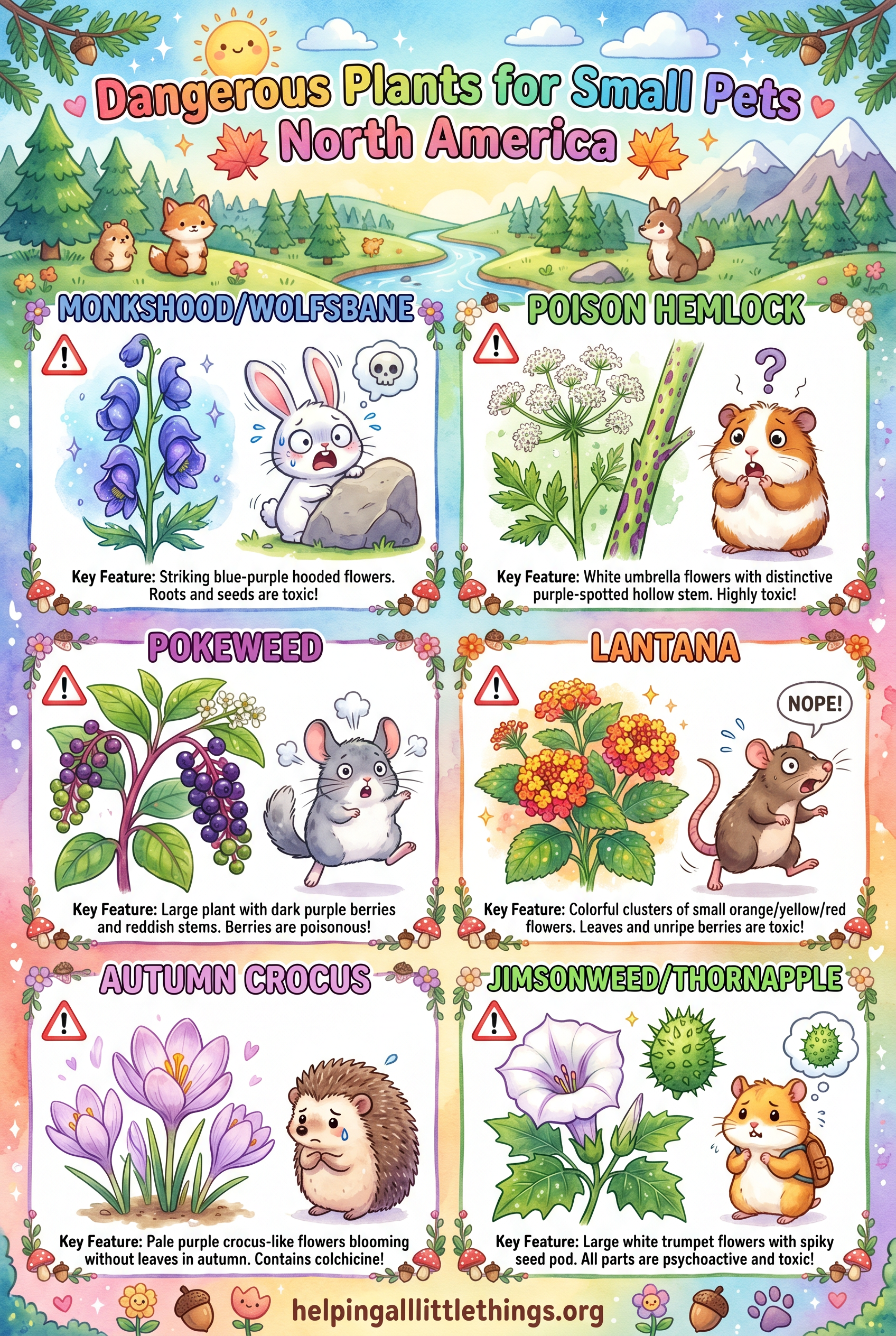
North America has a rich native flora, and many of the continent's most beautiful wildflowers and garden plants are highly toxic to small mammals. The following are among the most commonly encountered dangerous plants in the United States and Canada.2 3
Garden and Ornamental Plants
Monkshood / Wolfsbane (Aconitum spp.) is one of the most poisonous plants in the Northern Hemisphere. All parts contain aconitine, which causes rapid heart failure and respiratory paralysis. It is commonly grown as an ornamental for its striking blue-purple hooded flowers. Even skin contact with the sap can cause numbness.
Bleeding Heart (Lamprocapnos spectabilis) is a popular shade garden plant with distinctive heart-shaped pink or white pendant flowers. All parts contain isoquinoline alkaloids that cause seizures and respiratory depression in small mammals.
Lantana (Lantana camara) is widely grown in gardens and as a houseplant across the southern United States. Its colorful clusters of small flowers are attractive, but all parts — especially the unripe berries — contain triterpenoids that cause severe liver damage.4
Autumn Crocus (Colchicum autumnale) is often confused with the common spring crocus, but it is far more toxic. It contains colchicine, which interferes with cell division and can cause multi-organ failure. It blooms in autumn without leaves, making it easy to misidentify.
Wild and Foraging Plants
Poison Hemlock (Conium maculatum) and Water Hemlock (Cicuta spp.) are both found across North America and are among the most acutely toxic plants on the continent. Water hemlock (Cicuta) is considered the most violently toxic plant in North America by the USDA.3 Both are members of the carrot family and can be confused with edible plants like wild parsnip or cow parsley. Never allow your pet to forage in areas where these plants grow.
Pokeweed (Phytolacca americana) is a large, fast-growing native plant with distinctive dark purple berries. All parts are toxic, with the roots being most dangerous. It is common along roadsides, fence lines, and disturbed ground across the eastern United States.
Wild Parsnip (Pastinaca sativa) causes severe phototoxic burns on skin contact in humans, and its sap is toxic to small mammals. It has yellow umbrella-shaped flower clusters and is found in meadows and roadsides.
Jimsonweed / Thornapple (Datura stramonium) is found in disturbed soils across North America. All parts contain tropane alkaloids (atropine, scopolamine, hyoscyamine) that cause severe neurological symptoms and can be fatal.
| Plant | Region Within NA | Habitat | Most Toxic Part |
|---|---|---|---|
| Monkshood | Widespread | Gardens, mountain meadows | All parts |
| Bleeding Heart | Eastern/Pacific Coast | Shade gardens | All parts |
| Lantana | Southern US | Gardens, roadsides | Berries, leaves |
| Autumn Crocus | Widespread | Gardens | All parts |
| Poison Hemlock | Widespread | Roadsides, disturbed ground | All parts |
| Water Hemlock | Widespread | Wetlands, stream banks | Roots |
| Pokeweed | Eastern US | Roadsides, fence lines | Roots, berries |
| Jimsonweed | Widespread | Disturbed soils | All parts |
| Wild Parsnip | Eastern/Central | Meadows, roadsides | Sap, leaves |
🌿 United Kingdom and Europe
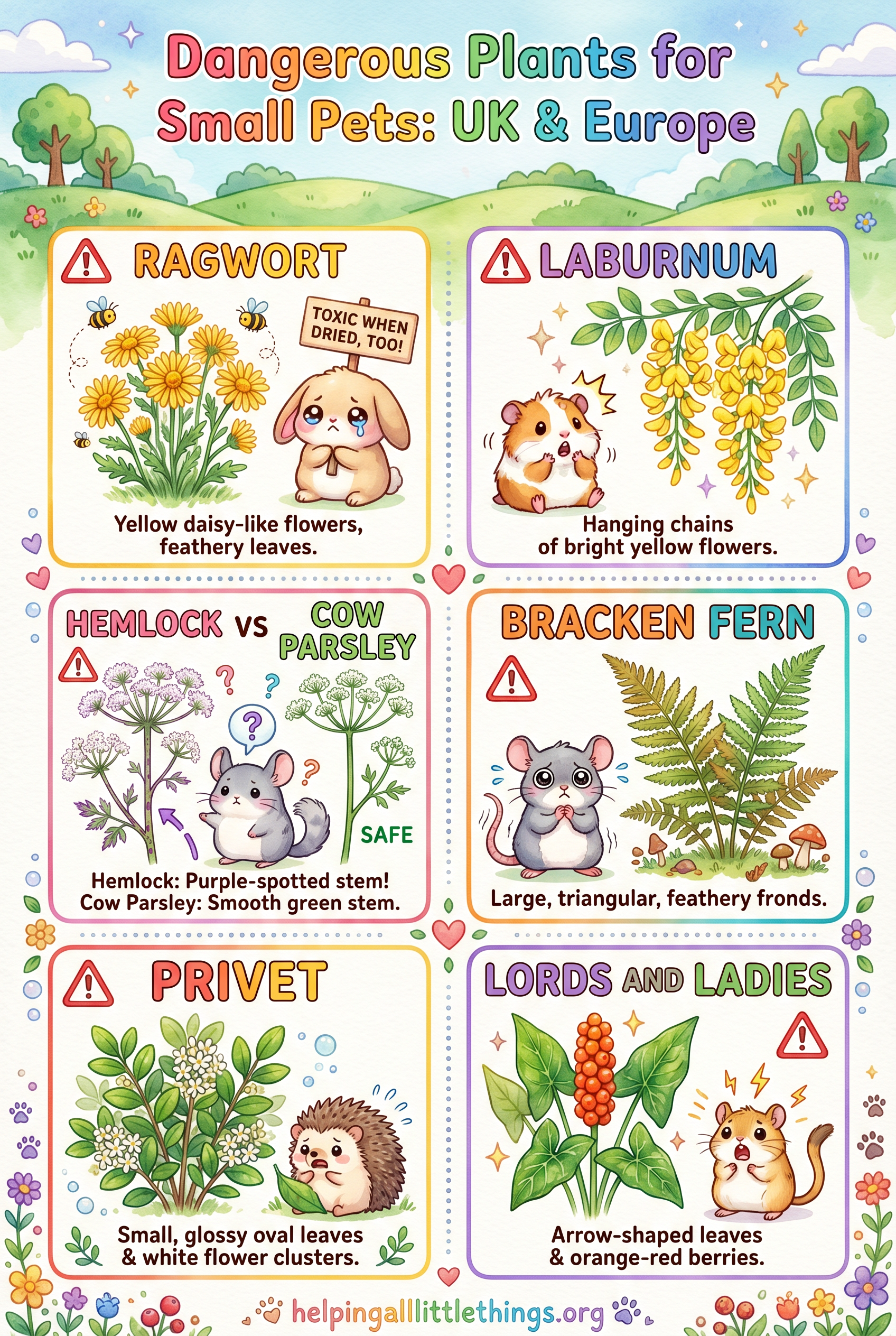
The UK and Europe have a long tradition of rabbit and guinea pig keeping, and the Rabbit Welfare Association & Fund (RWAF) maintains one of the most comprehensive toxic plant lists available.1 The following are the most important plants to know in the European context.
Garden Plants
Ragwort (Jacobaea vulgaris, formerly Senecio jacobaea) deserves special mention as one of the most dangerous plants for small mammals in the UK. It contains pyrrolizidine alkaloids that cause irreversible liver damage. Crucially, ragwort remains toxic when dried, meaning it is especially dangerous when it has been incorporated into hay. It loses its bitter taste when dry, making animals more likely to eat it. Learn to identify both its first-year (low rosette of crinkled leaves) and second-year (tall plant with yellow daisy-like flowers) forms.1
Laburnum (Laburnum anagyroides) is a common ornamental tree in UK and European gardens with hanging clusters of bright yellow flowers. All parts, especially the seeds, contain cytisine, a toxic alkaloid that causes severe vomiting, convulsions, and can be fatal.
Lupins (Lupinus spp.) contain quinolizidine alkaloids. While some varieties are grown as food crops, ornamental lupins are toxic to small mammals. The seeds are the most dangerous part.
Privet (Ligustrum spp.) is one of the most common hedging plants in the UK. All parts are toxic to small mammals, causing GI distress, tremors, and in severe cases, cardiac and respiratory failure.
Wild and Foraging Plants
Hemlock (Conium maculatum) is particularly dangerous in the UK context because it closely resembles cow parsley (Anthriscus sylvestris), which is safe for rabbits and commonly foraged. The key difference: hemlock has purple-spotted stems, shinier leaves, and a distinctly unpleasant smell when crushed. If you are foraging and are not 100% certain of identification, leave it.1
Bracken (Pteridium aquilinum) is extremely common on UK moorland and in woodland edges. All parts are toxic, containing thiaminase (which destroys Vitamin B1) and carcinogenic compounds. Even dried bracken in bedding can be dangerous.
Ragwort (see above) is also a major foraging hazard in the UK countryside.
| Plant | UK/EU Habitat | Most Toxic Part | Key Identifier |
|---|---|---|---|
| Ragwort | Meadows, roadsides | All parts | Yellow daisy flowers; crinkled leaves; purple-spotted stem (2nd year) |
| Laburnum | Gardens | Seeds, all parts | Hanging yellow flower clusters |
| Hemlock | Roadsides, riverbanks | All parts | Purple-spotted hollow stem |
| Bracken | Moorland, woodland | All parts | Large, triangular fronds |
| Privet | Hedgerows, gardens | All parts | Small, oval, glossy leaves; white flower clusters |
| Foxglove | Woodland edges, gardens | All parts | Tall spike of tubular purple/pink flowers |
| Lords and Ladies | Woodland, hedgerows | All parts | Arrow-shaped leaves; orange-red berries |
| Bluebell | Woodland | All parts | Nodding blue-purple bell flowers; strap-like leaves |
🦘 Australia and New Zealand
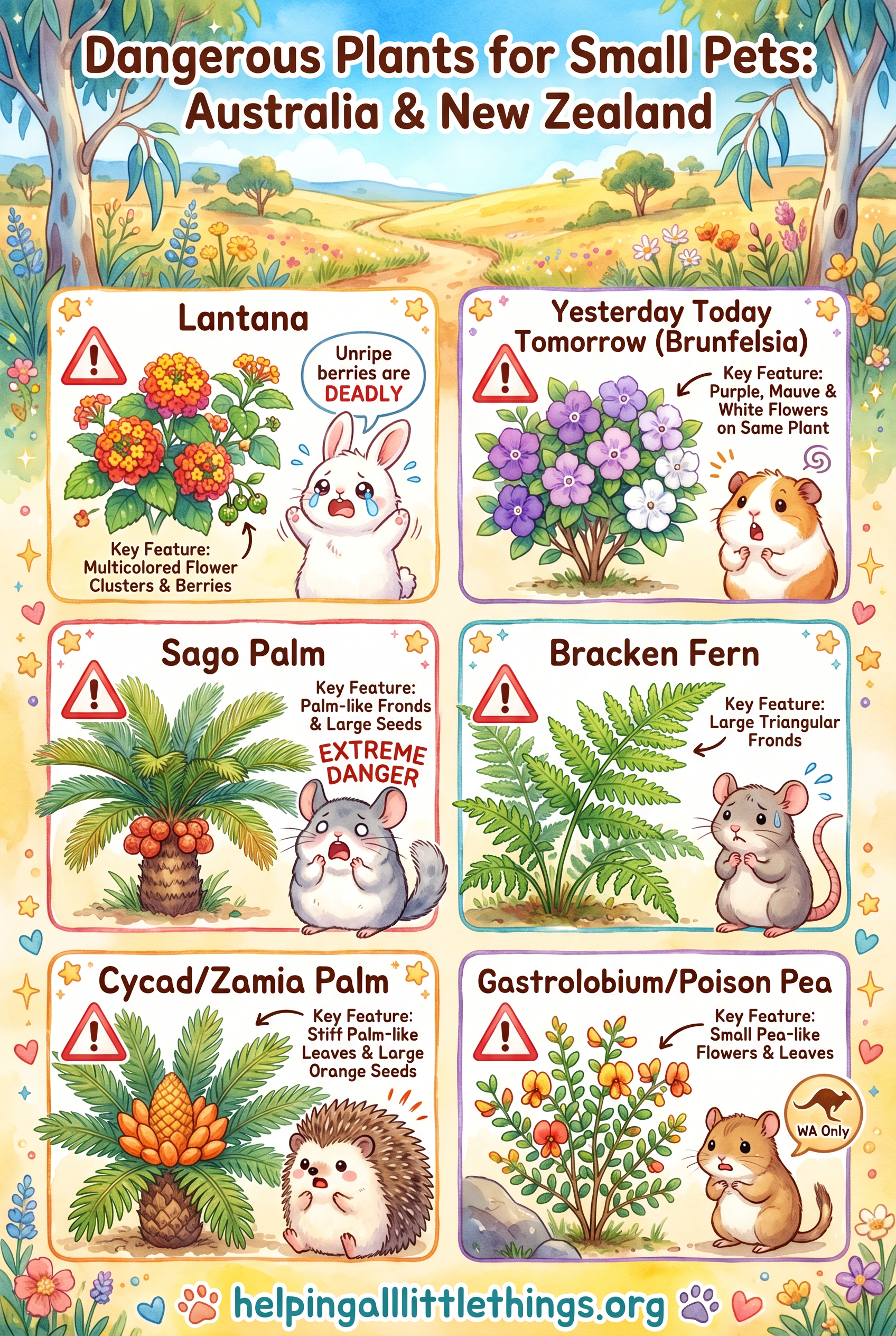
Australia and New Zealand present a unique challenge: many native plants have not been as thoroughly studied for toxicity to domestic small mammals as European and North American plants. Owners should exercise extra caution and consult with a local exotic vet familiar with the regional flora.4 5
Garden and Ornamental Plants
Lantana (Lantana camara) is one of the most significant plant toxicity risks for pets in Australia. It is widely naturalized as a weed across Queensland, New South Wales, and Victoria. The unripe green berries are especially toxic, causing liver damage, photosensitization, and in severe cases, death.4
Yesterday, Today and Tomorrow (Brunfelsia spp.) is a popular garden shrub in eastern Australia with fragrant purple, mauve, and white flowers. All parts are highly toxic to small mammals, containing brunfelsamidine and hopeanine, which cause severe neurological symptoms including tremors and seizures.
Sago Palm (Cycas revoluta) is widely grown as an ornamental across Australia. All parts are toxic, with the seeds being most dangerous. It contains cycasin, which causes severe liver failure. Even a small amount can be fatal.
Wandering Jew / Tradescantia (Tradescantia spp.) is a common groundcover and houseplant. While not acutely fatal, it causes significant skin irritation and GI distress in small mammals and should be kept well away from pets.
Native Australian Plants
Many native Australian plants have not been formally studied for toxicity to domestic small mammals. The following are known or suspected to be toxic:
Bracken Fern (Pteridium esculentum) — the Australian native equivalent of European bracken — contains the same thiaminase and carcinogenic compounds. It is extremely common in bush settings.
Zamia Palm / Cycads (Macrozamia spp., Cycas spp.) — all cycad species are highly toxic. Seeds contain cycasin and cause severe liver and neurological damage.
Gastrolobium spp. (including Box Poison and Poison Pea) — these native legumes contain sodium fluoroacetate (the same compound used in 1080 poison). They are found in Western Australia and are acutely lethal to non-native mammals.
| Plant | Region in AU/NZ | Most Toxic Part | Risk Level |
|---|---|---|---|
| Lantana | Eastern Australia, QLD/NSW/VIC | Unripe berries, leaves | High |
| Yesterday Today Tomorrow | Eastern Australia | All parts | High |
| Sago Palm | Widespread (ornamental) | Seeds | Extreme |
| Bracken Fern | Widespread | All parts | High |
| Cycads / Zamia | Widespread (native) | Seeds | Extreme |
| Gastrolobium spp. | Western Australia | All parts | Extreme |
🌏 Asia
Many small pet owners in Asia keep rabbits, guinea pigs, hamsters, and other small mammals. The following plants are commonly encountered across Asian countries and are toxic to small mammals.6
Caladium (Caladium spp.) is a popular ornamental houseplant across tropical Asia. All parts contain calcium oxalate crystals and other toxins that cause severe oral irritation, swelling, and GI distress.
Dieffenbachia (Dumb Cane) is extremely common as an indoor plant across Asia. It contains calcium oxalate crystals that cause intense burning and swelling of the mouth and throat, potentially causing respiratory obstruction.
Chrysanthemum (Chrysanthemum spp.) — widely grown and used in traditional medicine — contains pyrethrins and other compounds toxic to small mammals, causing GI distress and neurological symptoms.
Wisteria (Wisteria spp.) is grown throughout East Asia as an ornamental. All parts, especially the seeds and pods, contain wisterin (a glycoside) and lectin, causing severe GI distress and potentially fatal toxicity.
Rhododendron spp. are native to the Himalayas and widely grown across Asia. All parts contain grayanotoxins that cause cardiac arrhythmias and can be fatal.
🌺 Central and South America
Dieffenbachia, Caladium, and Philodendron are all native to Central and South America and are widely grown as houseplants globally. All contain calcium oxalate crystals.
Manchineel (Hippomane mancinella) — found in coastal areas of Central America and the Caribbean — is considered one of the most dangerous trees in the world. All parts are toxic; even standing under it in rain can cause skin burns.
Poinsettia (Euphorbia pulcherrima) — native to Mexico and widely sold as a holiday plant — contains a milky sap that causes GI irritation. While less acutely toxic than often believed, it should be kept away from all small pets.
🌸 How to Identify Dangerous Plants
The safest approach is a "when in doubt, leave it out" policy. However, building your plant identification skills is genuinely valuable. Here are the best tools and approaches:
Digital identification tools:
- iNaturalist — photograph a plant and get community-verified identification
- PlantNet — AI-powered plant identification app
- Seek — beginner-friendly version of iNaturalist
Reference resources:
- ASPCA Animal Poison Control: aspca.org/pet-care/animal-poison-control
- RWAF Poisonous Plants (UK): rabbitwelfare.co.uk/poisonous-plants
- The Poison Garden (UK): thepoisongarden.co.uk
Key identification principles:
- Learn the toxic plants most common in your specific local area — focus on 10–15 plants rather than trying to memorize hundreds
- Pay attention to habitat: hemlock grows near water; ragwort in meadows; yew in hedgerows
- When foraging, always collect from areas you know are chemical-free and away from roadsides
- Take photos of any plant your pet has eaten and bring them to the vet
Signs of Plant Poisoning
Because small mammals cannot vomit, plant toxins are absorbed rapidly. Symptoms vary by plant but commonly include:6
- Drooling or excessive salivation
- Loss of appetite or refusal to eat
- Diarrhea (sometimes bloody)
- Lethargy or sudden weakness
- Difficulty breathing or labored breathing
- Seizures or muscle tremors
- Abnormal heart rate
- Collapse
If you observe any of these signs, treat it as an emergency. Contact your veterinarian or an animal poison control hotline immediately. If possible, bring a sample or photograph of the plant your pet may have eaten.