Poop Guide: What Is Normal for Your Small Pet?
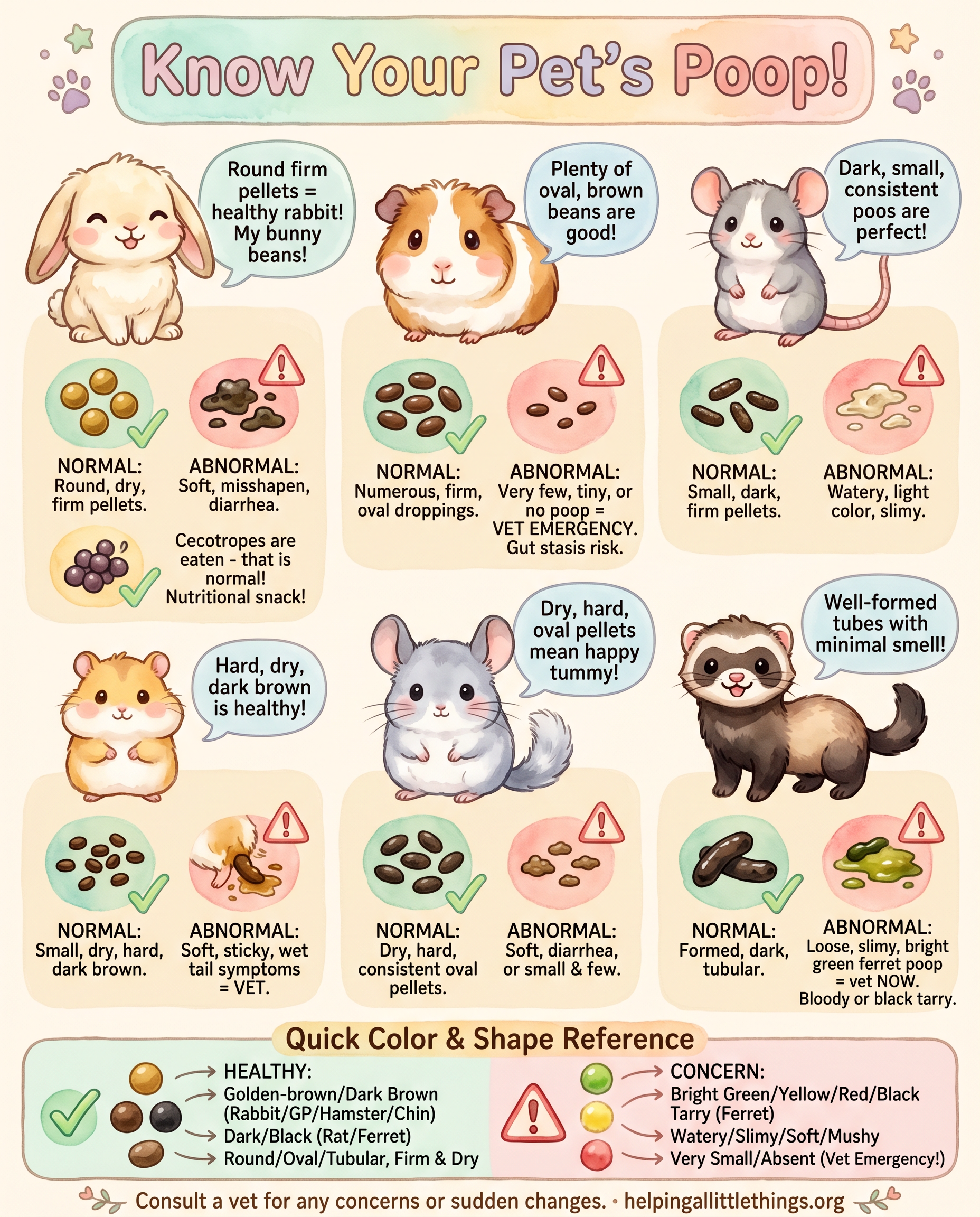

It may not be the most glamorous topic, but your small pet's droppings are one of the most reliable early warning systems for their health. Changes in the size, shape, color, consistency, or quantity of droppings can indicate dehydration, dietary problems, GI stasis, infection, or serious illness — often before any other symptoms appear.1
Daily cage cleaning is not just about hygiene — it is an essential health monitoring practice. When you clean the cage every day, you become familiar with what is normal for your individual pet, making it much easier to spot when something is wrong.
Cecotropes and Coprophagy: Eating Their Own Poop
Several HALT species practice coprophagy — the consumption of their own droppings. This is not a sign of illness or poor husbandry; it is a normal, essential part of their digestive process.
Species that practice coprophagy: Rabbits, guinea pigs, chinchillas, degus, hamsters, gerbils, rats, and mice all produce special nutrient-rich droppings called cecotropes (also called cecals, night feces, or soft droppings) that they consume directly from the anus, usually at night or in the early morning.2
Cecotropes are produced in the cecum (a specialized fermentation chamber in the digestive tract) and are packed with:
- Essential B vitamins (especially B12)
- High-quality protein
- Short-chain fatty acids
- Beneficial gut microorganisms
If you see cecotropes in the cage: A small number of uneaten cecotropes occasionally is normal. However, finding large quantities of uneaten cecotropes regularly indicates a problem — your pet may be unable to reach them (obesity, dental pain, arthritis), or their diet may be too rich (too many pellets, not enough hay). Contact your veterinarian.3
Species-by-Species Guide
🐇 Rabbits
Rabbits produce two types of droppings:
| Type | Appearance | Normal? |
|---|---|---|
| Fecal pellets | Round, firm, dry, dark brown, 1–1.5 cm | Normal — produced continuously |
| Cecotropes | Soft, shiny, grape-cluster shape, darker, pungent smell | Normal — should be consumed immediately |
Warning signs in rabbit poop:
- Small, dry, or misshapen pellets — dehydration, pain, or insufficient hay
- String of pearls (pellets connected by fur) — excessive grooming, needs more hay
- No poop at all — GI stasis, a life-threatening emergency. Contact a vet immediately.4
- Soft cecotropes left uneaten — diet too rich in pellets, or physical inability to reach them
- Mucus-coated droppings — intestinal inflammation, requires vet attention
- Bloody droppings — emergency, contact vet immediately
🐹 Guinea Pigs
Guinea pig droppings are oval-shaped, firm, and dark brown to black. Healthy droppings are 1–2 cm long with smooth, rounded ends and a slight sheen. They should not smell strongly.
Warning signs:
- Small, crumbly, or dry droppings — dehydration or insufficient hay
- Soft, mushy, or smelly droppings — diet too rich in vegetables or fruit, or infection
- No droppings — GI stasis, emergency
- Droppings with mucus — intestinal inflammation
- Bloody droppings — emergency5
Guinea pigs also produce cecotropes (cecal pellets) which are softer, darker, and often consumed directly from the anus. You may rarely see them.
🐭 Rats and Mice
Rat and mouse droppings are small, dark, and spindle-shaped (pointed at both ends). Rat droppings are approximately 1–2 cm; mouse droppings are 3–6 mm.
Warning signs:
- Soft, mushy, or liquid droppings — dietary change, infection, or stress
- Very dry or crumbly droppings — dehydration
- Bloody droppings — emergency (may indicate internal bleeding or infection)
- Significantly reduced quantity — illness, pain, or not eating
Rats and mice also produce cecotropes, though this is less well-known. They typically consume them immediately and you will rarely see them.
🐹 Hamsters
Hamster droppings are small, dark, and oval-shaped. They should be firm and dry.
Warning signs:
- Wet tail area (proliferative ileitis) — a life-threatening bacterial infection causing severe diarrhea. This is an emergency requiring immediate veterinary care.6
- Soft or liquid droppings — dietary change, stress, or infection
- No droppings — illness or GI blockage
🐭 Gerbils
Gerbil droppings are small, dark, and elongated. As desert animals, gerbils produce very dry droppings with minimal moisture — this is normal.
Warning signs:
- Soft or wet droppings — dietary change, stress, or infection (Tyzzer's disease)
- No droppings — illness
🐾 Chinchillas
Chinchilla droppings are oval-shaped, firm, and dark brown. They should be dry and have a slight sheen.
Warning signs:
- Soft, mushy, or clumped droppings — diet too rich, stress, or infection
- Very small or misshapen droppings — dental problems (malocclusion) causing reduced eating
- No droppings — GI stasis, emergency
- Droppings with mucus — intestinal inflammation7
🐾 Ferrets
Ferret droppings are tubular, brown to dark brown, and have a characteristic musky smell. They should be firm but not hard.
Warning signs:
- Bright green or yellow droppings — ECE (Epizootic Catarrhal Enteritis, "green slime disease") — highly contagious, requires immediate vet care
- Tarry black droppings — upper GI bleeding, emergency
- Bloody droppings — emergency
- Grainy, seedy texture — may indicate partial blockage or malabsorption8
🦔 Hedgehogs
Hedgehog droppings are dark brown to black, tubular, and firm. They have a stronger smell than most rodent droppings.
Warning signs:
- Green droppings — stress, rapid dietary change, or infection
- Bloody droppings — emergency
- White or very pale droppings — liver or gallbladder issues
- Significant change in quantity — illness
🐾 Degus
Degu droppings are small, oval-shaped, and dark brown. They should be firm and dry.
Warning signs:
- Soft or wet droppings — dietary change (especially too much sugar), stress, or infection
- No droppings — GI stasis, emergency
- Droppings with mucus — intestinal inflammation
When to Contact a Vet
Contact your veterinarian if you observe:
- No droppings for more than 12 hours in any species
- Bloody droppings in any species
- Severe diarrhea (wet tail in hamsters, green slime in ferrets)
- Significant change in dropping size, shape, or quantity lasting more than 24 hours
- Your pet is not eating or drinking alongside abnormal droppings