Help, I Found a Pet!
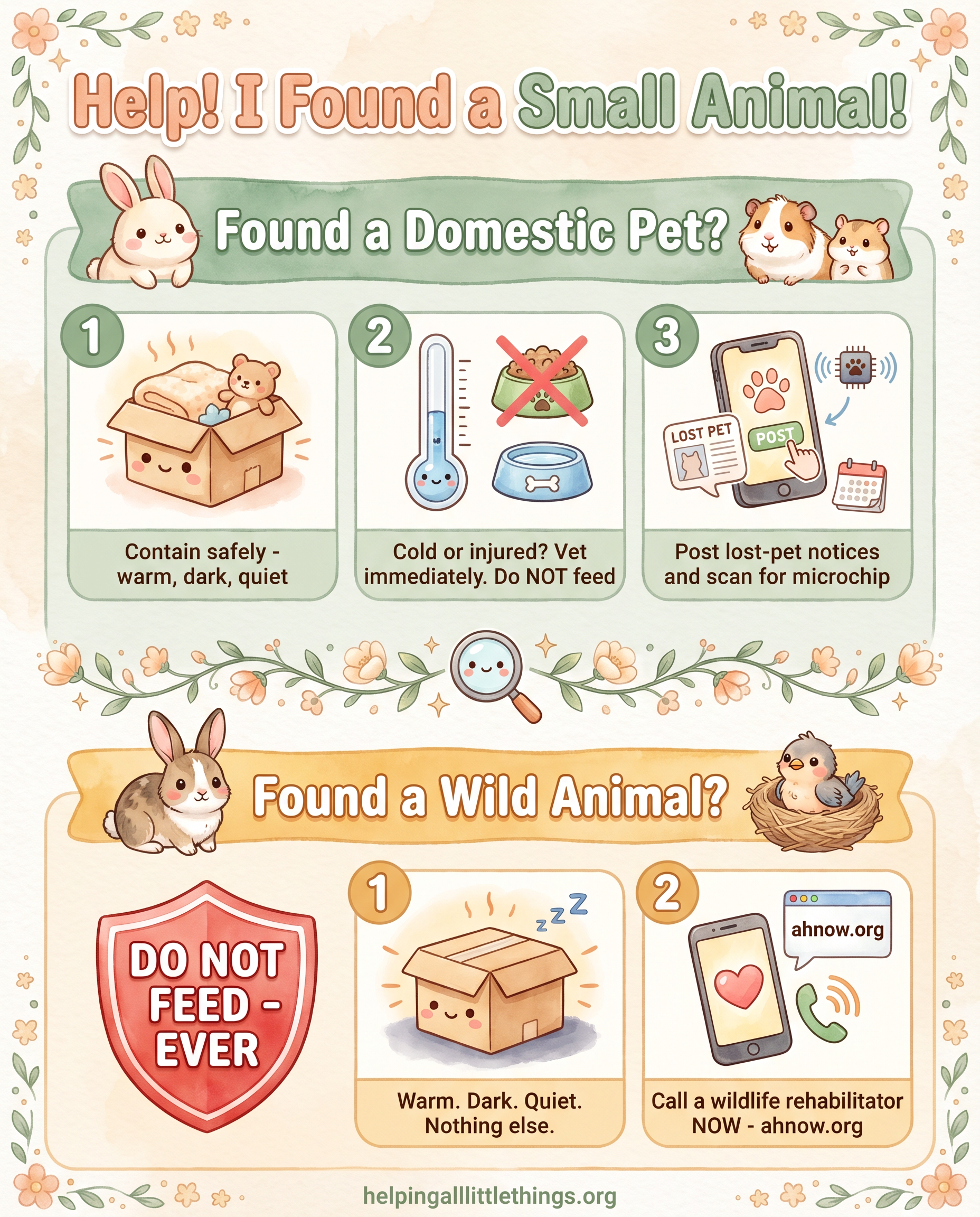

You've found a small animal — maybe a rabbit in your backyard, a guinea pig on the street, or an injured creature you can't quite identify. What do you do? The answer depends on whether the animal is a domestic pet or a wild animal, and the first step is always the same: stay calm, do not panic, and do not rush to feed or treat the animal.
Well-meaning feeding is one of the most common causes of death in found and rescued animals. An animal that is cold, injured, or in shock cannot safely digest food. Feeding the wrong formula, or feeding at the wrong time, can cause aspiration pneumonia, fatal digestive failure, or worsen an underlying condition. Do not feed any found animal unless you have been specifically instructed to do so by a veterinarian or licensed wildlife rehabilitator. See our guide: How to Hand-Feed a Small Pet for more information on when and how feeding is appropriate.
Step 1: Is It a Pet or a Wild Animal?
Before you do anything else, you need to determine whether the animal is a domestic pet or a wild animal. This matters because the steps you take — and the people you contact — are different for each.
How to Tell a Wild Animal from a Domestic Pet
The most common source of confusion is rabbits. In North America, the wild rabbit you are most likely to encounter is the Eastern Cottontail (Sylvilagus floridanus), a small, lean animal with an agouti (brown-black flecked) coat, a short fluffy white tail, narrow almond-shaped eyes, and relatively small ears. Wild cottontails weigh approximately 0.9–1.4 kg (2–3 lbs) and have a lean, angular build.1
Domestic rabbits are descended from the European rabbit (Oryctolagus cuniculus) and look noticeably different: they are larger (1–2.5+ kg), have a broader, boxier face, wider and often floppy ears, and can come in a wide range of colors including white, black, tan, grey, spotted, and orange. If you see a rabbit in any color other than agouti brown, it is almost certainly a domestic rabbit.2
| Feature | Wild Cottontail | Domestic Rabbit |
|---|---|---|
| Weight | ~0.9–1.4 kg (2–3 lbs) | 1–2.5+ kg (2.2–5.5+ lbs) |
| Coat color | Agouti brown/black only | Any color |
| Face shape | Narrow, angular | Broad, boxy |
| Ears | Short, upright | Often larger, sometimes floppy |
| Eyes | Narrow, almond-shaped | Rounder, wider |
| Behavior | Panics, freezes, extremely fearful | May be approachable or tame |
| Tail | Short, fluffy white | Short, often less visible |
Do not rely on behavior alone to identify an animal. A domestic rabbit that has been outdoors for some time may become very fearful of humans. Conversely, a wild animal that is sick or injured may appear unusually calm or approachable — this is often a sign that something is wrong, not that the animal is tame.2
For other species, the same principle applies: guinea pigs, hamsters, gerbils, chinchillas, and degus are not native wildlife anywhere in North America — if you find one of these animals outside, it is a domestic pet that has escaped or been abandoned. Hedgehogs are also domestic pets in most of North America (African Pygmy Hedgehogs). Ferrets are domestic animals. If you find any of these species outside, treat them as a lost or abandoned pet, not wildlife.
If You Found a Domestic Pet
Immediate Steps
The priority is to secure the animal safely and assess its condition — not to feed it or treat it.
Contain the animal safely. A cardboard box with air holes, a carrier, or a secure container lined with a soft cloth is ideal. Keep the animal in a warm, quiet, dark place away from other animals, children, and noise. Stress alone can be fatal for small animals.3
Assess the animal's condition. Is it alert and responsive? Are there visible injuries — wounds, broken limbs, labored breathing? Is it cold to the touch? A cold, limp, or unresponsive animal is a medical emergency. Do not attempt to feed it. Keep it warm and get it to a veterinarian as quickly as possible.
Do not offer food or water unless instructed by a vet. You do not know how long the animal has been without food, and sudden refeeding of a starved animal can cause fatal refeeding syndrome.4 You also do not know if the animal has an injury or obstruction that makes feeding dangerous.
Is This Someone's Lost Pet?
Before assuming the animal is abandoned, take steps to find its owner:
- Post on local community Facebook groups, Nextdoor, and lost-pet databases such as PetFBI and Helping Lost Pets.
- Contact local animal shelters, humane societies, and animal control agencies — file a found-animal report in person if possible.5
- Check for a microchip. Most veterinary clinics and animal shelters can scan for a microchip at no charge.
- Post flyers in the area where the animal was found.
Be Prepared for the Reality of Rescue
Shelters and rescues are frequently at or beyond capacity, particularly for small animals. Do not assume that an organization will be able to take the animal immediately. If you take in a found animal, be prepared to:
- Provide a safe, appropriate temporary housing space.
- Cover veterinary costs, at least initially — consider fundraising if needed.
- Properly feed and care for the animal (consult a vet or rescue for species-appropriate diet).
- Screen potential adopters carefully if you rehome the animal yourself — ask for veterinary references and personal references, and charge a small rehoming fee (approximately $25 for guinea pigs, $50 for rabbits) to deter people seeking animals for inappropriate purposes.6
If You Found a Wild Animal
Attempting to care for injured or orphaned wildlife without training and permits is illegal in most jurisdictions and is often fatal for the animal. Even experienced animal lovers cause harm by feeding the wrong food, handling the animal incorrectly, or delaying professional care. The single most important thing you can do for a wild animal is to get it to a licensed wildlife rehabilitator as quickly as possible.7
Does This Animal Actually Need Help?
Not every wild animal you see alone is in distress. Many animals are left alone by their parents for extended periods — this is normal and does not mean they are abandoned.
Baby rabbits are a common example. A mother cottontail leaves her nest for most of the day, returning only briefly at dawn and dusk to nurse. A nest of baby rabbits found alone in the grass is almost certainly fine. Do not remove them unless the nest has been disturbed by a predator, the babies are cold, or there is evidence the mother has been killed.8
Signs that a wild animal genuinely needs help include:
- Visible injuries (bleeding, broken limbs, wounds)
- The animal is cold, limp, or unresponsive
- A baby animal is found alone and clearly very young (eyes closed, no fur, unable to move)
- The animal is in immediate danger (e.g., in the road, near a predator)
- The animal is showing neurological signs (circling, seizures, head tilt)
- A parent is confirmed dead
If you are unsure, call a wildlife rehabilitator before touching or moving the animal. They can advise you over the phone whether intervention is needed.
The Three Rules: Warm, Dark, Quiet
If you have confirmed the animal needs help and you are waiting for a rehabilitator or transport, follow these three rules:9
1. Warm. Place the animal in a box lined with a soft cloth. If the animal is cold, place the box on top of a heating pad set to its lowest setting, with the pad covering only half the floor so the animal can move away from the heat. Never place the animal directly on a heating pad or under a heat lamp — rapid rewarming can cause cardiovascular collapse. Aim for a gradual, gentle warming.
2. Dark. Keep the container covered and in a dark, quiet room. Wild animals are prey species. Light, noise, and human presence cause extreme stress, which can be fatal even in an otherwise healthy animal.
3. Quiet. Do not handle the animal more than necessary. Do not talk to it, play music near it, or allow children or other pets near the container. The less stimulation, the better.
Do not offer food or water to a found wild animal under any circumstances unless you have been specifically instructed to do so by a licensed wildlife rehabilitator or veterinarian. Feeding the wrong food can cause fatal digestive failure. Giving water to an animal in shock can cause aspiration. Many injured animals cannot safely swallow. The risk of harm from well-intentioned feeding far outweighs any potential benefit.9
How to Find a Wildlife Rehabilitator
- Animal Help Now (ahnow.org) — Enter your location to find the nearest licensed wildlife rehabilitators. This is the fastest and most reliable tool in the US.
- NWRA Wildlife Rehabilitator Finder — The National Wildlife Rehabilitators Association maintains a directory by state and province.
- Your state or provincial wildlife agency — Most have a hotline or directory of licensed rehabilitators.
- Local veterinary clinics — Many vets can provide emergency stabilization and refer you to a rehabilitator.
- Local humane societies and animal control agencies — They often maintain contacts with wildlife rehabilitators.
If you cannot reach a rehabilitator immediately, do not panic. Rehabilitators are often extremely busy volunteers caring for hundreds of animals. Keep the animal warm, dark, and quiet, and keep trying.7
A Note on Permits and the Law
In the United States and Canada, it is illegal to keep most wild animals without a state or provincial wildlife rehabilitation permit, even temporarily and even with good intentions. This applies to common species such as rabbits, squirrels, opossums, and songbirds. The law exists to protect both the animals and the public.7
If you find a wild animal, your legal and ethical obligation is to contact a licensed rehabilitator and transfer the animal to their care as soon as possible. You are not expected to rehabilitate the animal yourself.
Quick Reference
| Situation | What to Do |
|---|---|
| Found domestic pet, appears healthy | Contain safely, post lost-pet notices, scan for microchip, contact shelters |
| Found domestic pet, appears injured or cold | Contain, keep warm, do not feed, get to a vet immediately |
| Found wild animal, appears uninjured | Observe from a distance; contact a rehabilitator if unsure |
| Found wild animal, injured or orphaned | Warm, dark, quiet; do not feed; contact a wildlife rehabilitator immediately |
| Found baby rabbits in a nest | Leave them alone unless nest is disturbed, babies are cold, or mother is confirmed dead |
| Animal is cold and unresponsive | Warm gently; do not feed; emergency vet or rehabilitator immediately |