Taking Your Small Pet Outside Safely
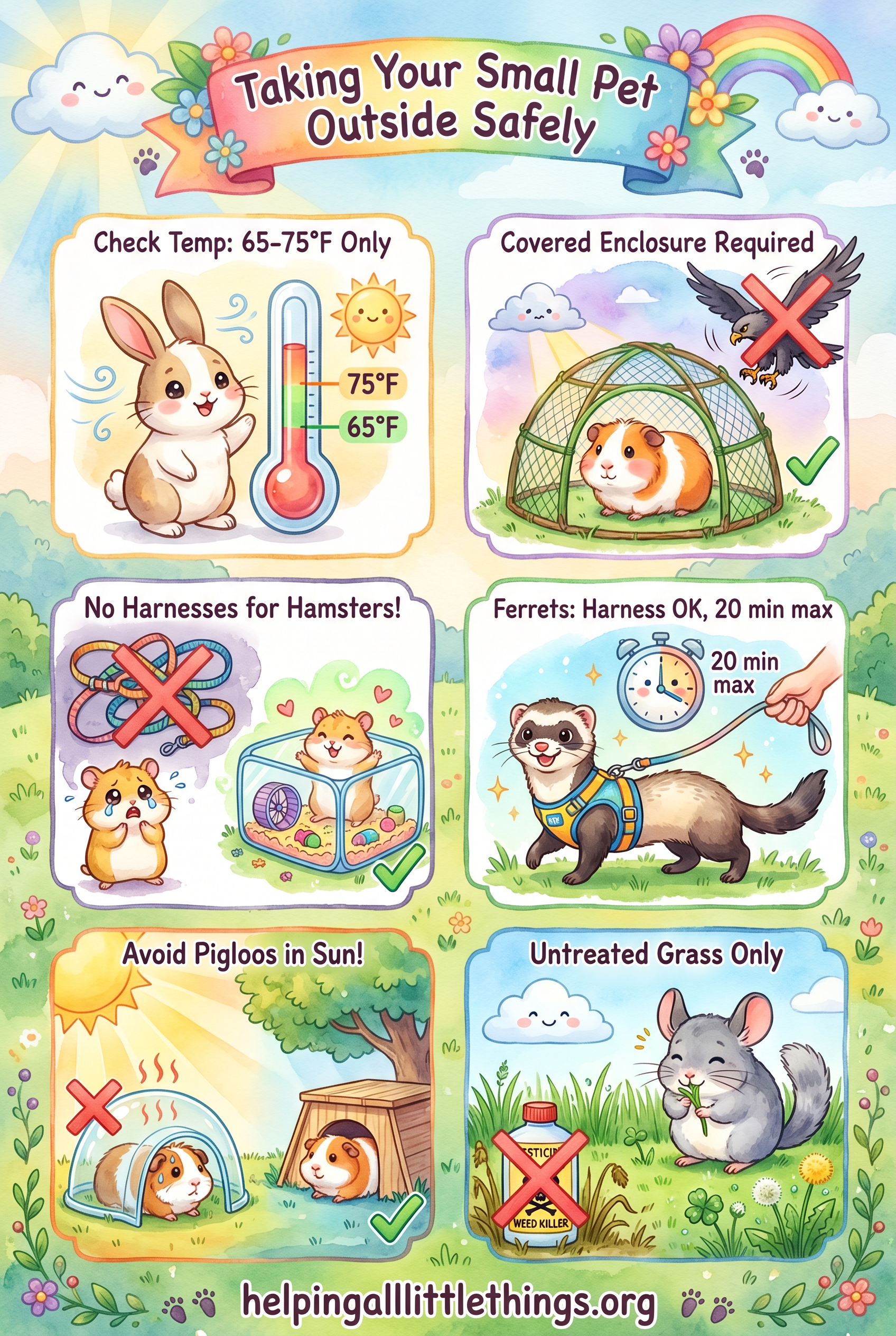
Fresh air, natural sunlight, and the smell of grass — outdoor time can be genuinely enriching for many small pets. For prey species like rabbits and guinea pigs, even a few minutes of supervised exploration in a safe, enclosed space can provide mental stimulation and physical exercise that is difficult to replicate indoors.1 However, the outdoors is also full of hazards that can injure or kill a small animal in seconds. This guide covers everything you need to know to make outdoor time safe and enjoyable for your pet.
Never leave your small pet outside unattended — not even for a moment. Predators can strike within seconds, and a frightened animal can injure itself trying to escape. Always stay within arm's reach.1
Is Outdoor Time Right for Your Pet?
Not every species — or every individual animal — is suited for outdoor time. Before taking your pet outside, consider the following:
| Species | Outdoor Suitability | Notes |
|---|---|---|
| Rabbits | ✅ Generally suitable | Benefit greatly from outdoor enrichment; must be supervised |
| Guinea Pigs | ✅ Generally suitable | Enjoy grazing on safe grass; very vulnerable to predators and heat |
| Chinchillas | ⚠️ Use extreme caution | Dense coat makes them highly prone to overheating; avoid outdoors in warm weather |
| Rats & Mice | ⚠️ Use extreme caution | Very fast and small; high escape risk; better served by indoor enrichment |
| Hamsters & Gerbils | ⚠️ Use extreme caution | Extremely fast; high escape risk; stress-prone in open environments |
| Ferrets | ✅ Generally suitable | Enjoy exploration; must be harness-trained and closely supervised |
| Hedgehogs | ✅ Generally suitable | Can enjoy supervised outdoor time in warm weather; avoid cold and damp |
| Degus | ⚠️ Use extreme caution | Similar to chinchillas; heat-sensitive and fast |
Even for species that tolerate outdoor time well, always introduce the outdoors gradually. Start with 5–10 minute sessions in a very secure enclosure and slowly increase duration over several weeks as your pet grows comfortable.2
The Outdoor Toolkit: Harnesses, Strollers, Bonding Bags, and Enclosures
There is no single "right" way to take your pet outside. The best option depends on your pet's species, temperament, and your environment.
Harnesses and Leashes
Harnesses allow rabbits and ferrets to explore more freely while remaining under your direct control. A well-fitted H-style or figure-8 harness distributes pressure across the chest and shoulders rather than the neck, which is important for animals with delicate spines.3
Important caveats:
- Guinea pigs should not be harnessed. Their spines are extremely fragile, and the sudden darting movement of a frightened guinea pig can cause serious spinal injury with a harness attached.4
- Hamsters should never be harnessed. Hamster communities and exotic vets are unanimous on this: harnesses and leashes are dangerous for hamsters. Their bodies are not built for the pulling and tugging a harness creates, and the risk of spinal injury, internal injury, and extreme stress is significant. Hamsters are also extraordinarily fast and can escape almost any harness in seconds. A secure playpen or bonding bag is always the safer choice.5
- Chinchillas, gerbils, and mice should not be harnessed — their bodies are too small and fragile, and they can slip out of almost any harness, creating an immediate escape risk.
- Ferrets can be harness-trained, but it requires patience and a ferret-specific harness (not a collar, which they can easily slip). A figure-8 or H-style ferret harness is recommended. Always harness-train indoors first before attempting outdoor walks. Note that ferrets are prone to heatstroke — skip walks above 75°F (24°C) and below 65°F (18°C). Keep walks to 20 minutes or less.6
- Harness training takes time and patience. Never force a harness on a distressed animal. If your rabbit or ferret consistently resists, switch to an enclosed option.
- Always check the fit before every outing — a harness that was snug last week may have loosened.
Pet Strollers
Pet strollers offer a safe, low-stress way to bring your small pet along on walks without exposing them to the ground-level hazards of grass, soil, or pavement. They are ideal for:
- Species that should not be harnessed (guinea pigs, chinchillas, small rodents)
- Elderly or recovering animals who need fresh air but cannot tolerate exertion
- Pets who are anxious about open spaces but enjoy watching the world go by
Choose a stroller with a fully enclosed mesh top to prevent escapes and to provide protection from above — a critical feature given the risk of predatory birds (see below). Ensure there is adequate ventilation and shade, and never leave a pet in a stroller in direct sunlight.
Bonding Bags and Pouches
Bonding bags — soft fabric pouches worn against the body — allow you to carry your small pet close to you while providing them with warmth, security, and the comfort of your scent and heartbeat. They are particularly popular for guinea pigs, hedgehogs, and chinchillas. They are not a substitute for proper outdoor enclosure time, but they are an excellent option for socialization and short outings.
Ensure the bag has adequate ventilation, is not too tight, and that your pet cannot overheat. Never use a bonding bag in direct sunlight or hot weather.
Exercise Pens and Playpens
A collapsible exercise pen (X-pen) placed on safe grass is one of the most versatile and affordable outdoor options. Choose a pen with:
- Sides tall enough that your pet cannot jump or climb out (at least 24–36 inches for rabbits)
- A wire or mesh top to prevent aerial predator access
- Panels that sit flush with the ground to prevent digging out — or use a pen with a removable floor panel2
Always place the pen so that at least half of it is in shade at all times. Rotate its position as the sun moves.
Rabbitats and Outdoor Enclosures
A rabbitat is a permanent or semi-permanent outdoor enclosure — essentially a catio designed for rabbits and other small pets. A well-designed rabbitat should include:7
- A minimum of 6×6 feet of floor space for two rabbits (larger is always better)
- Welded wire mesh (1×1 inch or 1.5×1.5 inch) rather than chicken wire, which predators can tear through
- A solid, weatherproof roof section to protect from rain, sun, and aerial predators
- Access from inside the house rather than directly from the yard, to prevent escapes
- A cleanable floor surface (concrete or tile) with a small gap at the base for cleaning
Sun Safety: Heat Is a Killer
Small mammals are far more vulnerable to heat than humans. Heatstroke can develop in minutes, and it can be fatal.2
Safe outdoor temperature range: 65–75°F (18–24°C). Above 80°F (27°C), most small mammals are at significant risk of heatstroke, even in the shade. Chinchillas are at risk at even lower temperatures due to their dense coats.
Signs of heatstroke include: rapid or labored breathing, drooling, lethargy, wet fur around the nose, loss of coordination, and collapse. If you observe any of these signs, bring your pet indoors immediately, offer cool (not cold) water, and contact your veterinarian.
Humidity is a hidden danger. Even on a mild day, high humidity can prevent your pet from cooling themselves effectively. Check both temperature and humidity before going out.1
Rules for sun safety:
- Never place any enclosure, stroller, or carrier in direct sunlight
- Always ensure shade is available within the enclosure at all times
- Provide fresh, cool water during every outdoor session
- On warm days, place a frozen water bottle wrapped in a towel inside the enclosure for your pet to lean against
- Avoid outdoor time between 10 a.m. and 4 p.m. in summer
A Note on Hiding Spots and Pigloos
Providing a hiding spot inside an outdoor enclosure is important for your pet's sense of security — but the type of hiding spot matters enormously outdoors.
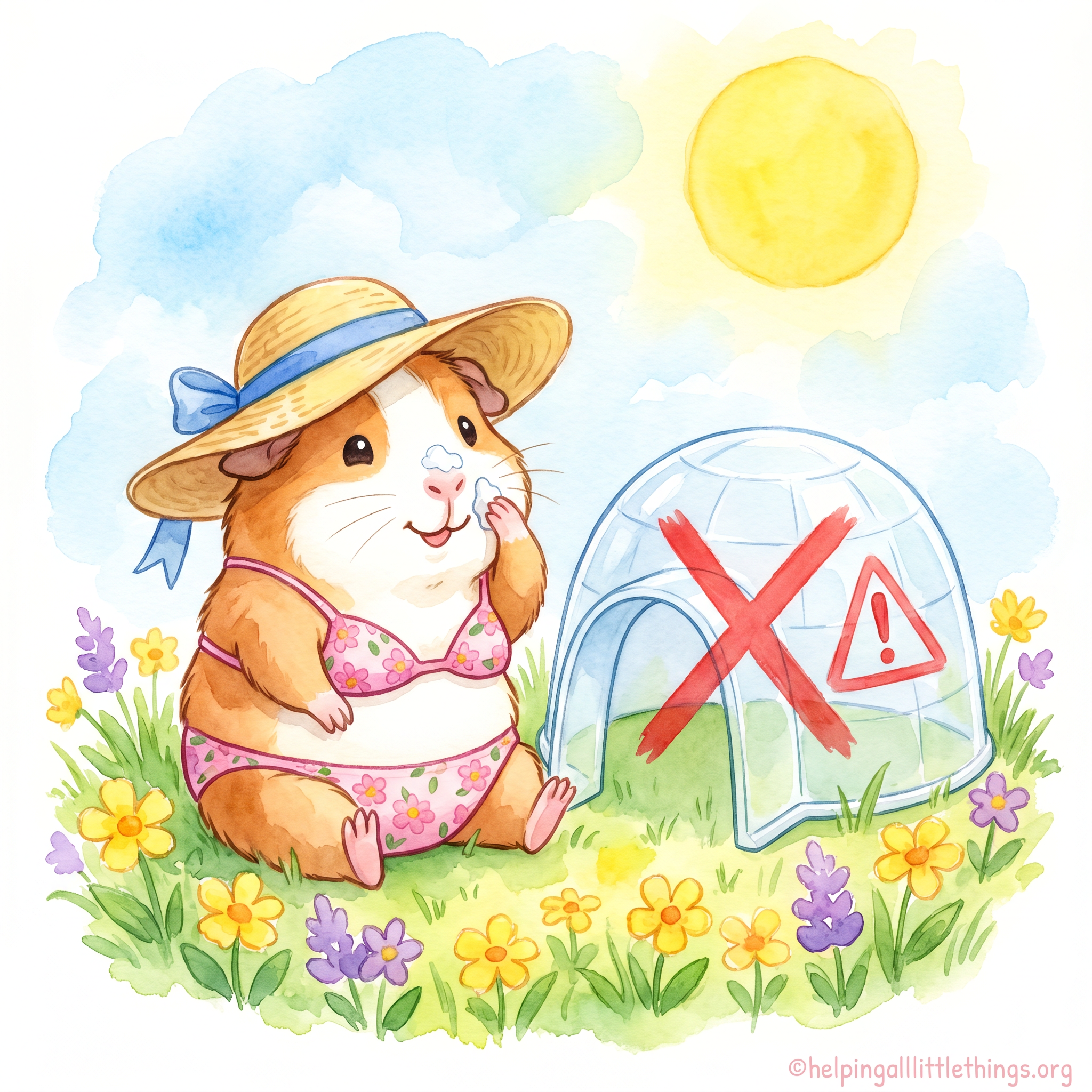
Pigloos and similar plastic dome hides are popular for guinea pigs indoors, but they can be dangerous outside. A solid plastic pigloo placed in an outdoor enclosure can trap heat like a greenhouse, turning into a dangerously hot oven within minutes in warm weather. Even worse, clear or translucent pigloos can act as a magnifying lens, concentrating sunlight and potentially causing sunburn or heat injury to any animal inside.
For outdoor use, choose hiding spots that:
- Are made of natural, breathable materials (untreated wood, wicker, or fleece tunnels) rather than solid plastic
- Are open on at least two sides to allow airflow
- Are positioned entirely in shade — not just partially
- Do not trap or concentrate heat
If you only have plastic hides available, place them in full shade and monitor the temperature inside regularly. When in doubt, leave them at home and use a simple piece of fleece draped over part of the enclosure to create a shaded retreat instead.
Watch the Sky: Predatory Birds
Hawks, falcons, and owls can and do take small pets from gardens and yards. A red-tailed hawk can strike in under two seconds. No small mammal is safe outdoors without overhead protection.8
Raptors that pose a risk to small pets include red-tailed hawks, Cooper's hawks, sharp-shinned hawks, peregrine falcons, and great horned owls. These birds are protected under the Migratory Bird Treaty Act in the United States and equivalent legislation in other countries — you cannot legally deter them by harm. The only effective protection is a fully covered enclosure.8
Never assume your presence alone is sufficient protection. A hawk will strike even when a human is nearby. If you are using a harness or open pen without a top, you must be close enough to physically cover your pet with your body at a moment's notice.
Ground-level predators — including foxes, coyotes, raccoons, neighborhood cats and dogs, and snakes — are an additional concern. Even if a predator does not make physical contact, the sight, sound, or scent of a predator can cause a rabbit to die of acute cardiac arrest from fright — a well-documented phenomenon in prey species.1
Only on Untreated Grass
Never allow your pet to graze on grass that may have been treated with pesticides, herbicides, or fertilizers. These chemicals can cause severe poisoning and death in small mammals, even in trace amounts.2
Safe grass rules:
- Only use grass from your own yard, and only if you are certain no chemicals have been applied — including by neighbors whose yards may border yours
- Avoid public parks, roadsides, and any area where you cannot confirm chemical-free treatment
- Do not let your pet drink from puddles or outdoor water sources, which may be contaminated with Giardia, fertilizer runoff, or other toxins1
- Check the area for animal droppings, which can carry parasites and disease
Know What's Growing: Dangerous Plants
Before allowing your pet to graze or explore, inspect the area carefully for toxic plants. Many common garden plants are highly dangerous to small mammals — some can cause death from even a small amount.
Common toxic plants to watch for include: buttercups, foxglove, ragwort, hemlock, nightshade (both woody and deadly), ivy, yew, daffodils and other bulb plants, rhododendron, azalea, and lily of the valley.9 10
For a comprehensive guide to identifying toxic plants by region, see our article: Dangerous Plants for Small Pets: A Regional Guide.
Parasites and Disease
The outdoors brings exposure to fleas, ticks, mites, and mosquitoes, all of which can transmit disease and parasites to small mammals. Avoid taking your pet outside during dawn and dusk when insects are most active. Avoid areas with tall grass, standing water, or evidence of other animals.1
Consult your veterinarian about appropriate parasite prevention for your species before beginning regular outdoor sessions.
Respecting Your Pet's Wishes
Not every animal wants to go outside. A rabbit who flattens themselves against the ground, a guinea pig who freezes and refuses to move, or a ferret who immediately tries to hide are all telling you they are frightened. Do not force outdoor time on an unwilling animal — the stress can be genuinely harmful.2
If your pet consistently shows fear outdoors, consider bringing the outdoors in: a tray of fresh grass, a handful of safe foraged herbs, or a small container of soil for digging can provide similar enrichment in the safety of your home.
Quick Reference: Outdoor Safety Checklist
| Before You Go | During the Session | When You Return |
|---|---|---|
| Check temperature (65–75°F ideal) | Stay within arm's reach at all times | Check for ticks, burrs, or debris in fur |
| Check humidity | Watch the sky for raptors | Check paws for cuts or irritation |
| Confirm grass is untreated | Keep shade available | Monitor for signs of stress or illness |
| Inspect area for toxic plants | Provide fresh water | Watch for changes in appetite or droppings |
| Ensure enclosure has a covered top | Limit sessions to 1–2 hours | Contact vet if anything seems off |
| Check harness fit (if using) | Watch for signs of overheating |