Introductions and Bonding
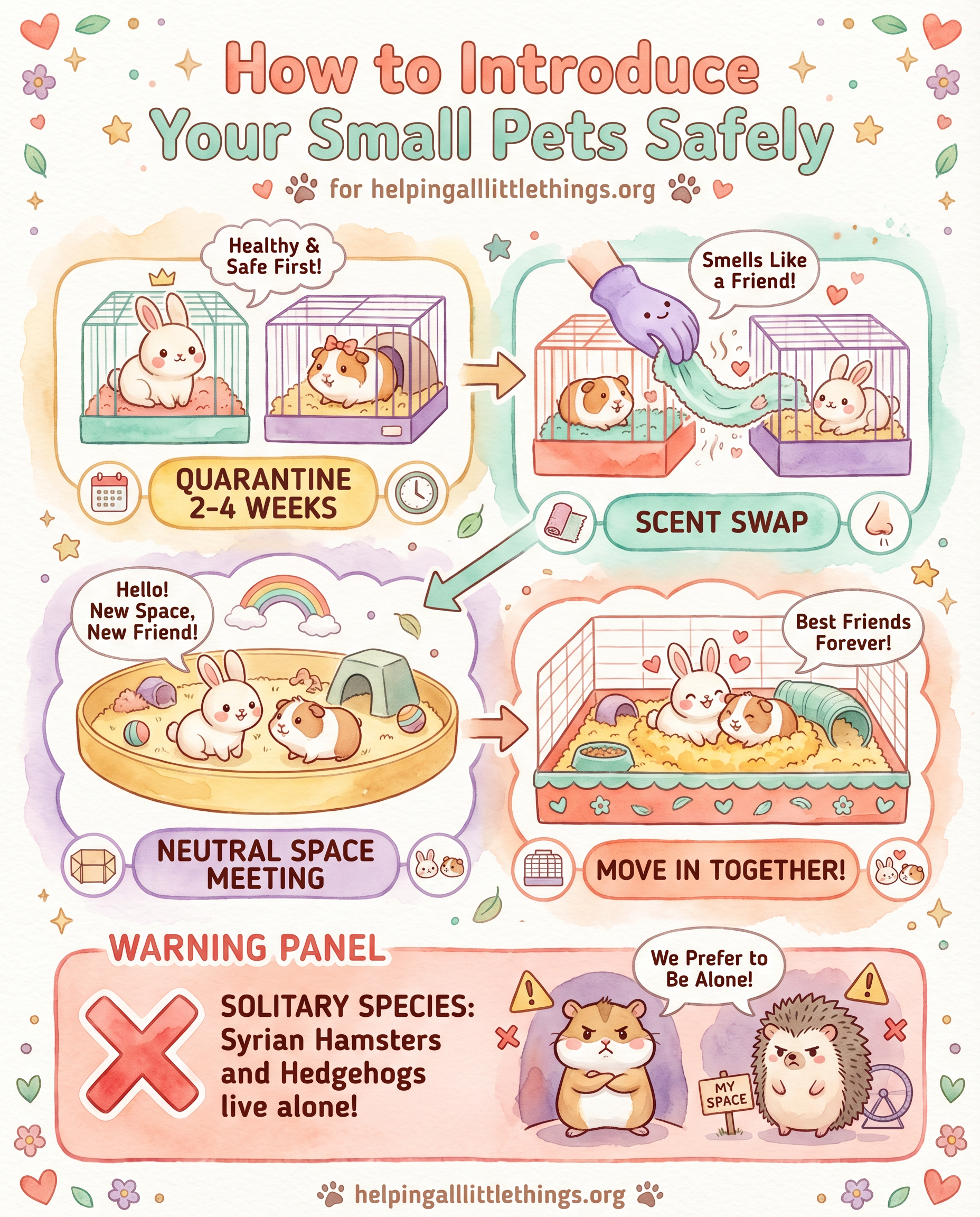
Bringing a new small pet home is exciting — but introducing them to a resident animal requires patience, preparation, and a solid understanding of your species' social needs. A rushed introduction can result in serious injuries, lasting stress, and a permanent breakdown in the relationship between two animals who could otherwise have become lifelong companions.
This guide covers the universal principles of safe introductions and provides species-specific guidance for all ten HALT species. Because social structures vary enormously between species — from the intensely bonded rabbit pair to the strictly solitary hamster — the most important first step is understanding whether your species is social at all.
Step 1: Quarantine
Regardless of species, any new animal must be quarantined for a minimum of 2–4 weeks before any contact with resident animals. This applies even if the new animal appears perfectly healthy and came from a reputable source. Many contagious illnesses — including respiratory infections, ringworm, mites, and some viral diseases — are not immediately visible.1
During quarantine, the new animal should be housed in a completely separate room, with no shared airflow if possible. Wash your hands thoroughly between handling each animal, and do not share bedding, food bowls, water bottles, or toys between the quarantined animal and your residents. At the end of the quarantine period, a veterinary health check is strongly recommended before proceeding with introductions.1
Step 2: Scent Swapping
Before any face-to-face meeting, allow the animals to become familiar with each other's scent. This is one of the most effective ways to reduce the stress and novelty of the first physical introduction.2
Scent swapping can be done by exchanging small pieces of used bedding between the two animals' enclosures, or by briefly swapping the animals into each other's clean enclosures for a short supervised visit. Watch carefully for any extreme reactions — frantic attempts to escape, prolonged freezing, or aggressive posturing toward the bedding — as these may indicate that the introduction will be difficult.
Step 3: Neutral Space Introduction
The first face-to-face meeting should always take place in a neutral space — an area that neither animal considers their territory. This is critical for species that are territorial, such as rabbits and guinea pigs. A bathroom, a spare room, or a large playpen set up in a new area of the home all work well.2
The neutral space should be large enough for both animals to move freely and retreat from each other, but not so large that you cannot monitor them closely. Remove any enclosed hides that could become territorial resources; instead, provide open tubes or boxes that animals can pass through rather than defend. Scatter food and hay around the space to give the animals a positive shared activity and reduce the focus on each other.3
Stay close and supervise the entire session. Have a thick towel or solid board ready to separate the animals quickly if needed. Never reach between two fighting animals with bare hands.
Reading Body Language
Understanding what is normal and what is dangerous during an introduction is essential. The table below summarises common behaviours across species.
| Behaviour | Meaning | Action |
|---|---|---|
| Sniffing each other | Normal curiosity | Continue monitoring |
| Chasing (brief, not relentless) | Establishing hierarchy | Monitor closely |
| Mounting / humping | Dominance behaviour | Normal unless constant or distressing |
| Rumblestrutting (guinea pigs) | Dominance display | Normal; watch for escalation |
| Grooming each other | Positive bonding signal | Excellent sign |
| Popcorning (guinea pigs) | Excitement/happiness | Excellent sign |
| Teeth chattering | Warning / aggression | Separate immediately |
| Biting that draws blood | Serious aggression | Separate immediately |
| Prolonged screaming | Fear or pain | Separate immediately |
| Freezing and refusing to move | Extreme stress | End session, try again later |
Species-Specific Guidance
Rabbits
Rabbits are social animals that generally do best in bonded pairs or small groups, but they are also strongly territorial and can inflict serious injuries on unfamiliar rabbits. Both animals should be spayed or neutered before bonding is attempted — this is especially important for male-female pairs and male-male pairs, as hormones significantly increase aggression.4
The bonding process for rabbits can take anywhere from a single afternoon to several months. The most reliable method involves a series of short supervised sessions in a neutral space, gradually increasing in length as the rabbits become more comfortable. Some rescues use "stress bonding" — placing the rabbits together during mildly stressful experiences such as a car ride — to encourage them to seek comfort from each other rather than compete. This technique should only be used by experienced handlers.4
Rabbits should never be housed with guinea pigs. Despite being commonly sold together, the two species cannot communicate effectively, and rabbits frequently bully, injure, or kill guinea pigs.3
Guinea Pigs
Guinea pigs are highly social and should always be kept in pairs or groups — a single guinea pig is a lonely guinea pig. Females tend to bond most easily, while male-male pairs can work well but require careful introduction. Groups of three or more males are generally not recommended as they frequently fight.3
The introduction process follows the scent-swap, neutral-space pattern described above. Provide plenty of open hides (tubes, open boxes) and scatter food throughout the space. Rumblestrutting, chasing, and mounting are all normal during early introductions; teeth chattering and biting are not. A minimum cage size of 5 ft × 2 ft (10 sq ft) is required for a bonded pair.3
Rats
Rats are highly social and should always be kept in same-sex groups of two or more. Lone rats suffer significantly from isolation and are prone to depression and illness. Introductions between rats are generally less fraught than for rabbits or guinea pigs, but still require a structured approach.5
The recommended method is the carrier method: place both rats in a small, clean carrier with no bedding and allow them to interact for 1–2 hours. The confined space prevents prolonged chasing and forces the rats to negotiate proximity. Follow this with a neutral-space session, then gradually introduce them to the main cage (thoroughly cleaned first to remove the resident rat's scent).5
Hamsters
Hamsters are solitary animals and should not be housed together. The only exception is dwarf hamster species (Roborovski, Campbell's, and Winter White), which can sometimes live in same-sex pairs if introduced as juveniles and given sufficient space. Even dwarf hamsters must be monitored closely for signs of fighting, and a second cage must always be available for emergency separation.6
Syrian hamsters (also known as golden hamsters) are strictly solitary and will fight to the death if housed together as adults. Never attempt to introduce or bond Syrian hamsters.
Gerbils
Gerbils are social animals that live in family groups in the wild and should be kept in same-sex pairs or small groups. The safest way to introduce gerbils is the split cage method: divide a large tank with a mesh divider, place one gerbil on each side, and swap sides daily for 1–2 weeks. This allows the gerbils to become thoroughly familiar with each other's scent before any physical contact.7
Once the gerbils are showing positive interest in each other through the mesh (sniffing, following along the divider, sleeping near it), remove the divider and supervise the first meeting. Gerbils can inflict serious wounds on each other, so monitor closely for the first several hours. Note that gerbil pairs can "declick" — a previously bonded pair can suddenly begin fighting, often after one animal has been handled separately or has visited the vet. If this happens, the split cage method must be restarted from the beginning.7
Chinchillas
Chinchillas can live in same-sex pairs or groups but require a careful, patient introduction process. The split cage method (as described for gerbils) works well for chinchillas. Introductions should be attempted only after a full quarantine period and should proceed very slowly — rushing a chinchilla introduction can result in fur-slip injuries or serious bites.8
Chinchillas are most active at dawn and dusk; plan introduction sessions for these times when they are naturally more social and exploratory.
Ferrets
Ferrets are social animals that generally do well in pairs or small groups ("businesses"). Introductions are usually straightforward but should still follow the quarantine and neutral-space protocol. Young ferrets (kits) are typically easy to introduce to established groups. Older ferrets may take longer to accept a newcomer but usually do so within a few weeks of gradual introductions.9
During introductions, some scruffing and dragging is normal ferret play behaviour. Watch for prolonged screaming, biting that draws blood, or one ferret consistently pinning and refusing to release the other — these are signs that the session should end.
Hedgehogs
Hedgehogs are solitary animals and should not be housed together. Female hedgehogs may tolerate brief supervised interaction, but cohabitation is not recommended and frequently results in injury. Male hedgehogs will fight aggressively if housed together. Provide each hedgehog with their own enclosure.10
Mice
Mice are social animals and should be kept in same-sex groups of two or more. Female mice generally get along very well and can be introduced using the neutral-space method. Male mice are more territorial and may fight; introductions between males should be attempted only with juvenile mice, and a second cage must always be available.11
Degus
Degus are highly social animals that live in large family groups in the wild and suffer significantly from isolation. They should always be kept in groups of two or more. The split cage method works well for degu introductions. Degus that have been separated for veterinary treatment may need to be re-introduced to their group using this method, as the returning degu may smell different and be treated as a stranger.12
When Introductions Fail
Not every introduction will succeed, and forcing incompatible animals to live together causes chronic stress that can shorten their lives and make them more susceptible to illness. If two animals have had multiple introduction sessions over several weeks and continue to show serious aggression, it is kinder to accept that they are not compatible and house them separately.
For social species that cannot be bonded to another of their kind, enrichment, regular human interaction, and — where appropriate — a mirror or recorded sounds of conspecifics can help reduce isolation stress. Consult your exotic animal veterinarian for guidance specific to your animal's situation.