Rat Dental Care Guide
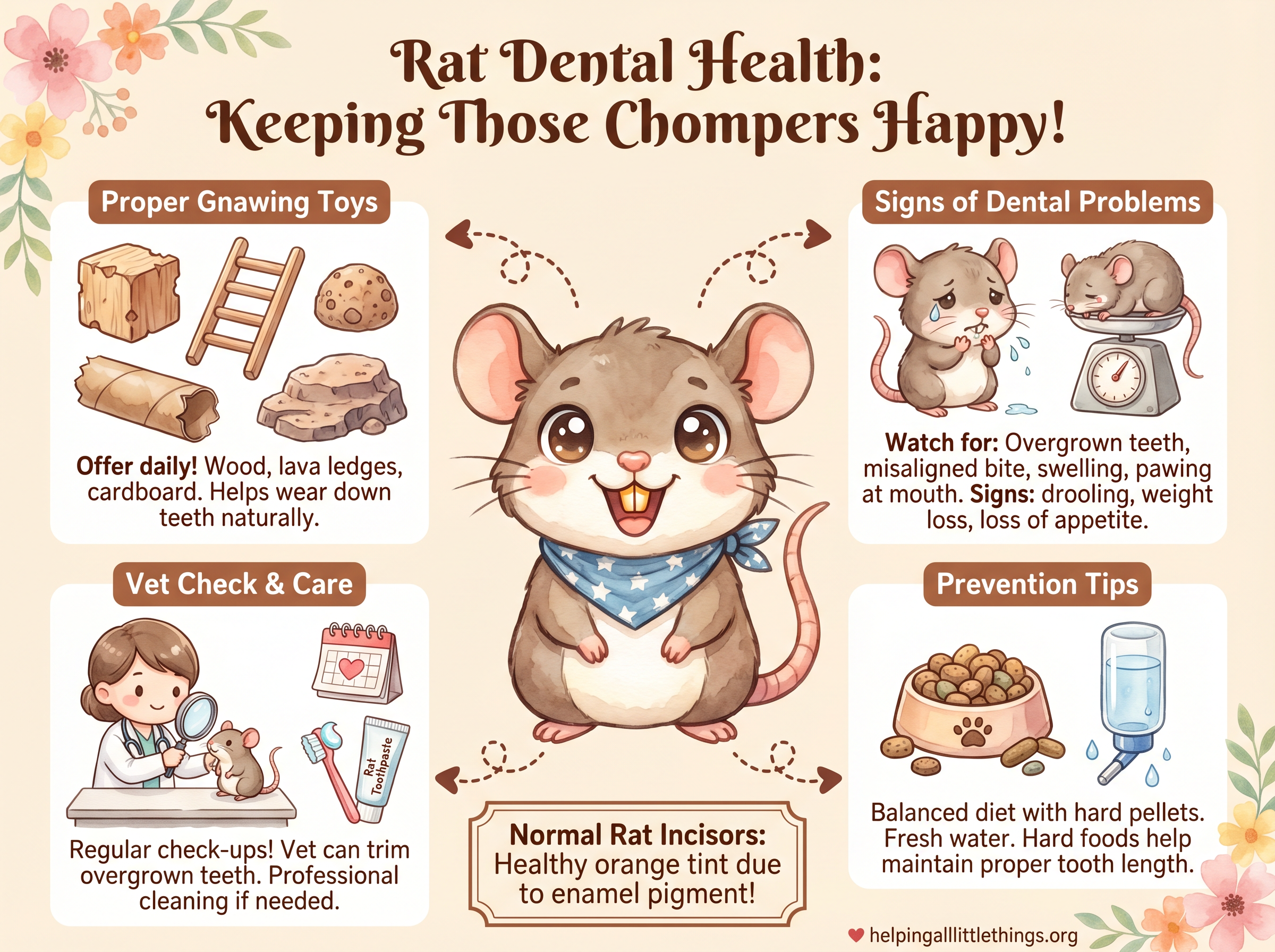

Dental health is one of the most important — and most overlooked — aspects of rat care. Because rat incisors grow continuously throughout life, they must wear down properly to prevent serious complications. A rat with dental problems will struggle to eat, lose weight rapidly, and can deteriorate quickly. Understanding how rat teeth work and how to support healthy dental wear is essential for every rat owner.
How Rat Teeth Work
Rats have a total of 16 teeth:
- 4 incisors (2 upper, 2 lower) — the large front teeth used for gnawing
- 12 molars — the back teeth used for grinding food
- No canine teeth — there is a gap called the diastema between the incisors and molars
The incisors grow continuously at approximately 2–3 mm per week [1]. In a healthy rat, normal chewing, gnawing, and bruxing (the grinding sound you may hear your rat make — a sign of contentment) keeps the incisors worn to a safe length and properly aligned.
The color of healthy rat incisors is yellow-orange, not white. This yellow pigmentation comes from iron-containing enamel and is completely normal. White incisors in a rat can actually indicate a nutritional deficiency or illness [2].
What Healthy Teeth Look Like
| Feature | Healthy | Concerning |
|---|---|---|
| Color | Yellow-orange | White or pale |
| Length | Short, proportional | Visibly long or curving |
| Alignment | Upper incisors slightly overlap lower | Crossed, side-by-side, or not meeting |
| Eating behavior | Normal appetite, eating solid food | Dropping food, preferring soft food, weight loss |
Supporting Healthy Tooth Wear
The best way to prevent dental problems is to ensure your rats always have appropriate materials to chew on.
Provide Chewing Materials
- Wooden chew toys (untreated hardwood, apple sticks, willow balls)
- Lava ledges and mineral chews
- Cardboard — boxes, tubes, and egg cartons
- Hard lab blocks — the texture of a good quality rat block helps wear teeth naturally
- Hay — a small amount of hay provides both chewing material and enrichment
Diet
A diet based on hard, dry lab blocks is far better for dental health than soft foods alone. Rats that eat primarily soft or wet foods do not get enough natural tooth wear [3].
Common Dental Problems
Malocclusion (Misalignment)
Malocclusion occurs when the upper and lower incisors do not meet correctly, so they cannot wear each other down through normal use. This causes one or more teeth to grow unchecked.
Causes:
- Genetic predisposition (some rats are born with slightly misaligned jaws)
- Trauma (a fall or impact that shifts tooth alignment)
- Tooth loss (a missing tooth allows the opposite tooth to overgrow)
Signs:
- Visibly long, curved, or crossed incisors
- Dropping food while eating
- Preferring soft food or refusing hard food
- Weight loss
- Drooling
Treatment: Malocclusion cannot be cured at home. A veterinarian must trim the teeth under anesthesia or sedation. In severe or recurring cases, incisor extraction may be recommended. Rats can live well without their incisors — they adapt to eating soft and mashed foods [1].
Overgrown Incisors
Even without true malocclusion, incisors can overgrow if a rat is not chewing enough. This is common in older rats or those with illness-related appetite changes.
Treatment: Veterinary trimming. Never attempt to trim your rat's teeth at home with nail clippers — this can cause the tooth to shatter and create a painful fracture [2].
Broken or Missing Incisors
Rats can break a tooth from a fall, a fight, or chewing on cage bars. A broken incisor will usually regrow within a few weeks. During this time, the opposite tooth may overgrow slightly and will need monitoring. Offer soft foods while the tooth regrows.
Dental Abscesses
Abscesses can form at the root of a tooth, particularly the molars. They may appear as a swelling on the jaw or face. Dental abscesses are serious and require veterinary treatment, which typically involves antibiotics and sometimes surgical drainage or tooth extraction [4].
When to See a Veterinarian
Contact your vet if you notice:
- Incisors that appear longer than usual or are visibly curving
- Crossed or misaligned front teeth
- Your rat is dropping food, losing weight, or avoiding hard food
- Drooling or wet fur around the mouth
- Any swelling on the face or jaw
- A broken tooth that has not regrown within 3–4 weeks
Checking Your Rat's Teeth at Home
Make a habit of briefly checking your rat's front teeth during your weekly health check. Gently hold your rat and use your thumb to lift the upper lip slightly to view the incisors. You are looking for:
- Normal yellow-orange color
- Appropriate length (not visibly long or curving)
- Proper alignment (upper slightly overlapping lower)
You cannot easily check the molars at home — that requires a veterinary examination with appropriate lighting and tools.
References
[1] Malocclusion in Aging Wistar Rats — Dontas, I.A. et al., PMC/NIH, 2010
[2] Routine Health Care of Rats — Merck Veterinary Manual
[3] Oral Disorders of Exotic Rodents — Legendre, L.F.J., PMC/NIH, 2005
[4] Disorders and Diseases of Rats — Merck Veterinary Manual
[5] Anatomy and Disorders of the Oral Cavity of Rat-like Rodents — Mancinelli, E., PMC/NIH, 2016