Wheels vs. Saucers for Rats: What You Need to Know
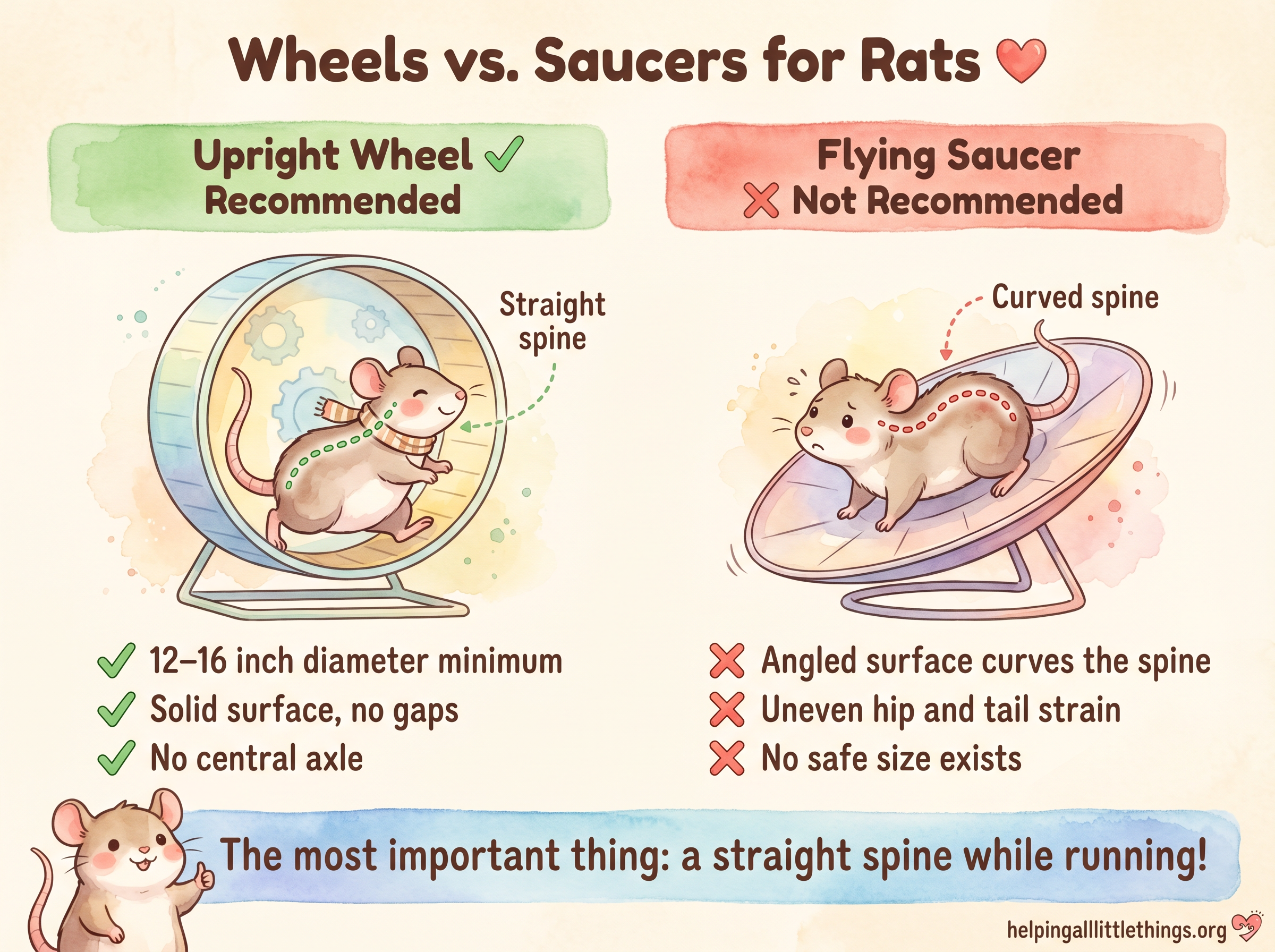

If you spend any time in rat owner communities, you will quickly encounter the wheels-versus-saucers debate. Some owners swear by upright wheels; others insist that flying saucers are safer and more natural. The reality is more nuanced than either camp tends to admit, and the most important factors are not which style you choose, but whether the option you select is the right size and whether your individual rats actually want to use it.
Do Rats Even Need a Wheel?
Unlike hamsters, rats are not obligate runners. In the wild, their movement is driven by exploration, foraging, climbing, and social interaction rather than sustained, repetitive running.1 Rats do not develop the same compulsive wheel-running behaviour that hamsters can, and an adult rat who never touches a wheel is not missing something essential from their care.
That said, research has shown that wheel-running is intrinsically rewarding for rats. A study conducted by the Leiden University Medical Center placed cages containing food and a wheel in areas where wild mice and rats lived. Cameras recorded animals returning to the wheels repeatedly and running even when no food was present, demonstrating that the behaviour is genuinely voluntary and not simply a captivity-induced coping mechanism.2 For rats who enjoy it, a wheel or saucer can be a valuable addition to their environment.
Female rats (does) tend to be more active and are more likely to use a wheel consistently. Adult male rats (bucks) are heavier and generally less interested in repetitive running; it is entirely normal for a buck to ignore a wheel completely, especially as he matures.3
The Non-Negotiable: Spine Safety
Regardless of which style you choose, the single most important factor is that the running surface allows the rat to keep their spine completely straight while running. A rat who must arch their back to fit on a wheel or saucer is at risk of spinal injury over time.4
This requirement has different implications for each style:
Upright wheels must be large enough in diameter that the rat's back does not curve downward as they run. The minimum recommended diameter is 12–14 inches for does and 14–16 inches for bucks, with larger always being better.3 4 Many wheels marketed as suitable for rats are actually closer to hamster sizes and should be avoided.
Flying saucers present a different postural challenge. Because the running surface is angled (typically 30–45 degrees), rats run with their bodies tilted, which causes lateral spinal curvature and uneven strain on the hips and tail base. Most rat care experts and veterinary sources consider this a significant concern and recommend against saucers for rats.4 5 Some owners report that their rats use saucers without apparent discomfort, but the consensus among experienced rat keepers is that an appropriately sized upright wheel is the safer choice.
| Feature | Upright Wheel | Flying Saucer |
|---|---|---|
| Spinal posture | Straight if correctly sized | Laterally curved (angled running surface) |
| Minimum size (does) | 12–14 inches diameter | Not generally recommended |
| Minimum size (bucks) | 14–16 inches diameter | Not generally recommended |
| Tail/foot injury risk | Low if solid surface, no axle | Low (open design) |
| Cage space required | Moderate (mounts to cage side) | Larger footprint (freestanding) |
| Noise | Varies by model | Generally quieter |
| Popularity with rats | Individual preference | Individual preference |
What to Look for in an Upright Wheel
If you decide to offer an upright wheel, the following features matter most:
Solid running surface. Wire mesh or bar rungs can trap toes, feet, and tails, causing serious injury. The running surface must be solid plastic or solid metal with no gaps.3
Axle-free or centre-axle design. A central axle running through the wheel creates a pinch point where tails can be caught. Wheels with a rear axle or no axle at all are significantly safer.5
Stability. A wheel that wobbles, tips, or shifts while running is a safety hazard. Freestanding wheels should have a wide, weighted base; cage-mounted wheels should attach securely.
Ease of cleaning. Rats will run and defecate at the same time. A wheel that cannot be fully disassembled and cleaned is a hygiene problem.
Brands commonly recommended by experienced rat owners include the Silent Runner (axle-free, fully disassembles, available in 9-inch and 12-inch diameters — the 12-inch is the minimum for does) and the Wodent Wheel (solid surface, rear axle, available in sizes up to 11 inches). Always verify the actual diameter before purchasing, as product descriptions are sometimes misleading.3
What About Saucers?
Flying saucers are popular because they are quiet, open, and visually appealing. Some rats do use them enthusiastically. However, the angled running surface means the rat's spine is never in a neutral position during use, and there is no saucer size that corrects this problem — it is a design issue, not a size issue.4
HALT's recommendation is to offer an appropriately sized upright wheel rather than a saucer. If your rat shows a strong preference for a saucer and ignores an upright wheel, limit saucer sessions rather than making it the primary exercise option, and monitor for any signs of back or hip discomfort.
Better Exercise Than Any Wheel
For most rats, the following provide more natural, varied, and beneficial exercise than any wheel or saucer:
Daily free-roam time outside the cage in a safe, rat-proofed space is the single most important form of exercise. At least one hour per day allows rats to run, jump, climb, and explore at their own pace.1
Multi-level cage layouts with platforms, ropes, ladders, and hammocks encourage full-body movement and balance. Vertical space is as important as floor space.
Scatter feeding and foraging adds gentle movement and mental stimulation simultaneously, mimicking natural foraging behaviour.
Social interaction with cage-mates and with you is itself a form of enrichment that keeps rats mentally and physically active.
A wheel or saucer is optional enrichment, not a substitute for these fundamentals.
The Bottom Line
Wheels can be a worthwhile addition for rats who enjoy them, particularly for does and younger rats. If you offer one, choose an upright wheel with a solid surface, no central axle, and a diameter large enough to keep your rat's spine completely flat while running. Flying saucers are not recommended due to the lateral spinal strain caused by their angled design. And if your rat never touches the wheel at all, that is perfectly normal — focus on free-roam time, a well-designed cage, and daily interaction, and your mischief will thrive.