A Guide to Fancy Rat Varieties
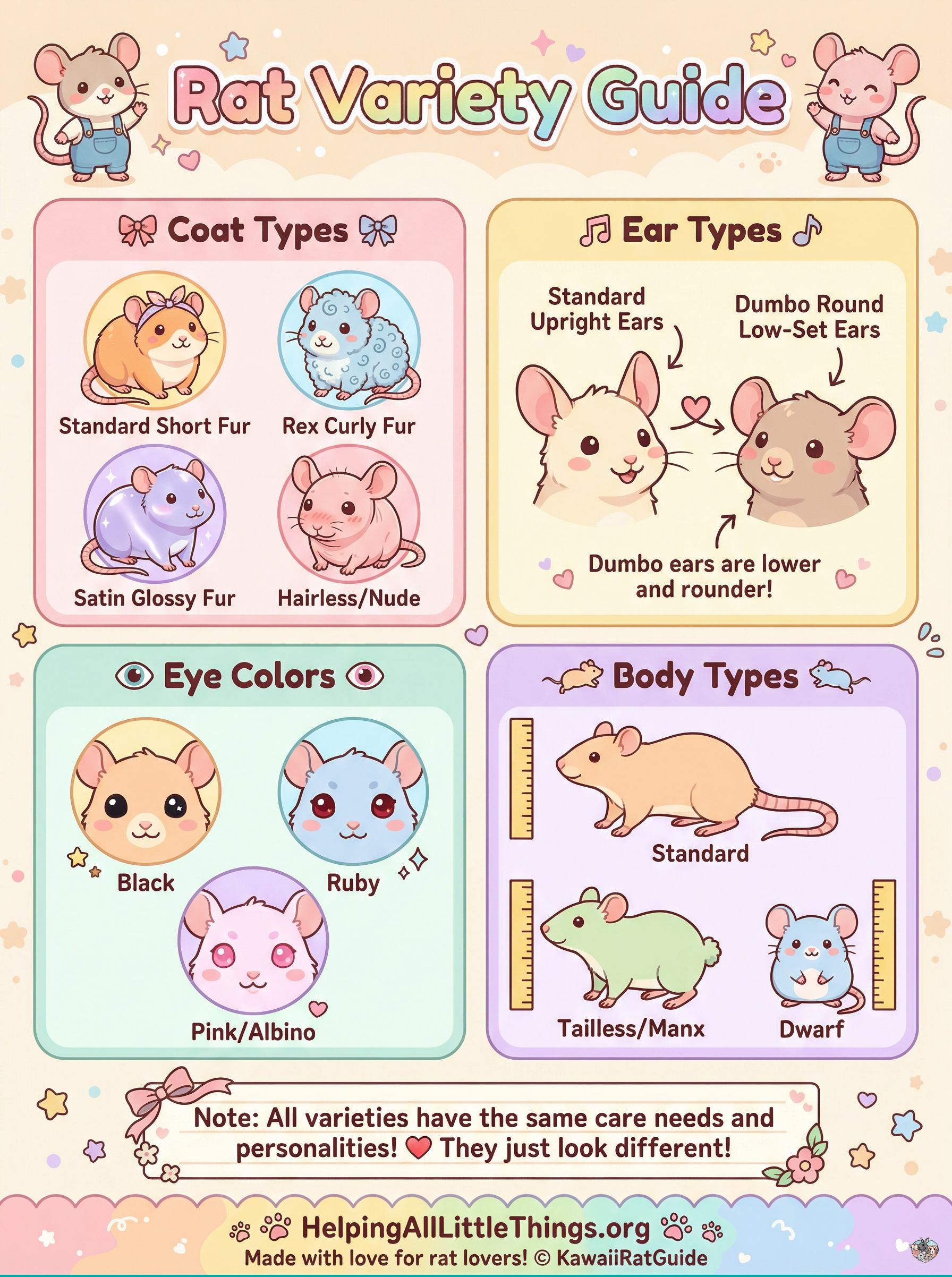

Welcome to the colorful world of fancy rats! Through selective breeding, pet rats have been developed in a stunning array of colors, coat types, and markings. While these varieties are fascinating, it’s crucial to remember that unlike dog breeds, a rat's appearance does not determine its personality, health, or temperament [1]. This guide is designed to help you understand the common terms you might encounter when adopting from a rescue or shelter.
Coat Types
The texture of a rat's fur is one of its most defining features.
- Standard: The most common coat type, which is smooth and glossy.
- Rex: A curly or wavy coat and whiskers. The fur is often softer and less dense than a standard coat [1].
- Double Rex: These rats have a sparse, patchy coat that can change over time, sometimes leaving them temporarily bald in areas.
- Hairless: As the name suggests, these rats have no fur, though they may have a very fine, sparse down. They require extra care to keep warm and protect their skin.
Markings (Patterns)
Markings refer to the pattern of color on a rat's body.
- Self: The entire rat is a single, solid color.
- Hooded: Color is concentrated on the head and shoulders, with a stripe running down the back.
- Berkshire: A solid colored top with a white belly and white feet.
- Capped: Color is only on the rat's head, like a small cap.
- Blaze: A white wedge-shaped mark on the face [1].
- Dalmation: A white rat with colored spots, similar to a Dalmatian dog.
Ear Types
There are two primary ear types in fancy rats.
- Top-Eared: The standard ear type, set high on the head.
- Dumbo: The ears are set lower on the sides of the head, are larger and more rounded, giving the rat a different head shape.
A Note on Health and Temperament
While these physical traits are interesting, they are not linked to a rat's personality. A Dumbo rat is not inherently more docile than a Top-Eared rat, and a Rex rat is not necessarily friendlier than a rat with a standard coat. Factors like genetics (unrelated to appearance), socialization, and quality of care are what shape a rat's temperament.
Furthermore, some varieties, like Hairless rats, may have more specific health needs. Always focus on finding a healthy, well-socialized rat, regardless of its appearance.
When choosing rats, always adopt in pairs or groups — rats are highly social and can suffer from loneliness and depression if kept alone. Variety and appearance are secondary to temperament and health. Look for active, curious rats with bright eyes, clean coats, and no signs of respiratory distress.
References
[1] Description and Physical Characteristics of Rats — Katherine E. Quesenberry, Kenneth R. Boschert, 2024
[2] Caring for pet mice and rats — RSPCA Victoria, Unknown
[3] Rat Fan Club — Debbie Ducommun, 2018