Rat Sexing Guide: How to Identify Male and Female Rats at Different Ages
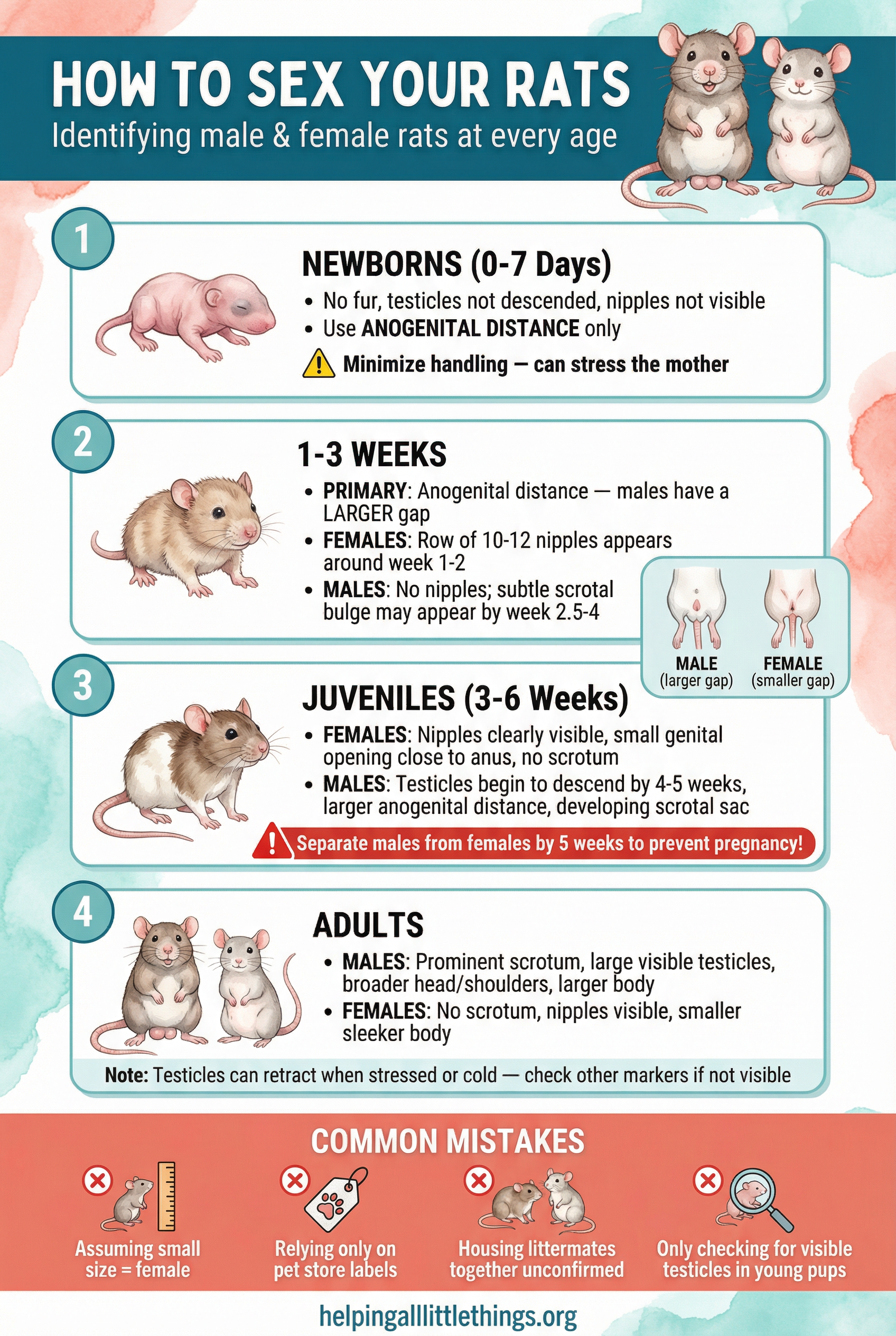

Correctly sexing rats is essential to prevent accidental litters and ensure proper housing. Rats can reproduce very young, and misidentification is one of the most common causes of surprise pregnancies.
This guide explains how to identify male and female rats from birth through adulthood, what changes with age, and common mistakes to avoid.
Newborns (0–7 Days)
It is generally not advised to handle rat pups during their first week unless medically necessary. Early disturbance can stress the mother and the litter.
At this stage:
- Pups have no fur
- Testicles have not descended
- Nipples may not yet be clearly visible
While it is possible to sex pups at this age, it relies exclusively on anogenital distance (see below), which becomes more pronounced by week one and most obvious by weeks three to four. Confirmation at a later age is advised, as there is meaningful room for error — especially among those without prior experience.
Sexing Young Pups (1–3 Weeks)
As pups grow, fur develops, body size increases, and anatomical differences become easier to observe. By around one week of age, brief handling for sex confirmation is appropriate if needed.
Primary Marker: Anogenital Distance
Sex can be assessed using the anogenital distance — the space between the genital opening and the anus:
| Sex | Anogenital Distance |
|---|---|
| Male | Larger gap |
| Female | Openings positioned closer together |
Comparing littermates side by side makes this difference much easier to identify.
Secondary Sex Characteristics
Secondary characteristics begin to develop during this period and often provide clearer confirmation than spacing alone:
Females:
- Develop a visible row of nipples (typically 10–12) around 1–2 weeks of age
- Do not develop a scrotum
Males:
- Do not develop nipples
- A subtle scrotal bulge may begin to appear between 2.5–4 weeks of age
As these secondary characteristics become visible, sexing becomes more straightforward and reliable.
Juveniles (3–6 Weeks)
Rats become sexually mature during this period.
Males should be separated from females by 5 weeks of age to prevent pregnancy. Rats can conceive before they are fully grown.
Females:
- Nipples clearly visible
- Small genital opening close to the anus
- No scrotum
Males:
- Testicles begin to descend (often obvious by 4–5 weeks)
- Larger anogenital distance
- Developing scrotal sac
By five weeks, most males have visible testicles, though some may descend slightly later. While uncommon, male rats may occasionally develop nipples — it is therefore beneficial to consider multiple sex characteristics when sexing rats.
Adult Rats
In adults, sexing is usually straightforward.
| Feature | Male | Female |
|---|---|---|
| Scrotum | Prominent, clearly visible | Absent |
| Testicles | Large, often very visible | Absent |
| Nipples | Absent (usually) | Visible through thin fur |
| Body shape | Larger, broader head and shoulders | Smaller, sleeker |
Male rats often appear physically bulkier overall, though size alone should never be used as the only indicator.
Special Considerations
Retracted Testicles
Male rats can temporarily pull their testicles up into the body, especially when:
- Stressed
- Cold
- Nervous
If testicles are not visible, rely on the overall anatomy — including anogenital distance and nipple presence — rather than assuming the rat is female.
Common Mistakes
- Assuming small size means female — body size varies widely and is not a reliable indicator
- Waiting for visible testicles in very young pups — they won't be present yet
- Housing littermates together without confirming sex — or without accounting for reproductive capacity
- Relying only on pet store labels or sexing — always visually confirm sex yourself
Quick Reference
| Age | Most Reliable Indicator |
|---|---|
| Newborn (0–7 days) | Anogenital distance |
| 1–3 weeks | Distance + nipples (females) / early scrotal bulge (males) |
| 3–6 weeks | Distance + nipples (females) / descending testicles (males) |
| Adult | Visible scrotum (males) or nipples (females) |
Being able to sex rats accurately reduces the risk of accidental pregnancy and unplanned litters. While early identification requires a careful eye, it becomes easier with age. When in doubt, consider multiple sex characteristics together — and reach out to a more experienced rat keeper or your vet if things are unclear.