Eye & Vision Issues in Rabbits
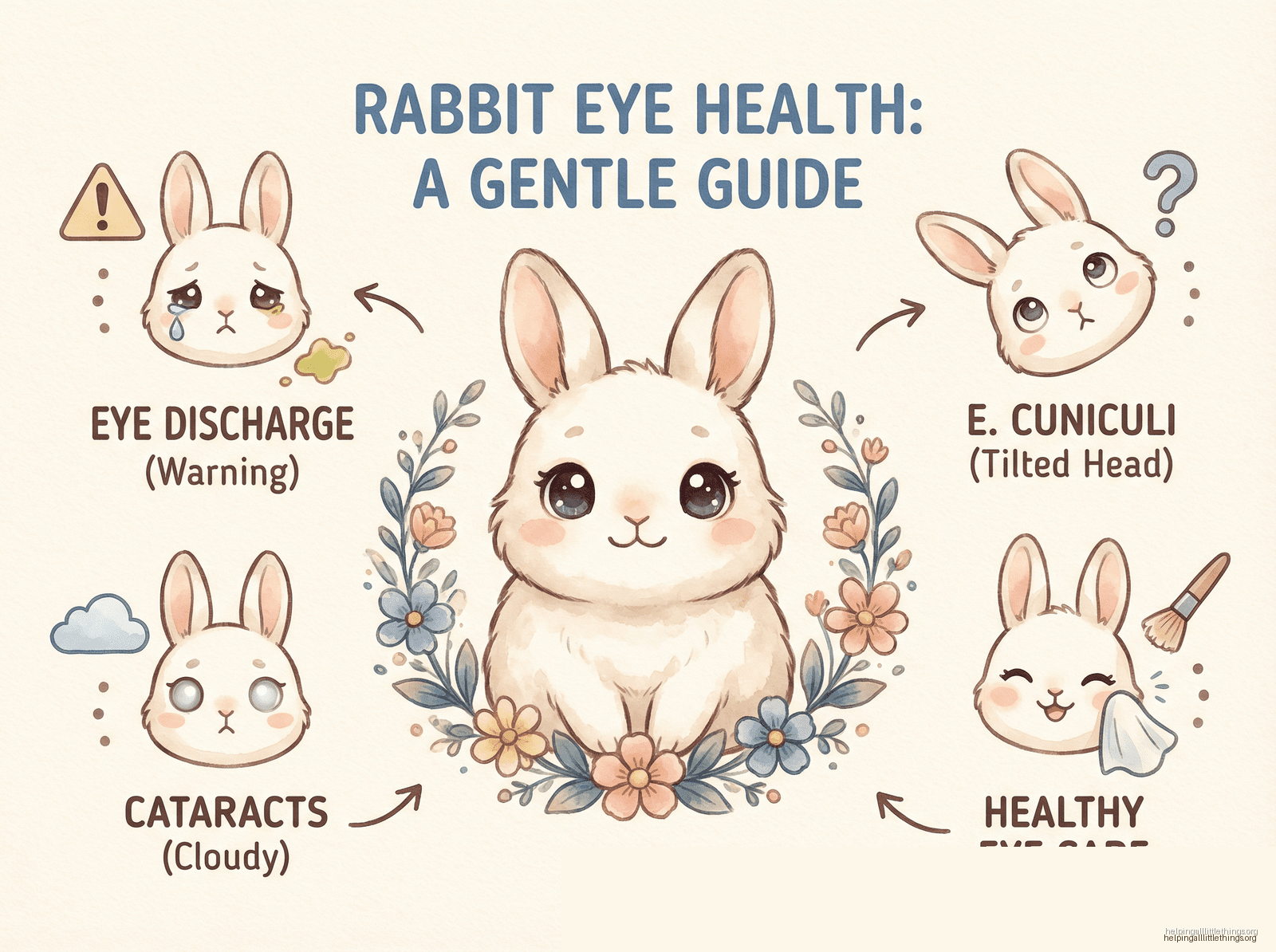

Eye issues are an extremely common problem in pet rabbits, but they are very often a symptom of a problem elsewhere in the body. A weepy or runny eye in a rabbit is rarely just a simple eye infection; more often than not, it is a direct consequence of dental disease. Understanding this connection is one of the most critical aspects of rabbit healthcare.
The #1 Cause of Weepy Eyes: Dental Disease
A rabbit's teeth grow continuously throughout its life. The roots of the upper incisors and cheek teeth extend deep into the skull, right next to the nasolacrimal duct—the tear duct. This duct is a tiny tube that drains tears from the eye out through the nose.
- The Mechanism: When a rabbit's diet is low in hay, the teeth are not worn down properly. The roots of the upper teeth begin to elongate and grow in the wrong direction. These overgrown roots press on, inflame, and eventually block the delicate tear duct.
- The Result (Epiphora): With the duct blocked, the tears have nowhere to drain. They spill over the lower eyelid, causing the fur to become wet. This condition is called epiphora.
- Progression (Dacryocystitis): The stagnant, trapped tears within the blocked duct are a perfect breeding ground for bacteria. This leads to a painful infection and inflammation of the tear duct, known as dacryocystitis. The discharge will change from clear tears to a thick, white, pus-like substance.
- Action: A weepy eye in a rabbit warrants an immediate and thorough veterinary examination of the mouth and teeth. Skull x-rays are essential to visualize the tooth roots and their impact on the tear ducts. While antibiotic eye drops may be prescribed, the problem will not resolve until the underlying dental disease is addressed. This may require tooth trimming or, in severe cases, extraction.
Other Common Eye Problems
-
Corneal Ulcers:
- Cause: A scratch on the surface of the eye (cornea) is very common. It is most often caused by a poke from a sharp piece of hay.
- Signs: The rabbit will be in extreme pain, holding the eye completely shut. The eye will be tearing profusely.
- Action: This is an emergency. An untreated ulcer can lead to the loss of the eye. A vet will diagnose the ulcer with a special stain and prescribe antibiotic eye drops and pain medication.
-
Conjunctivitis:
- Cause: An inflammation of the pink tissues around the eye. It can be caused by environmental irritants (dust, ammonia) or a bacterial infection, often secondary to a blocked tear duct.
- Signs: Redness and swelling of the conjunctiva, with a clear or milky discharge.
-
Abscesses:
- Cause: An abscess (a pocket of thick pus) can form behind the eye, often originating from an infected tooth root.
- Signs: The eye will appear to bulge outwards. This is a very serious and painful condition.
- Action: This requires aggressive veterinary treatment, including surgery to drain the abscess and often remove the affected tooth.
-
Cataracts:
- Cause: A clouding of the lens. This can be an age-related change in senior rabbits or can be caused by the parasite E. cuniculi in younger rabbits.
- Action: Rabbits adapt well to blindness. The main importance of a cataract diagnosis is to consider testing and treating for E. cuniculi if it is suspected.
-
Entropion:
- Cause: Entropion is the most commonly observed eyelid abnormality in rabbits. The eyelid rolls inward, causing fur to rub against the cornea. It can be primary (congenital, with a breed predisposition in New Zealand Whites and French Lops) or secondary to chronic blepharitis or infection.
- Signs: Epiphora (tearing), squinting, conjunctival redness, and in advanced cases, corneal ulceration.
- Action: A veterinarian should examine the eye and check for corneal ulcers. Surgical correction using the modified Hotz-Celsus technique is the standard treatment. See our full guide: Entropion in Small Pets
-
Microphthalmia (Congenital Small Eye):
- What it is: Microphthalmia is a congenital condition in which one or both eyes are abnormally small from birth. It may occur alongside other structural eye defects such as cataracts, colobomas, or retinal abnormalities. Some rabbits with a small eye retain partial vision; others have no functional vision in the affected eye.
- Signs: One eye visibly smaller than the other, detected at or shortly after birth. The rabbit may navigate poorly in unfamiliar environments or startle more easily. Squinting, discharge, or corneal cloudiness may develop if the small eye is not adequately protected by the eyelids.
- Action: A veterinarian should assess whether the eye is comfortable and whether the corneal surface is healthy. Many rabbits adapt well and require only monitoring and lubrication. A chronically painful eye may need to be removed. See our full guide: Microphthalmia in Small Pets
Because of the intricate connection between a rabbit's eyes and teeth, any eye problem—especially a weepy one—should be considered a serious warning sign that requires a comprehensive veterinary workup.