Rabbit Exercise and Enrichment
Rabbits are athletic, intelligent animals built for speed and agility. In the wild, European rabbits (Oryctolagus cuniculus) can run at speeds exceeding 56 km/h (35 mph) and may travel several kilometers each day.1 Pet rabbits retain this physiological need for movement, and a sedentary lifestyle is one of the leading contributors to obesity, GI stasis, sore hocks, and behavioral problems in captive rabbits.2
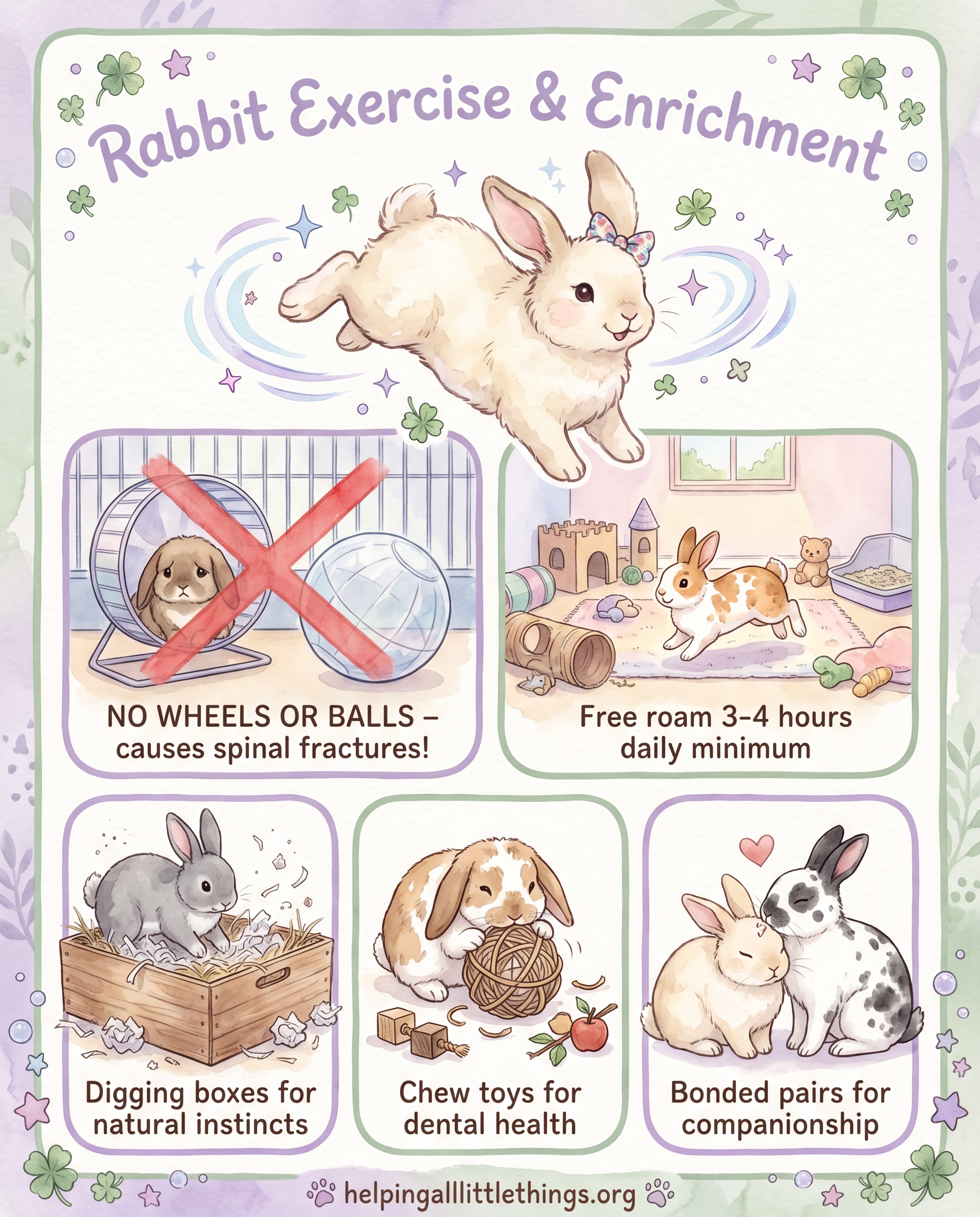
Rabbits must never use exercise wheels or exercise balls. Rabbits are built to hop with a long, powerful stride — their skeletal structure is fundamentally different from that of rodents. The curved surface of a wheel forces the spine and hindquarters into an unnatural position, and the repetitive motion can cause severe spinal injuries, including fractures and paralysis.3 Exercise balls are equally dangerous: they restrict airflow, cause overheating, prevent the rabbit from stopping, and have been known to cause broken bones when rabbits panic inside them.4
No wheel or ball is safe for a rabbit, regardless of how large it is marketed to be.
How Much Exercise Do Rabbits Need?
Rabbits need a minimum of 3–4 hours of free-roam time per day outside their enclosure, in a safe, rabbit-proofed space.2 Many rabbit welfare organizations, including the Rabbit Welfare Association and Fund (RWAF), recommend that rabbits have access to a permanent run or free-roam area at all times rather than being confined to a hutch for most of the day.5
The minimum recommended living space for a rabbit is a hutch plus attached run totalling at least 3 m × 2 m × 1 m (approximately 10 ft × 6 ft × 3 ft), though larger is always better.5 A rabbit confined to a small hutch without adequate exercise time will develop both physical and psychological problems.
Free-Roam Living
Many rabbit owners choose to give their rabbits free-roam access to one or more rooms of the house, similar to a cat or small dog. Free-roam rabbits tend to be healthier, more confident, and better bonded with their owners.6 To free-roam safely:
- Rabbit-proof the space by covering electrical cords, blocking access to toxic houseplants, and securing gaps behind furniture
- Remove or secure anything chewable that could be harmful (baseboards, carpets, books)
- Provide multiple litter boxes — rabbits are naturally clean and will use a litter box reliably once trained
- Ensure escape routes are blocked — rabbits can squeeze through surprisingly small gaps
For a full guide to rabbit-proofing, see our Rabbit Habitat article.
Safe Exercise and Enrichment Activities
Tunnels and Digging Boxes
Rabbits are natural burrowers and love to dig and explore enclosed spaces. Provide cardboard tunnels, fleece tunnels, and wooden hideaways. A digging box filled with shredded paper, hay, or child-safe sand gives rabbits a safe outlet for their digging instinct.7
Foraging Activities
Scatter hay, fresh herbs, and leafy greens around the exercise area to encourage natural foraging behavior. Stuff toilet paper tubes with hay and herbs, hide treats in paper bags, or use a snuffle mat. Foraging slows eating, provides mental stimulation, and encourages movement.7
Obstacle Courses and Agility
Rabbits can be trained to navigate simple agility courses — low jumps, tunnels, weave poles, and platforms. This provides both physical exercise and mental stimulation, and is an excellent bonding activity. Keep jumps low (no higher than the rabbit's shoulder height) to protect joints and the spine.8
Chewing and Destruction
Rabbits have continuously growing teeth and a strong drive to chew. Provide safe chewing enrichment such as willow balls, apple wood sticks, untreated wicker baskets, cardboard boxes, and dried herbs. Destructible toys (cardboard boxes, phone books, paper bags) are highly enriching and give rabbits a safe outlet for their natural behavior.7
Social Interaction
Rabbits are highly social animals and should ideally be kept in bonded pairs. A companion rabbit provides constant enrichment, grooming, and companionship that no amount of human interaction can fully replace.5 See our Introductions and Bonding guide for how to safely bond two rabbits.
Rabbits and guinea pigs should never be housed together, despite the common misconception that they make good companions. Rabbits can injure guinea pigs with their powerful hind legs, and they have different dietary, social, and behavioral needs.5
Enrichment Ideas Table
| Type | Examples |
|---|---|
| Foraging | Scatter feeding, hay tubes, snuffle mats, herb pots |
| Digging | Digging boxes with shredded paper or hay |
| Chewing | Willow balls, apple sticks, cardboard boxes, wicker |
| Exploration | Tunnels, new objects, rearranging furniture |
| Agility | Low jumps, weave poles, platforms |
| Social | Bonded rabbit companion, gentle human interaction |
| Sensory | Fresh grass, dried flowers, different textures |
Signs Your Rabbit Needs More Exercise or Enrichment
- Thumping or aggression — often a sign of frustration from confinement
- Destructive behavior directed at the enclosure (chewing bars, digging at corners)
- Obesity — a rabbit that cannot groom their cecotropes is dangerously overweight
- GI stasis — insufficient movement is a major contributing factor
- Repetitive behaviors such as circling or head-pressing
If you observe these signs, increase free-roam time, expand the living space, and add more enrichment immediately. Consult a rabbit-savvy veterinarian if behavioral changes are sudden or severe.