Rabbit Coat Color Genetics
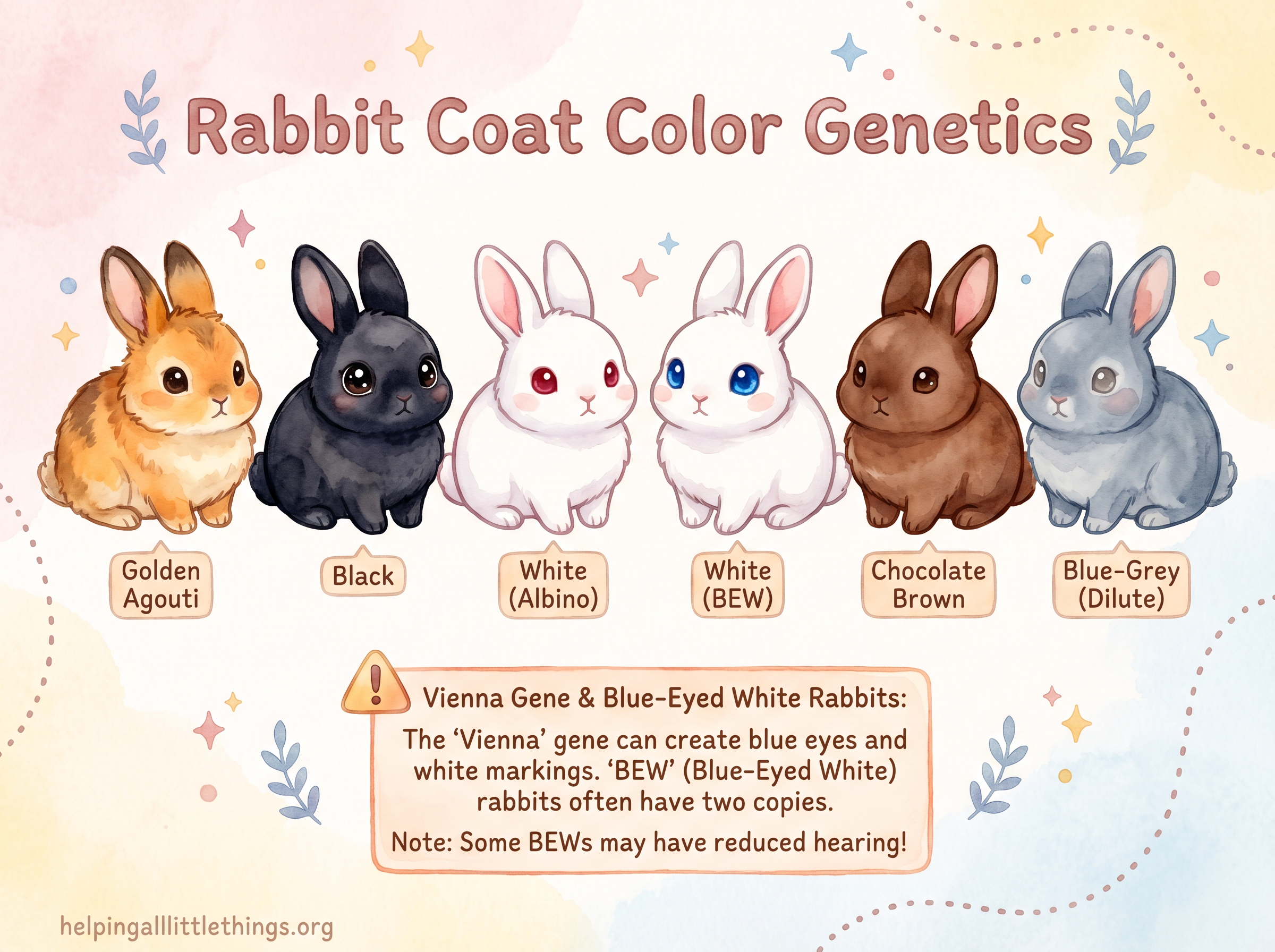
Rabbits display one of the widest ranges of coat colors and patterns of any domestic animal. From the classic agouti of a wild rabbit to the deep chocolate of a Havana, the bright orange of a Rex, and the striking broken pattern of a Dutch, this diversity is the result of a relatively small number of interacting gene loci. Understanding the basics of rabbit coat genetics helps owners, rescuers, and adopters appreciate the animals in their care — and helps breeders make responsible decisions.
This article covers the major gene series that determine rabbit coat color and pattern, with particular attention to the Blue-Eyed White (Vienna) gene, which is the rabbit equivalent of the guinea pig's roan gene in terms of its welfare implications.
The Five Major Gene Loci
Rabbit coat color is controlled by five primary gene loci, each with multiple alleles. The combination of alleles across all five loci determines the final appearance of the coat.1
| Locus | Name | Key Alleles and Effects |
|---|---|---|
| A | Agouti | A (agouti/wild pattern) > a^t^ (tan pattern) > a (self/solid) |
| B | Black/Brown | B (black eumelanin) > b (brown/chocolate eumelanin) |
| C | Color/Albino | C (full color) > c^chd^ (chinchilla) > c^chl^ (light chinchilla) > c^e^ (Himalayan) > c (albino) |
| D | Dense/Dilute | D (dense, full color) > d (dilute — blue, lilac, fawn) |
| E | Extension | E (full extension of dark pigment) > e^s^ (steel) > e (yellow/red — no dark pigment) |
The A locus determines the fundamental pattern of the coat. An agouti rabbit (A_) has banded hairs — each individual hair shows alternating bands of dark and light pigment, producing the classic "wild" ticked appearance. A tan-pattern rabbit (a^t^a^t^ or a^t^a) has solid dark coloring on the back with tan or orange markings on the belly, face, and legs. A self rabbit (aa) is a single solid color throughout.1
The B locus determines whether the dark pigment (eumelanin) is black or chocolate. A rabbit with at least one B allele will have black-based eumelanin; a rabbit homozygous for b (bb) will have chocolate-based eumelanin, producing chocolate, lilac, and chocolate-based agouti colors.1
The C locus is the most complex, controlling the intensity of both pigments. The chinchilla alleles (c^chd^ and c^chl^) reduce or eliminate the yellow/orange pigment (phaeomelanin) while leaving dark pigment largely intact, producing the silvery chinchilla pattern. The Himalayan allele (c^e^) is temperature-sensitive, restricting pigment to the cooler extremities (nose, ears, feet, tail). The albino allele (cc) eliminates all pigment, producing a pure white rabbit with pink eyes.1
The D locus controls the density of pigment deposits. A dilute rabbit (dd) has pigment granules that are clumped rather than evenly distributed, producing a washed-out version of the base color: black becomes blue, chocolate becomes lilac, orange becomes fawn.1
The E locus controls whether dark pigment is extended throughout the coat. The recessive e allele prevents dark pigment from being expressed, resulting in a yellow or red coat regardless of what the A and B loci specify. This is how orange, red, and yellow rabbits are produced.1
The Vienna Gene and Blue-Eyed Whites
The V locus (Vienna gene) operates separately from the five main color loci and deserves special attention because of its welfare implications.
A rabbit with two copies of the recessive Vienna allele (vv) is a Blue-Eyed White (BEW) — a pure white rabbit with distinctive blue eyes. This is a leucistic condition, meaning the white coloration results from a failure of pigment cells to migrate properly during development, rather than from a true lack of pigment production (as in albino).2
A rabbit with one copy of the Vienna allele (Vv) is called a Vienna Carrier. These rabbits may appear normally colored, or they may show partial expression of the Vienna gene as white patches, white toenails, or blue eyes on an otherwise colored coat. This partial expression is sometimes called a "Vienna Marked" rabbit.2
Unlike the guinea pig's roan/lethal white gene, the Vienna gene in rabbits does not produce a lethal homozygous condition. Blue-Eyed White rabbits (vv) are generally healthy, though some may have reduced hearing due to the absence of pigment cells in the inner ear — a phenomenon seen in many white animals with blue eyes across species.3
However, Vienna Carriers can complicate rescue and rehoming situations because their partial white markings may be mistaken for other patterns, and unexpected BEW offspring can appear when two carriers are bred together.
Common Color Patterns at a Glance
| Pattern | Description | Key Genes |
|---|---|---|
| Agouti | Ticked, banded hairs; wild-type appearance | A_ |
| Self | Single solid color throughout | aa |
| Tan | Dark back, tan/orange belly and markings | a^t^a^t^ or a^t^a |
| Chinchilla | Silver-grey; yellow pigment removed | A_, c^chd^ |
| Himalayan | White body, dark points (nose, ears, feet) | aa, c^e^c^e^ |
| Albino (REW) | Pure white, pink/red eyes | cc |
| Blue-Eyed White | Pure white, blue eyes | vv |
| Broken | White base with colored patches | En (English spotting gene) |
| Dutch | White front, colored rear with cheek spots | Complex multi-gene |
| Harlequin | Alternating bands of two colors | e^j^ (Japanese gene) |
Why This Matters for Rescue
Understanding coat color genetics has practical value for rescue organizations and adopters. Knowing that a white rabbit with blue eyes is a BEW — and that some BEWs may have reduced hearing — helps caregivers provide appropriate enrichment and handling. Recognizing Vienna Marked rabbits helps rescues identify potential carriers and provide accurate information to adopters.
For a guide to rabbit breeds and their typical appearances, see our Know Your Rabbit Breeds article.