Wheels vs. Flying Saucers for Mice
Mice are among the most enthusiastic wheel runners in the animal kingdom. Wild mice will voluntarily run on wheels placed in open fields — not because they are stressed or bored, but because running is genuinely rewarding to them.1 A pet mouse without an outlet for this behaviour is a mouse that is likely to pace, over-groom, or develop other signs of frustration. Providing a wheel is not optional enrichment; for most mice, it is a core welfare need.
The question is not whether to provide a wheel, but which kind. Flying saucer wheels have become popular in recent years due to their low profile and visual appeal, and mice will often use them enthusiastically. However, enthusiasm is not the same as safety. This article explains why upright wheels are the correct choice for pet mice, and why flying saucers carry welfare risks that make them unsuitable as a primary exercise option.
Why Mice Need to Run
A 2014 study published in Science confirmed what many mouse owners already suspected: wheel running is intrinsically motivated behaviour, not a product of captivity.1 Wild mice given access to wheels in natural settings used them regularly, sometimes for extended periods. The behaviour is associated with the brain's reward circuitry and produces measurable neurological benefits, including increased neurogenesis in the hippocampus.2
In a home environment, mice typically run between 3 and 8 kilometres per night. Denying this outlet does not eliminate the drive — it redirects it into less healthy behaviours. A wheel is therefore one of the most important items in any mouse enclosure.
The Problem with Flying Saucers
Flying saucers — flat, angled spinning discs — are marketed as a natural-looking alternative to upright wheels. Mice will often use them readily, which can make them seem like a good option. The problem lies in the geometry.
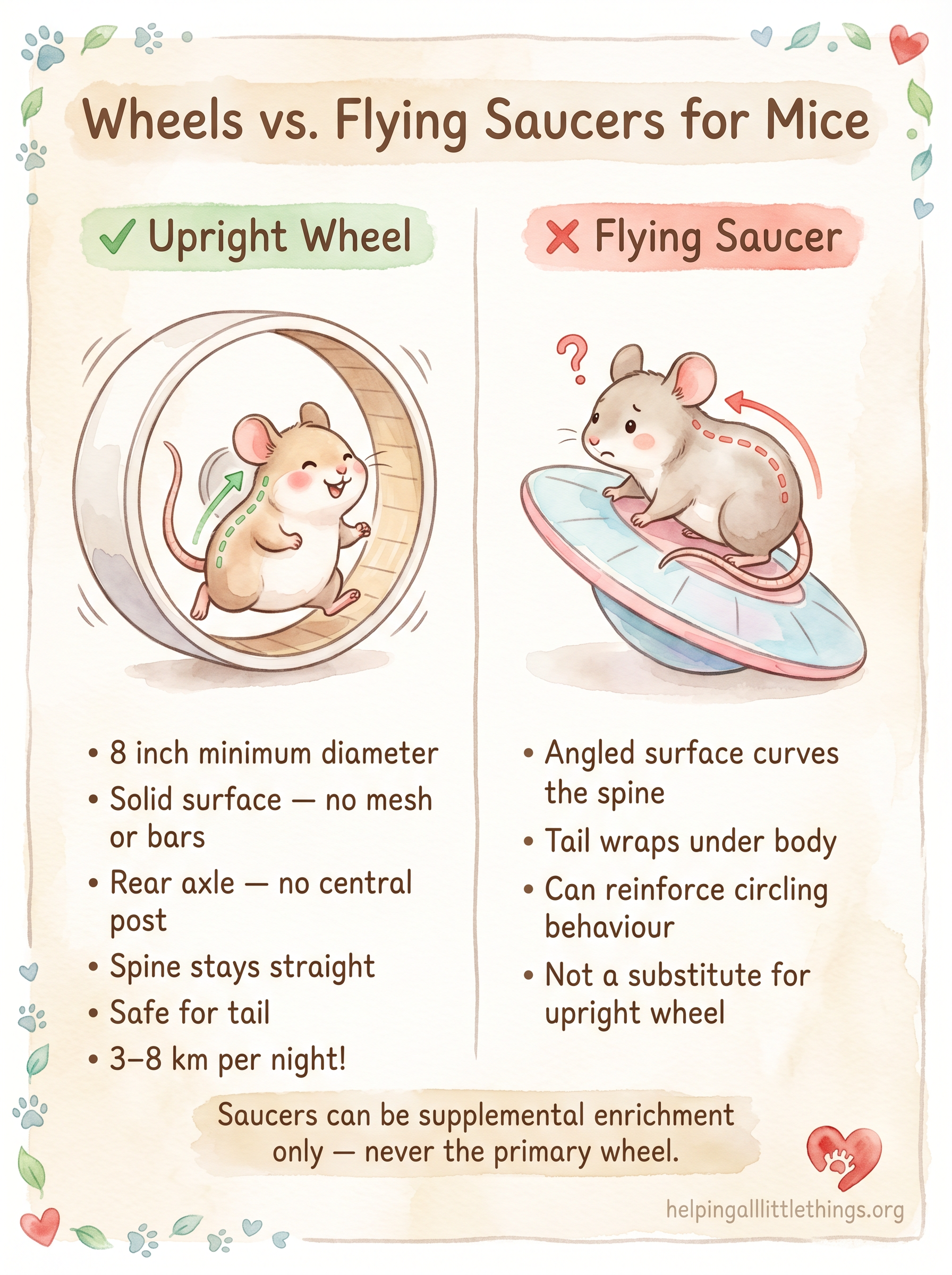
Spinal alignment. When a mouse runs on a correctly sized upright wheel, its spine remains straight, its head and shoulders align naturally, and its legs move in a normal gait.3 On a flying saucer, the angled surface forces the mouse to run in a lateral curve. The spine bends sideways, the hips are loaded unevenly, and the tail is often forced to curl underneath or to one side. Over time, this can cause musculoskeletal strain and discomfort, particularly in the lower back and hips.
Tail injury. The angled running surface of a saucer causes the tail to wrap around or tuck under the body in an unnatural position. This creates a real risk of tail injury, particularly in mice with longer tails.4
Stereotypic circling. This is the most significant concern specific to mice. A 2017 case study published in the Journal of the American Association for Laboratory Animal Science found that wheel running can induce permanent stereotypic circling behaviour in genetically predisposed mice.5 The circular running path of a saucer — which encourages the mouse to run in tight, repeated circles — is particularly likely to reinforce this pattern. Stereotypic circling is associated with altered dopamine and serotonin levels and is considered a welfare concern. While not every mouse will develop this behaviour, the risk is real and the consequences are irreversible in affected individuals.
Saucers do not replace upright wheels. A saucer can be offered as supplemental enrichment for mice that enjoy them, but it should never be the only exercise option. The primary wheel must always be an upright, solid-surface wheel of appropriate size.
Choosing the Right Upright Wheel
Size
The minimum recommended wheel diameter for mice is 8 inches (20 cm).3 6 This ensures the spine remains straight while running. Larger mice, or mice that tend to run at high speed, may benefit from a 10-inch wheel. When in doubt, go larger — a wheel that is slightly too big is far less harmful than one that is too small.
| Mouse size | Recommended wheel diameter |
|---|---|
| Standard / small mice | 8 inches (20 cm) minimum |
| Larger mice or fast runners | 10 inches (25 cm) |
Surface
The running surface must be solid — no mesh, no bars, no gaps. Wire or slatted surfaces carry a serious risk of foot and leg injuries, including degloving (where skin is stripped from a limb when it catches between the bars). Solid plastic or metal surfaces are both acceptable.
Axle placement
Choose a wheel with a rear or side axle rather than a central axle. A central axle runs through the middle of the running surface and can interfere with the mouse's body, particularly the tail. Rear-axle designs eliminate this risk entirely.
Noise
Mice are most active at night. A silent or near-silent wheel is considerate to both the mice (who will not be startled by their own wheel) and to anyone sleeping nearby. Look for wheels with sealed bearings.
Recommended options
The following wheels are widely recommended by the mouse care community and meet all of the above criteria:
- Silent Runner (8" or 9") — solid surface, rear axle, very quiet, easy to clean
- Niteangel wheels (20 cm or 25 cm) — solid surface, rear axle, silent, available in multiple sizes
- Wodent Wheel Junior (8") — solid surface, enclosed design that some mice prefer
What to Avoid
| Item | Why to avoid |
|---|---|
| Flying saucers as primary wheel | Lateral spinal curvature, tail injury risk, reinforces stereotypic circling |
| Wire or mesh wheels | Foot and leg injury, degloving risk |
| Wheels under 8 inches | Spine arches during running, causes discomfort and long-term strain |
| Wheels with central axles | Tail injury risk |
| Noisy wheels | Disrupts sleep and startles mice during night activity |
A Note on Saucers as Supplemental Enrichment
Some mice genuinely enjoy saucers and will use them alongside an upright wheel. If your mouse has access to a correctly sized upright wheel and shows no signs of stereotypic behaviour, a saucer can be offered as an additional enrichment item. It should not replace the upright wheel, and you should monitor your mouse for any signs of circling or repetitive movement patterns. If these appear, remove the saucer.
Summary
Mice are natural runners and benefit enormously from having a wheel. The wheel must be upright, solid-surfaced, at least 8 inches in diameter, and free of central axles. Flying saucers are not a safe substitute — they cause spinal misalignment, tail injury risk, and can reinforce stereotypic circling behaviour that may become permanent. Offer a saucer only as supplemental enrichment alongside a proper upright wheel, and only if your mouse shows no signs of stereotypic behaviour.