Know Your Mouse Breeds
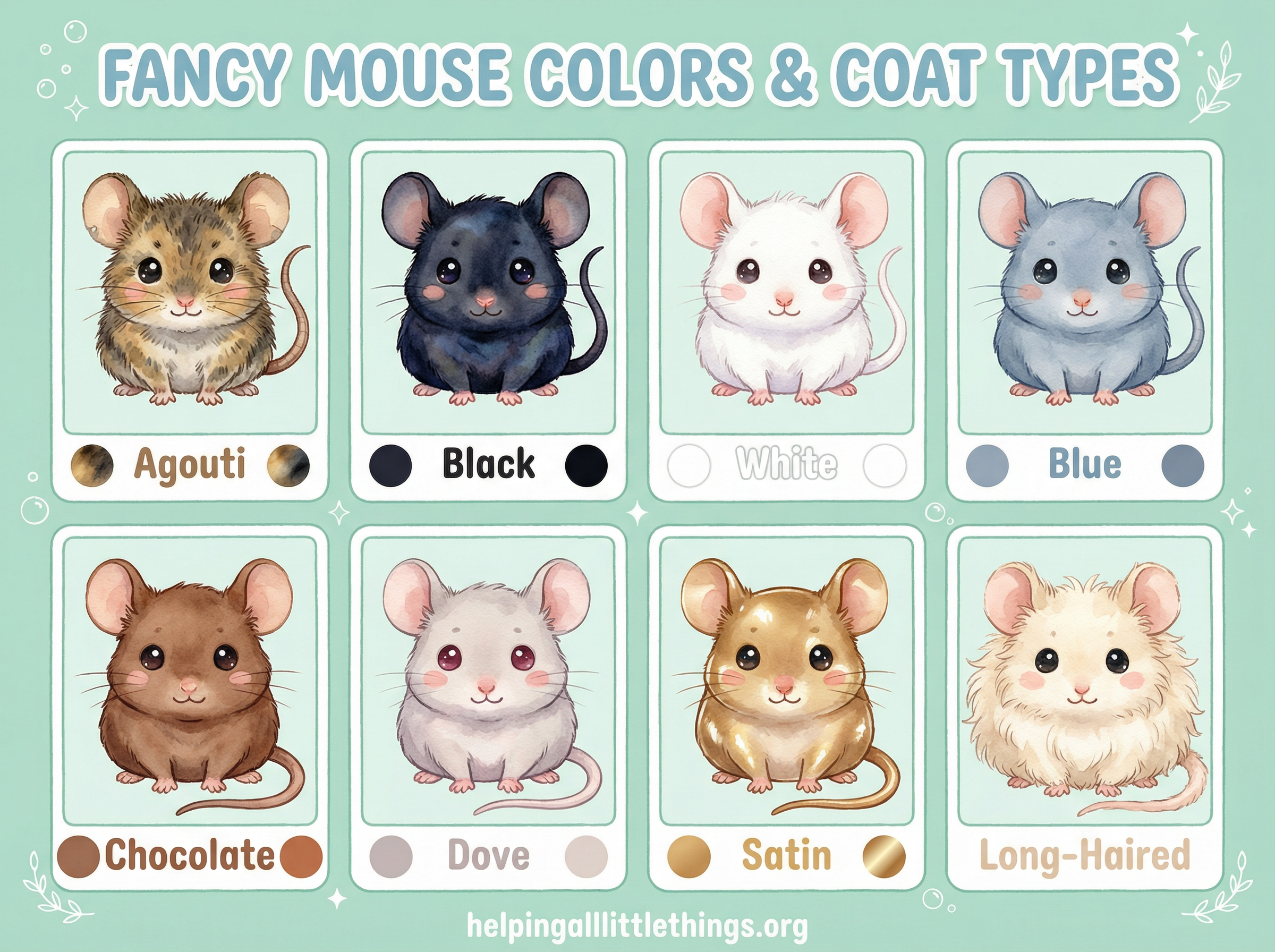

Unlike dogs or cats, fancy mice do not have distinct "breeds." All pet mice are the same species — the domesticated house mouse (Mus musculus). Instead, they are classified by variety, which refers to their coat type, color, and markings. The American Fancy Rat and Mouse Association (AFRMA) is the primary organization that establishes and maintains the official standards for fancy mouse varieties in the United States. [1]
Coat Type Varieties
The AFRMA recognizes eight coat type varieties.
| Variety | Description |
|---|---|
| Standard | The most common type. Short, sleek, and smooth coat. |
| Satin | Similar to Standard but with a distinctive, high-gloss, almost wet-looking sheen. |
| Long Hair | A longer, flowing coat. |
| Long Hair Satin | Long hair with the glossy satin sheen. |
| Frizzie | A curly, wavy coat caused by a recessive gene. |
| Frizzie Satin | Curly coat with the satin sheen. |
| Hairless | A mouse with little to no fur. They require extra care as they are sensitive to temperature and skin injuries. |
| Texel | A newer variety with a dense, curly coat. |
[2]
Color Groups
Fancy mice come in a vast array of colors, which are grouped into categories.
- Self Colors: A single, solid color all over, including the belly. Examples include Black, Chocolate, Blue, Dove, Lilac, Cream, Fawn, Red, and White (albino).
- Tan: A self-colored top coat with a tan or orange belly.
- Agouti: The wild-type pattern where each hair has bands of color, giving a ticked, natural appearance.
- Marked: Mice with specific patterns of white combined with a color. Examples include Broken (irregular patches), Dutch (white blaze and saddle), Rump White, and Himalayan (white body with colored points). [3]
Ear Types
Mice also come in two ear types:
- Standard (Upright) Ears: The typical, upright ear position.
- Dumbo Ears: A recessive mutation that causes the ears to sit lower on the sides of the head, giving a rounder, "dumbo" appearance. Dumbo mice are extremely popular in the pet trade.
References
[1] AFRMA. (n.d.). AFRMA Fancy Mice - Varieties. https://www.afrma.org/micevar.htm
[2] AFRMA. (n.d.). AFRMA Fancy Mouse Standards. https://afrma.org/fancymice.htm
[3] Mice and Rats. (n.d.). Varieties of Fancy Mice. https://www.miceandrats.com/standmic.htm