
Hedgehog Wheels: Why They're Essential and How to Choose One
A running wheel is one of the most important items you can provide for a pet hedgehog — not a nice-to-have, but a genuine welfare necessity. Understanding why, and how to choose the right one, is fundamental to responsible hedgehog care.
Why Hedgehogs Need a Wheel
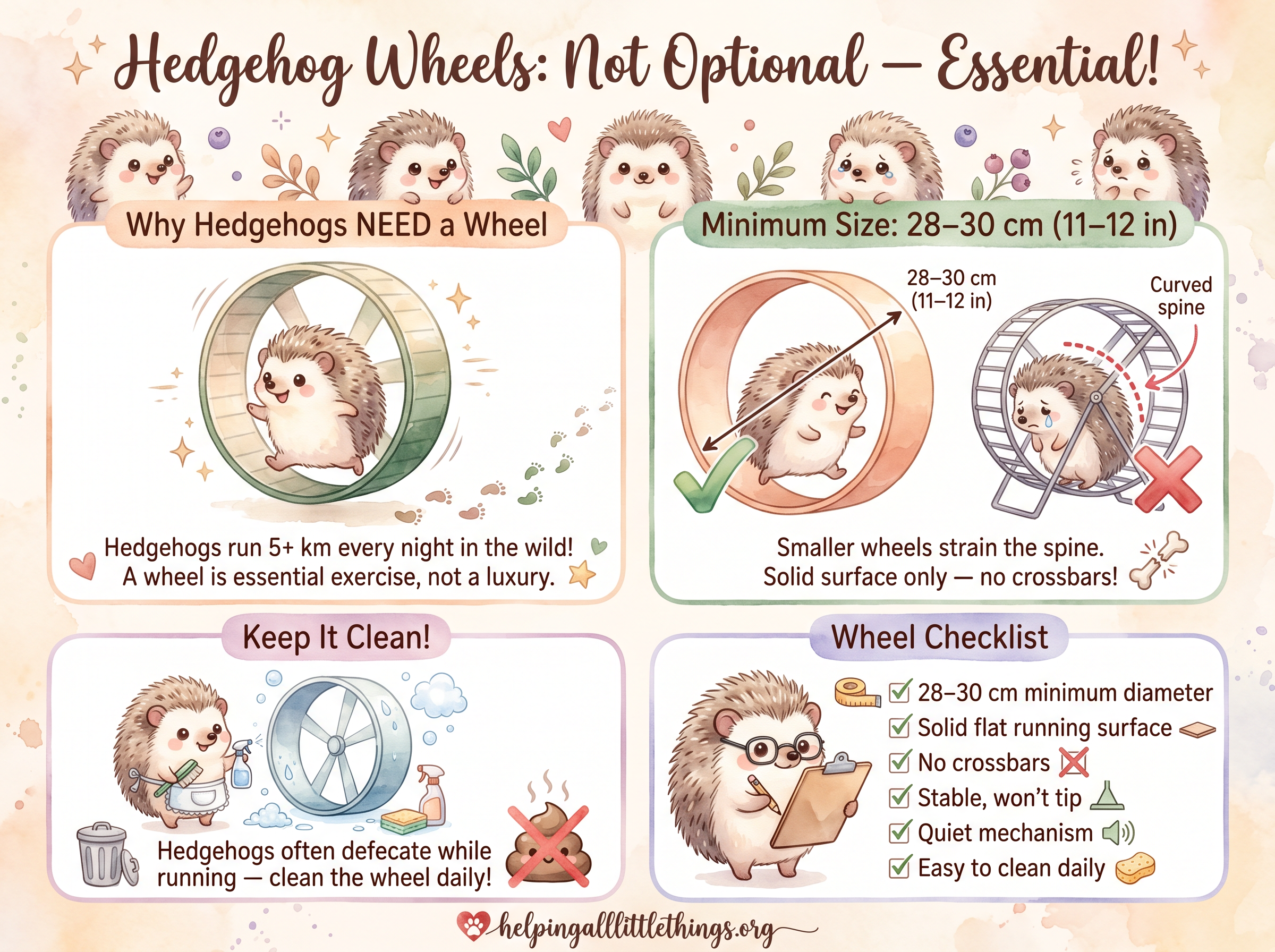
African pygmy hedgehogs, the species most commonly kept as pets, are highly active animals. In the wild, hedgehogs travel remarkable distances each night in search of food, covering 5 km or more as a routine part of their nightly activity.1 This drive to move is deeply ingrained in their biology.
In captivity, a hedgehog's enclosure — however large — cannot replicate the open terrain of their natural habitat. A running wheel provides the closest available substitute for this nightly locomotion. Without one, hedgehogs are at significant risk of obesity, muscle atrophy, and the behavioural frustration that comes from being unable to express a core natural behaviour.1
The Hedgehog Program, an international hedgehog education and research organisation, states clearly:
"For hedgehogs in particular, a running wheel is one of the most important pieces of enrichment. Small mammals are prone to obesity when their activity is restricted. Lack of movement weakens muscles, stresses joints, and reduces cardiovascular health."1
Unlike some other small animals where a wheel is optional enrichment, for hedgehogs it is a baseline care requirement.
Minimum Wheel Size: 28–30 cm (11–12 inches)
The diameter of the wheel matters enormously. A wheel that is too small forces the hedgehog to arch their back while running, placing sustained abnormal stress on the spine. Over time, this can cause permanent spinal curvature and chronic pain.
The Hedgehog Program recommends a minimum diameter of 28–30 cm (approximately 11–12 inches) for hedgehogs, noting that smaller wheels can strain the spine.1 MN Pocket Pet Rescue's wheel guide similarly recommends 9–11 inches as the appropriate range for hedgehogs, with a solid base.2
The running surface must be completely flat and solid — no wire mesh, no bar rungs, no crossbars. Hedgehog feet and legs can become caught in gaps, causing serious injury, and the quills can also snag on crossbars.
Many hedgehog starter kits and commercially sold cages include a wheel that is too small for an adult hedgehog. If your hedgehog's back arches while running, or their head tilts upward, the wheel needs to be replaced with a larger one.
The Cleaning Requirement
One aspect of hedgehog wheel ownership that surprises many new owners is how frequently the wheel needs to be cleaned. Hedgehogs commonly defecate while running — a behaviour that appears to be instinctive and is not something that can be trained away.1 A wheel that is not cleaned daily will quickly become a source of bacterial contamination and foot irritation.
Choose a wheel that can be fully disassembled and washed. A wheel with a smooth, non-porous running surface is far easier to keep clean than one with textured surfaces or hard-to-reach corners.
What to Look for in a Good Hedgehog Wheel
A safe, appropriate hedgehog wheel should have all of the following:
Diameter of 28–30 cm (11–12 inches) minimum. This is the lower bound; larger is always acceptable. Never go below 28 cm for an adult hedgehog.
Completely solid, flat running surface. No mesh, no bars, no rungs. The surface should be smooth enough to clean easily but not so slippery that the hedgehog cannot grip it.
No crossbars. Crossbars can catch quills and cause injury. The interior of the wheel should be completely open.
Stable, non-tipping design. Hedgehogs run vigorously and for long periods. A wheel that wobbles or tips is a safety hazard.
Quiet mechanism. Hedgehogs are most active at night. A squeaky or rattling wheel will disrupt sleep for both the hedgehog and their owner. Look for wheels with a smooth ball-bearing mechanism.
Easy to disassemble and clean. Given the daily cleaning requirement, this is not optional.
A Note on Flying Saucers
Flying saucers are sometimes marketed for hedgehogs, but they are generally not recommended as a primary exercise option. The angled running surface causes lateral spinal curvature, and the open design means hedgehogs may step off the edge during use. A correctly sized upright wheel is the safer and more appropriate choice.2
Balancing Wheel Use with Free Roaming
A wheel provides consistent nightly exercise, but free roaming adds variety and mental stimulation that a wheel alone cannot provide. The Hedgehog Program recommends offering both: a wheel available every night within the enclosure, plus regular supervised free-roaming sessions in a safe, hedgehog-proofed space.1 Free roaming should be offered in the evening or at night, aligned with the hedgehog's natural activity cycle.