Sexing Your Pet Hedgehog
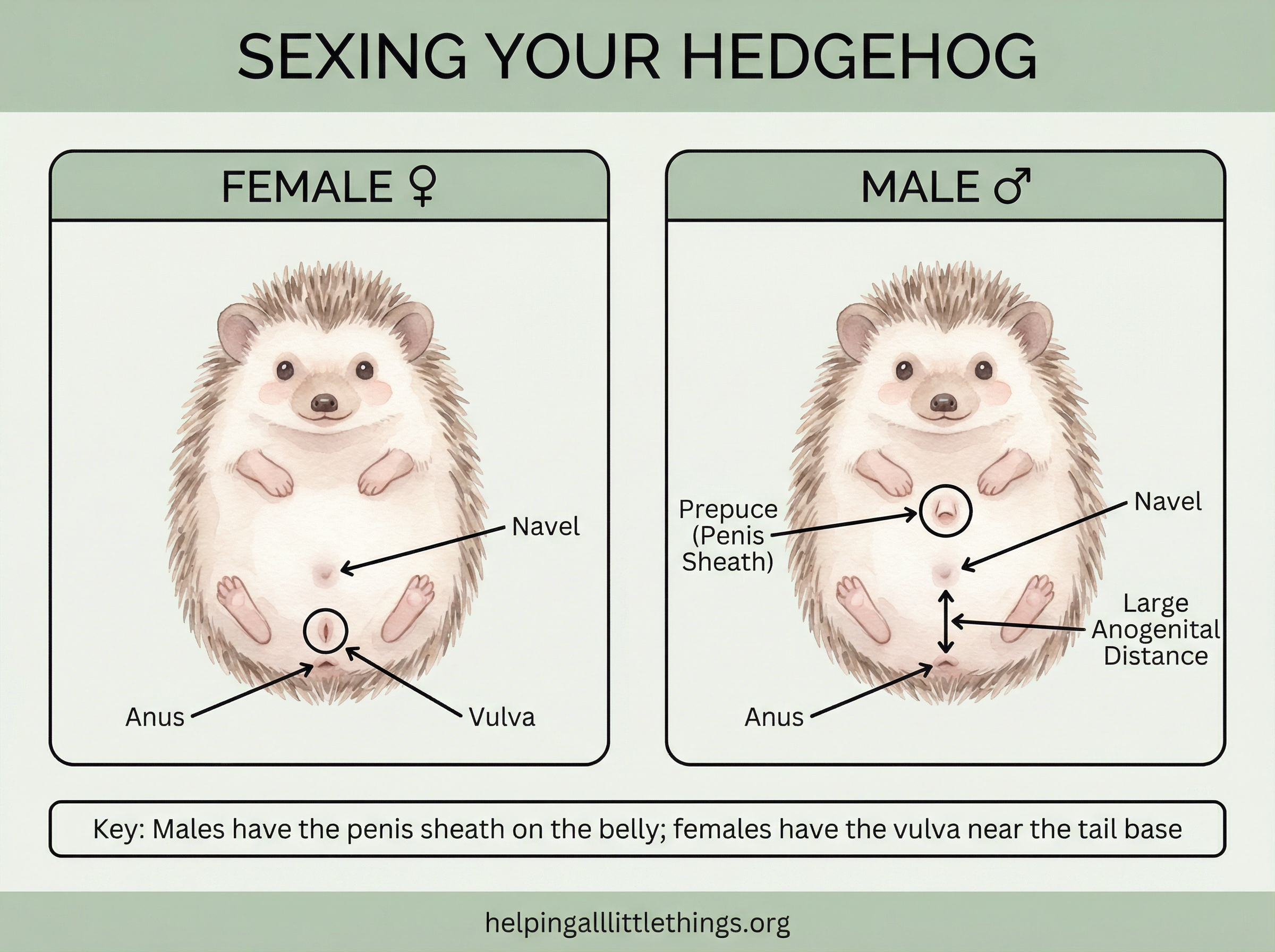

Correctly identifying the sex of your hedgehog is a simple process once you know the key difference to look for. Unlike many other small mammals, the distinction is not subtle.
The "Belly Button" Rule
The easiest and most reliable way to determine the sex of a hedgehog is to look for what appears to be a belly button.
-
Males (Boars): A male hedgehog has a penile sheath located in the middle of his abdomen. To a casual observer, this looks exactly like a belly button. If you see this feature, you have a male. [1]
-
Females (Sows): A female hedgehog has a smooth, unbroken belly. Her vulva is located directly adjacent to her anus, with very little space between the two openings. [2]
| Feature | Male (Boar) | Female (Sow) |
|---|---|---|
| "Belly Button" | Present (this is the penile sheath) | Absent |
| Genital Location | Mid-abdomen | Directly next to the anus |
How to Check
To get a look at your hedgehog's underside, you can either gently encourage them to uncurl while holding them on their back, or you can place them on a clear surface, like a glass coffee table, and look from underneath. [3]
There are no significant behavioral differences between male and female hedgehogs that can be used to reliably determine their sex. The presence or absence of the "belly button" is the only foolproof method. [4]
References
[1] Hedgehog Headquarters. (n.d.). Gender Differences. https://hedgehogheadquarters.com/secure/gender.htm
[2] Hedgehog Bottom Rescue. (n.d.). Is it a boy or a girl. http://www.hedgehog-rescue.org.uk/sexing.php
[3] Little Silver Hedgehog. (2016). How to sex a hedgehog. https://littlesilverhedgehog.com/2016/04/03/hedgehog-sex-2/
[4] Reddit Community. (n.d.). Gender? Species?. https://www.reddit.com/r/Hedgehog/comments/1i8k22p/gender_species/