Know Your Hedgehog Colors and Varieties
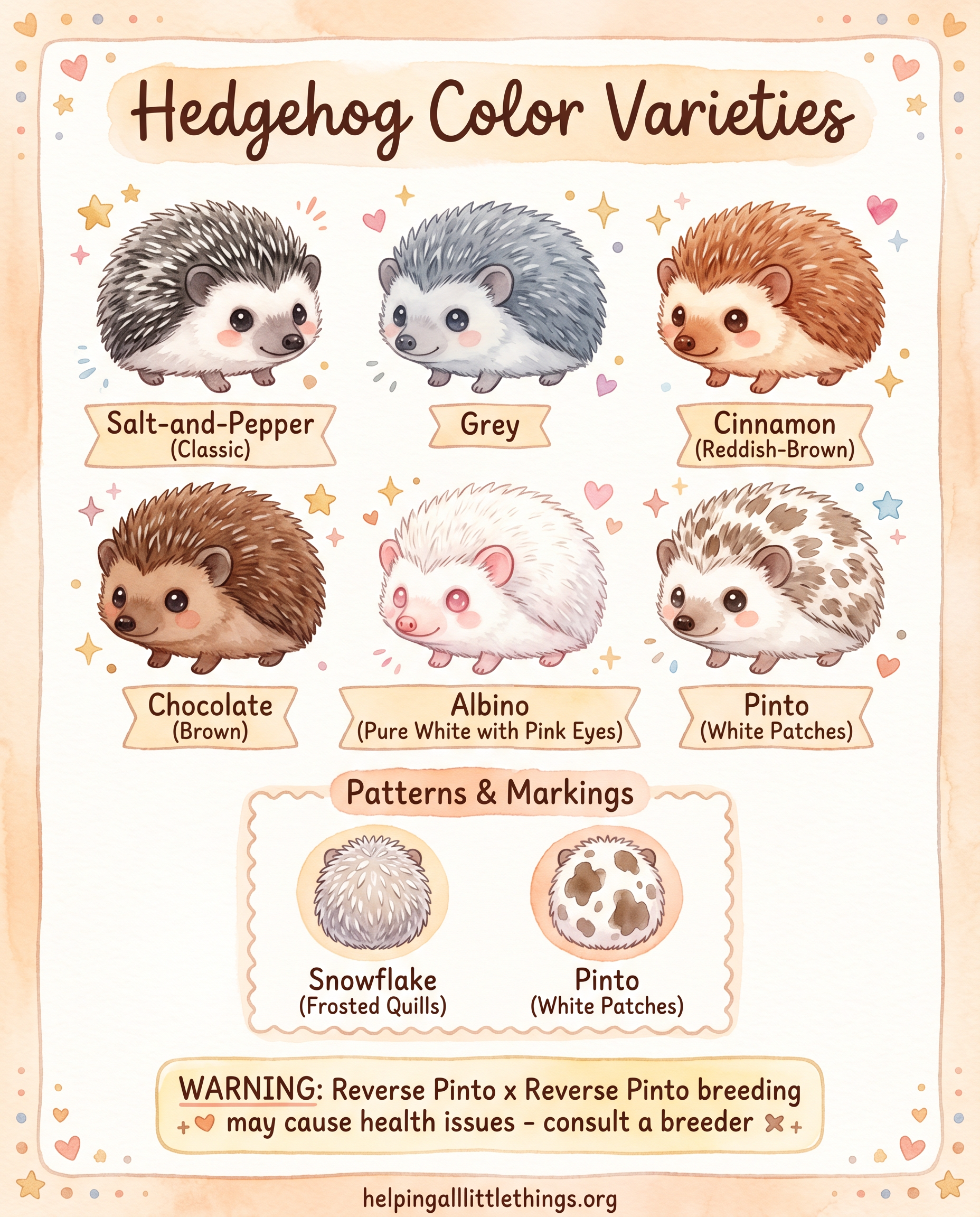
The African Pygmy Hedgehog (Atelerix albiventris), the species kept as a pet in most of the world, comes in a remarkable range of colors and patterns. In total, there are over 90 recognized color combinations, though most pet hedgehogs are sold as the common "salt and pepper" variety.1 Understanding hedgehog color genetics helps owners identify their hedgehog's variety, make informed breeding decisions, and appreciate the diversity within this species.
All color information in this article refers to the African Pygmy Hedgehog (Atelerix albiventris), which is a hybrid of the white-bellied and Algerian hedgehog. This is the species kept as a pet in North America, Europe, and most of the world. European hedgehogs (Erinaceus europaeus) are wild animals and are not kept as pets.
The Four Base Color Groups
Hedgehog colors are organized into four primary groups based on the base color of their quill banding and skin pigmentation.2
1. White-Bellied (Standard)
White-bellied hedgehogs are the most common variety. As the name suggests, they have white hair on their underbelly. This group includes the widest range of color variations and encompasses the familiar "salt and pepper" hedgehog.
| Color | Description |
|---|---|
| Salt and Pepper | Classic variety; white quills with black bands, black nose and shoulders, white belly |
| Grey | Similar to salt and pepper but with a softer mask and grey (not black) shoulders |
| Dark Grey | Closest match to salt and pepper; dark grey shoulder coloring |
| Cinnamon | Light reddish nose, white belly, quills with cinnamon-colored bands |
| Chocolate | White quills with brown bands, darker nose, white belly |
| Brown | Consistent light-rich brown throughout; white quills with light brown bands |
| Dark Cinnicot | White belly, pink shoulders, dark reddish-brown nose, no mask |
| Cinnicot | Lighter version of dark cinnicot; very pale coloring |
| Apricot | Very light coloring with orange and beige tones; pink skin |
2. Algerian
Algerian hedgehogs have a different base pigmentation pattern, with darker, more uniform coloring. They are named after the Algerian hedgehog species that contributed to the African Pygmy Hedgehog hybrid.2
| Color | Description |
|---|---|
| Algerian Grey | Dark, uniform grey coloring throughout; no mask |
| Algerian Dark Grey | Very dark grey, almost black in some individuals |
| Algerian Brown | Rich, uniform brown coloring |
| Algerian Chocolate | Dark chocolate-brown uniform coloring |
| Algerian Black | The darkest hedgehog color; very rare |
3. Snowflake
Snowflake hedgehogs have a distinctive pattern where white quills are interspersed throughout the colored quills, giving a "frosted" or "snowflake" appearance. The white quills are randomly distributed rather than forming a pinto patch.1
Snowflake is a pattern modifier that can appear on top of any base color — for example, a "Grey Snowflake" or "Chocolate Snowflake."
4. Albino
Albino hedgehogs lack all pigmentation. They have pure white quills, white skin, and pink or red eyes due to the visibility of blood vessels through unpigmented irises.2 Albinos are prone to sun sensitivity and should be kept out of direct bright light.
Pattern Variations
In addition to base colors, hedgehogs can display several pattern variations that affect quill distribution.
Pinto
Pinto hedgehogs have patches of white (unpigmented) quills interspersed with colored quills. The white patches appear in distinct groups rather than being randomly distributed. Pinto is a pattern, not a color — a "Chocolate Pinto" has chocolate-colored quills with white patches.1
High Pinto
High pinto hedgehogs have a large proportion of white quills — more than 50% of their quills are white. They may appear almost entirely white with small patches of color.
Reverse Pinto
Reverse pinto hedgehogs have mostly white quills (like a high pinto) but with no pigment on the face, ears, or feet. Many reverse pintos also have pink or blue eyes. They can be visually striking but may have associated health considerations including reduced hearing or vision.3
Eye Colors
Hedgehog eye color is linked to their base color genetics:
| Eye Color | Associated Colors |
|---|---|
| Black | Most white-bellied and Algerian varieties |
| Ruby/Red | Albino, some reverse pinto |
| Pink | Albino, some pale varieties |
| Blue (rare) | Some reverse pinto and high pinto individuals |
Coat Types
Standard
The vast majority of pet hedgehogs have standard quills — stiff, hollow spines covering the back and sides, with soft fur on the belly, face, and legs.
Wobbly Hedgehog Syndrome (WHS) Note
Coat color is not directly linked to Wobbly Hedgehog Syndrome (WHS), a progressive neurological disease seen in African Pygmy Hedgehogs. However, WHS has a genetic component and responsible breeders screen their breeding animals. See our Wobbly Hedgehog Syndrome article for more information.
Identifying Your Hedgehog's Color
Hedgehog color can be tricky to identify because:
- Quilling (the process of replacing juvenile quills with adult quills) can change a hedgehog's apparent color
- Lighting conditions significantly affect how colors appear
- Mask patterns (dark facial markings) are separate from body color and can make identification harder
- Age — some colors lighten or darken with age
The most reliable way to identify a hedgehog's color is to examine the quill banding (the colored bands on individual quills) and the skin color under the quills in good natural light.
A Note on Breeding
If you are considering breeding hedgehogs, color genetics is only one of many factors to consider. Responsible hedgehog breeding requires health screening for WHS, knowledge of the genetic implications of certain color pairings (particularly reverse pinto × reverse pinto crosses), and a commitment to the welfare of both parents and offspring. Consult with an experienced hedgehog breeder or exotic veterinarian before breeding.