Understanding Hamster Behavior: A Guide for Owners
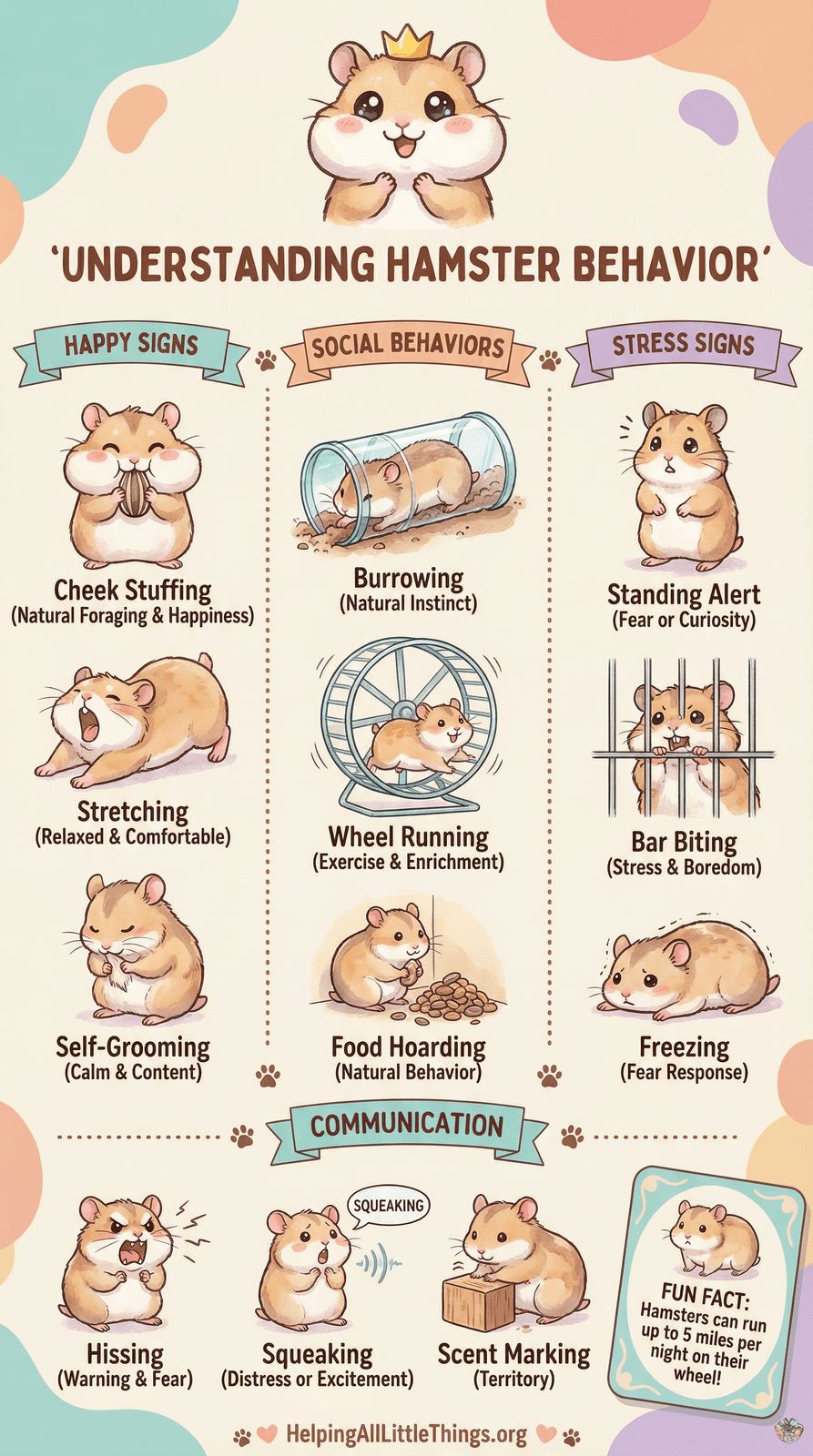

Hamsters are solitary, nocturnal animals with a fascinating range of behaviors. Because they are most active at night and spend much of the day sleeping, many owners miss important behavioral cues. Learning to read your hamster's body language is essential for building trust and keeping them healthy.
Common Hamster Body Language
| Behavior | Common Meaning(s) | Context & Interpretation |
|---|---|---|
| Standing on Hind Legs | Alert, Curious | A hamster standing upright on their hind legs is alert and curious, using their height advantage to survey their environment. This is a positive, engaged behavior. [1] |
| Stretching & Yawning | Relaxed, Comfortable | A hamster that stretches out and yawns upon waking is comfortable and feels safe in their environment. [1] |
| Stuffing Cheek Pouches | Natural Foraging Behavior | Hamsters instinctively stuff their cheek pouches with food to carry back to their burrow. This is completely normal and healthy. |
| Burrowing | Natural Instinct, Comfort | Hamsters are burrowing animals and need deep bedding to express this behavior. A hamster that burrows enthusiastically is happy and engaged. |
| Flattened to Ground | Fear, Submission | A hamster pressed flat against the ground is frightened and trying to make themselves small. Approach slowly and give them space. [1] |
| Rolling onto Back | Extreme Fear, Defensive | A hamster that rolls onto their back and shows their teeth is in a state of extreme fear. This is a defensive posture — do not attempt to pick them up. [1] |
| Grooming | Calm, Content | Regular self-grooming is a sign of a calm, comfortable hamster. A hamster that stops grooming may be ill or severely stressed. |
| Bar Biting | Boredom, Stress, Inadequate Space | Repetitive bar biting is a stereotypy — a sign of chronic stress, usually caused by an enclosure that is too small or insufficiently enriched. |
Common Hamster Vocalizations
Hamsters are relatively quiet but do vocalize, particularly when stressed or frightened.
| Sound | Common Meaning(s) | Context & Interpretation |
|---|---|---|
| Squeaking | Fear, Pain, Excitement | A short squeak can indicate excitement or mild surprise. Repeated squeaking signals fear or pain. [1] |
| Hissing | Warning, Aggression | A hiss is a clear warning. The hamster is telling you to back off. Respect this signal. [1] |
| Teeth Chattering | Aggression, Extreme Fear | Teeth chattering is an escalation beyond hissing. A hamster chattering their teeth is about to bite. |
| Screaming | Extreme Pain or Terror | A hamster scream is rare and very alarming. It requires immediate investigation. |
Solitary Nature and Housing
All pet hamster species are best housed alone. Syrian and Chinese hamsters are strictly solitary and will fight to the death if housed together after weaning. Dwarf species (Roborovski, Campbell's, Winter White) are sometimes described as more social, but experienced keepers consistently report fatal fighting — even in pairs that have lived together for months. HALT's recommendation is to house all hamsters individually, regardless of species.
It is also worth noting that most Campbell's and Winter White hamsters sold in the US are hybrids of the two species, which makes predicting their social tolerance even more difficult. Chinese hamsters, despite sometimes being grouped with the dwarfs, have a wild social structure that is closer to the Syrian's — they too should be treated as fully solitary.
A hamster kept alone is not lonely — they are living as nature intended. Providing deep bedding, tunnels, a large wheel, and foraging opportunities is far more important for their welfare than companionship. If two hamsters appear to be tolerating each other, this does not mean the arrangement is safe — one animal may be suppressing its natural behaviour out of stress, and conflict can escalate without warning.
Signs of a Happy and Healthy Hamster
A happy hamster is active during their natural waking hours (evening and night), curious about their environment, and eager to forage and explore. They will stuff their cheeks, burrow, run on their wheel, and groom regularly. Their coat should be smooth, their eyes bright and clear, and their weight stable.
Signs of Stress, Fear, or Pain
- Wet tail (diarrhea around the tail area) — a veterinary emergency
- Hunched posture, reluctance to move
- Puffed fur
- Excessive hiding during waking hours
- Repetitive behaviors (bar biting, pacing) — signs of chronic stress
- Loss of appetite or weight loss
Wet tail in particular can be fatal within 24-48 hours. Contact a vet immediately if you notice diarrhea or a wet, soiled tail area.
References
[1] Omlet. (2019). How to Understand Your Hamster's Body Language. Retrieved from https://blog.omlet.us/2019/05/17/how-to-understand-your-hamsters-body-language/