
Hamster Wheels and Saucers: Size, Safety, and What the Evidence Says
Hamsters are prolific runners. In the wild, they cover an average of 8.3 km per night foraging and exploring across open terrain.1 In captivity, a running wheel is not a luxury accessory — it is one of the most important welfare provisions you can make for your hamster. Getting the size and style right, however, matters enormously. An undersized or poorly designed wheel can cause lasting spinal damage, foot injuries, and chronic pain.
Why Wheel Size Is a Welfare Issue
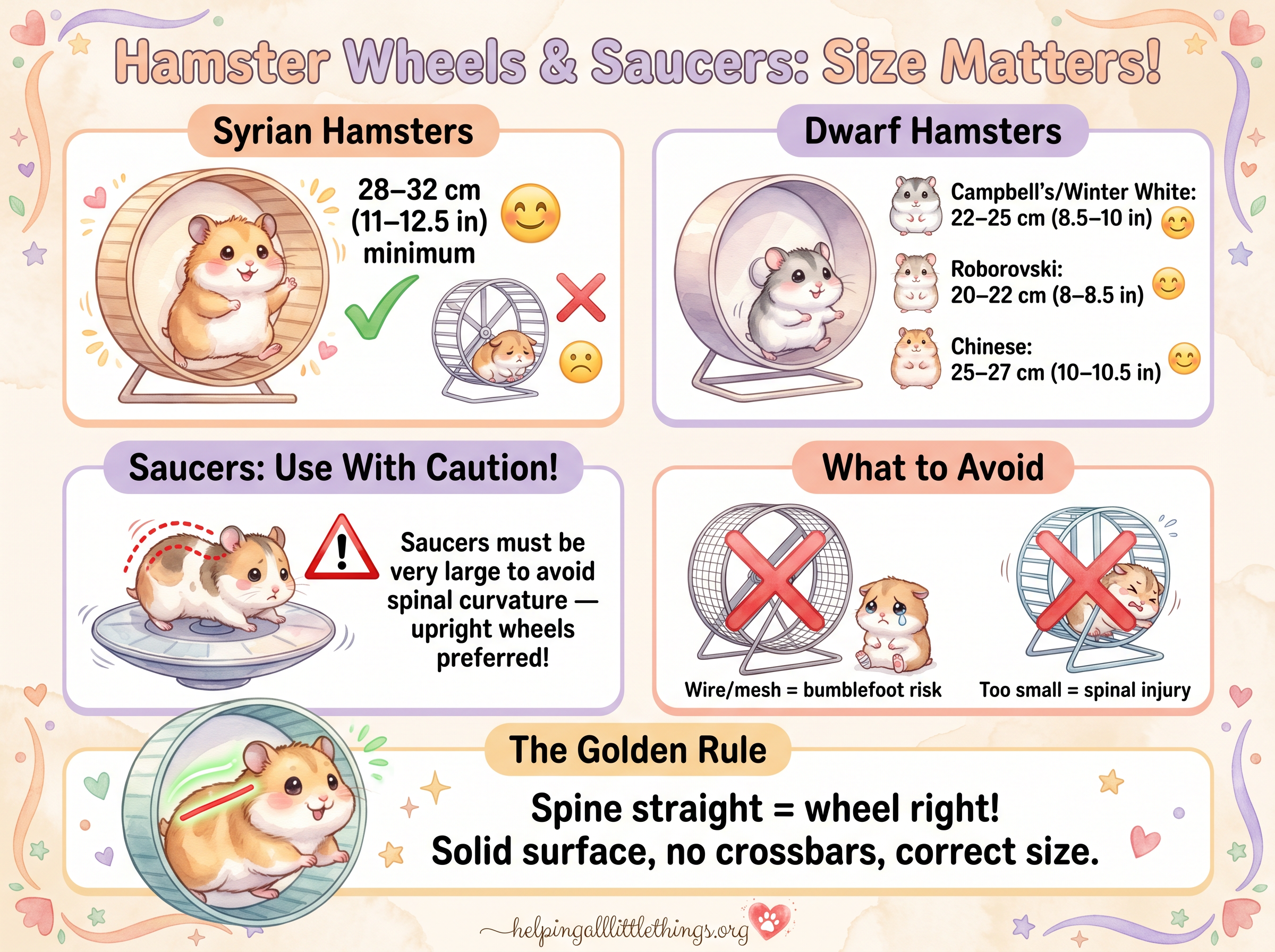
When a hamster runs on a wheel that is too small, their spine curves upward in an unnatural arch. Over time — and hamsters run for hours every night — this repeated abnormal posture can cause permanent spinal curvature, particularly in young, still-developing animals.1
The Tierärztliche Vereinigung für Tierschutz (TVT), the German Veterinary Association for Animal Protection, has published explicit minimum size recommendations based on this evidence:
"TVT recommends wheels should be at least 20 cm (8″) for Dwarf Hamsters and at least 30 cm (12″) for Syrian Hamsters, since smaller diameters lead to permanent spinal curvatures, especially in young animals."1
The Blue Cross, one of the UK's leading animal welfare charities with over 125 years of experience, reinforces this concern:
"Often, hamster wheels sold along with a hamster cage are too small. Despite this fact, hamsters will continue to use the small wheels and over time it can cause damage to the spine. Therefore, these wheels should be replaced with a suitable alternative."2
The key principle is straightforward: a hamster should be able to run with their spine completely flat and their head level with their shoulders. Any wheel that forces the head upward or the back to arch is too small.
Minimum Wheel Sizes by Species
Because hamster species vary considerably in body size, there is no single "correct" wheel size. The following table summarises the evidence-based recommendations from the TVT, Blue Cross, and MN Pocket Pet Rescue:
| Species | Minimum Diameter | Recommended Range |
|---|---|---|
| Syrian hamster | 28 cm (11 in) | 27–32 cm (10.5–12.5 in)2 |
| Campbell's dwarf | 22 cm (8.5 in) | 22–25 cm (8.5–10 in)2 |
| Winter White dwarf | 22 cm (8.5 in) | 22–25 cm (8.5–10 in)2 |
| Roborovski dwarf | 20 cm (8 in) | 20–22 cm (8–8.5 in)2 |
| Chinese hamster | 25 cm (10 in) | 25–27 cm (10–10.5 in)2 |
Many commercially sold hamster cages are too small to fit an appropriately sized wheel. A cage that cannot accommodate at least a 20 cm wheel cannot provide a suitable environment for any hamster species. If your cage does not fit the correct wheel size, the cage itself needs to be upgraded.
What About Flying Saucers?
Flying saucers — angled, disc-shaped running platforms — are popular in many pet shops and online communities. However, the consensus among hamster welfare advocates is that saucers are not a safe primary exercise option for most hamsters.
The problem is the angle. Because the running surface is tilted, a hamster on a saucer runs with their body twisted to one side, creating lateral spinal curvature — a sideways bend rather than the upward arch caused by a small upright wheel, but equally harmful over time.3 The only way a saucer could be used safely would be if it were large enough that the curvature is minimal, but no commonly available saucer achieves this for the smaller hamster species.
For Syrian or Chinese hamsters, some owners use very large saucers (12 inches or more) as a secondary enrichment item alongside a proper upright wheel. This is a matter of individual preference, but the upright wheel should always be the primary exercise option.3
Even if your hamster appears to enjoy a saucer, it should never replace a correctly sized upright wheel. The lateral spinal curvature caused by saucer running is a genuine welfare concern.
The Wire Mesh Problem
Wire mesh and bar-runged wheels are widely sold but pose a serious injury risk. A study examining hamster paw health found that 78 out of 80 hamsters who ran on a metal bar wheel developed wounds — small pinpricks, cuts, or scabs on the paws, mostly the hind feet.1 This condition, sometimes called bumblefoot, is painful and can become infected.
Always choose a wheel with a completely solid running surface. There should be no gaps, bars, rungs, or mesh of any kind on the part of the wheel your hamster runs on.
What to Look for in a Good Hamster Wheel
A safe, appropriate hamster wheel should have all of the following:
Solid running surface. No mesh, no bars, no rungs. Solid plastic or solid wood only.
Correct diameter for your species. Use the table above as your guide. When in doubt, go larger — a wheel that is slightly too big is never a problem; a wheel that is too small causes injury.
No crossbar through the centre. A central axle creates a pinch point where tails and feet can be caught. Look for wheels with a rear axle or a completely axle-free design.
Stable base. The wheel should not tip, wobble, or shift while your hamster is running at full speed. Freestanding wheels need a wide, weighted base.
Easy to clean. Hamsters frequently defecate while running. A wheel that cannot be fully disassembled and scrubbed is a hygiene problem.
Brands commonly recommended by experienced hamster keepers include the Niteangel Hamster Wheel, the Exotic Nutrition Hamster Wheel, and the Tic Tac Wheel (for Syrians), and the Wodent Wheel in smaller sizes for dwarfs. Always verify the actual measured diameter before purchasing, as product listings are sometimes inaccurate.1
A Note on Hamster Welfare and the Law
In the UK, hamsters are protected under the Animal Welfare Act, which requires owners to provide a suitable environment and protect animals from pain, injury, and suffering. Providing a wheel that is too small — or no wheel at all — may constitute a breach of this duty. While enforcement against individual owners is rare, the principle is clear: a hamster without access to an appropriate wheel is not receiving adequate care.1
Even outside the UK, the ethical obligation is the same. Hamsters are highly motivated to run, and denying them the ability to do so causes measurable stress and frustration. A correctly sized wheel is one of the most impactful welfare improvements you can make.