Hamster Habitat & Housing
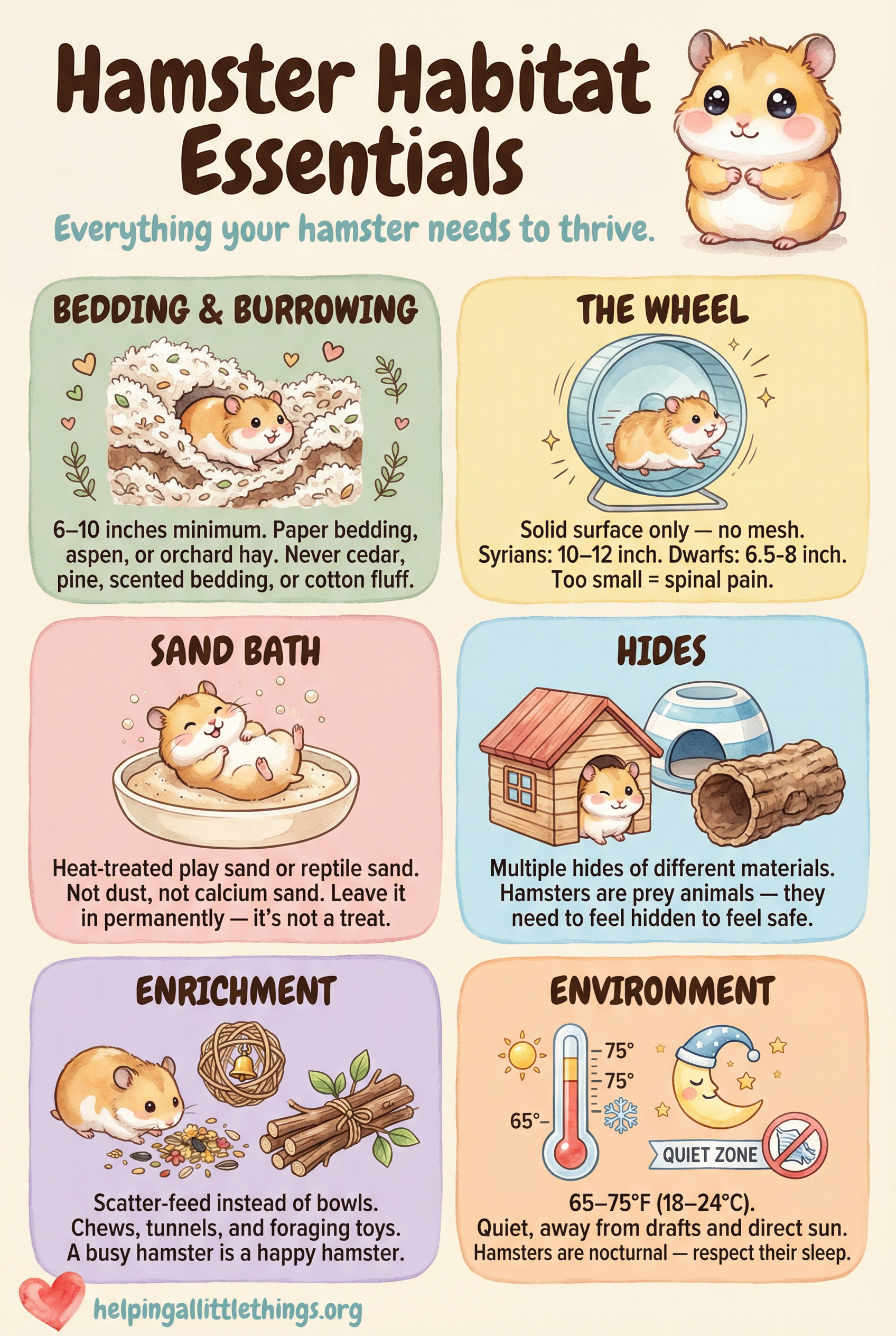

A hamster's cage is its entire world. Unlike dogs or cats that share your living space, a hamster's enclosure is where it sleeps, forages, burrows, runs, and explores — every single day of its life. Getting this right is the single most important thing you can do for your hamster's physical and mental health.
Enclosure Size: Bigger Is Always Better
The US minimum standard is 600 square inches of uninterrupted floor space. HALT recommends 800 square inches or more for all species, and 775+ square inches specifically for Syrian hamsters, who are the largest domesticated species and have correspondingly larger territory needs in the wild [1].
| Species | US Minimum | HALT Recommendation |
|---|---|---|
| Syrian | 600 sq in | 775+ sq in |
| Campbell's Dwarf | 600 sq in | 800+ sq in |
| Winter White Dwarf | 600 sq in | 800+ sq in |
| Roborovski Dwarf | 600 sq in | 800+ sq in |
| Chinese | 600 sq in | 800+ sq in |
Floor space is what matters — vertical height does not substitute for horizontal area. Hamsters are not climbers; they are burrowers. A cage with multiple wire levels provides less usable space than a single large flat floor.
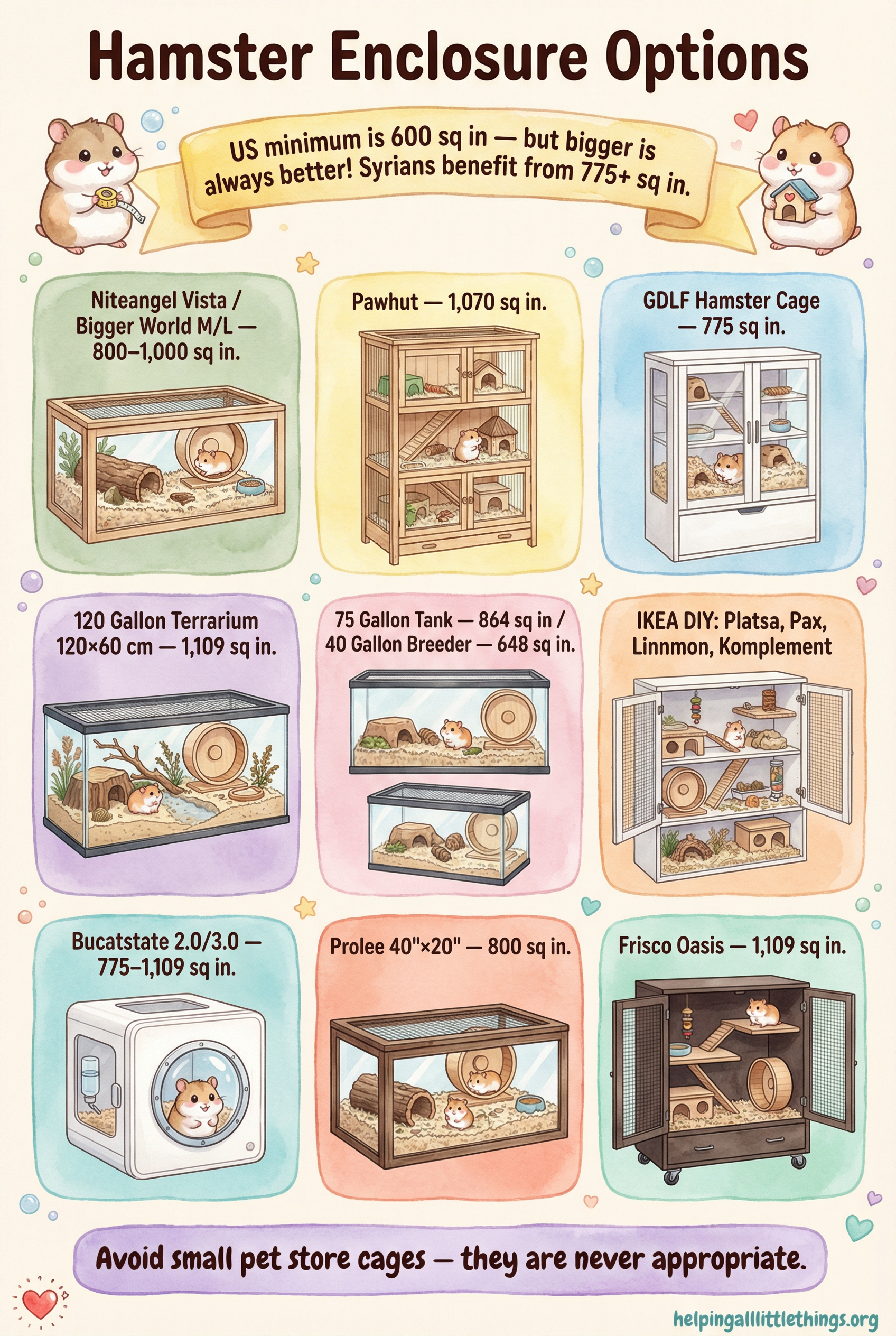

Recommended Enclosures
| Enclosure | Floor Space | Notes |
|---|---|---|
| Niteangel Vista / Bigger World M/L | 800–1,000 sq in | Glass-fronted wooden frame; excellent visibility and ventilation |
| Pawhut | 1,070 sq in | Multi-level wooden cage; large floor area |
| GDLF Hamster Cage | 775 sq in | Meets Syrian minimum; solid build |
| 75 Gallon Tank | 864 sq in | Classic glass aquarium with mesh lid |
| 40 Gallon Breeder Tank | 648 sq in | Meets minimum for dwarfs; acceptable minimum for Syrians |
| 120 Gallon Terrarium (120×60 cm) | 1,109 sq in | Excellent choice; widely available |
| IKEA DIY (Platsa, Pax, Linnmon, Komplement) | Customisable | Affordable; requires mesh panel modification for ventilation |
| Bucatstate 2.0 / 3.0 | 775–1,109 sq in | Modern plastic design with distinctive porthole window |
| Prolee 40"×20" | 800 sq in | Wooden-framed glass terrarium; deep bedding-friendly |
| Frisco Oasis | 1,109 sq in | Cabinet-style on casters; spacious and attractive |
What to Avoid
Small pet store cages — The brightly coloured plastic cages sold in most pet stores (Habitrail, CritterTrail, etc.) are almost universally too small, many providing fewer than 200 square inches. They are never appropriate and cause stereotypic behaviour [2].
Multi-level wire cages — Wire mesh floors and ramps can injure hamster feet, and vertical space does not substitute for horizontal floor area.
Bar spacing too wide — ½ inch or less for Syrian hamsters; ¼ inch or less for dwarf hamsters.
Bedding and Burrowing Depth
Burrowing is one of the most critical natural behaviours for hamsters. In the wild, hamsters construct complex multi-chamber burrow systems for sleeping, food storage, and safety [1]. Denying this behaviour causes significant chronic stress.
Provide at least 6–10 inches of bedding across the entire enclosure floor. Many experienced keepers provide 12 inches or more — deeper is always better.
Safe bedding options:
- Paper-based bedding (Kaytee Clean & Cozy, Carefresh, etc.)
- Aspen shavings
- Kiln-dried pine (not raw pine)
- Orchard grass or meadow hay mixed in for nesting material
Never use:
- Cedar or pine shavings — aromatic phenol oils are toxic and cause respiratory damage [3]
- Scented or deodorised bedding
- Fluffy cotton or kapok "nesting fluff" — fibres wrap around limbs and cause amputations; fatal if ingested [4]
Essential Enrichment
Wheel
Non-negotiable. Use a solid-surface wheel with no mesh or bars, which cause foot injuries and tail entrapment. Size matters enormously — a wheel that is too small forces the hamster to run with an arched spine, causing chronic pain and spinal deformity [5].
- Syrian hamsters: 10–12 inch wheel
- Dwarf hamsters: 6.5–8 inch wheel
Sand Bath
A shallow dish of heat-treated children's play sand or reptile sand (not dust, not calcium sand) is essential for grooming. Hamsters roll in sand to remove excess oils from their coat. Leave it in the enclosure permanently — it is not an occasional treat.
Hides
Provide multiple hides of different materials: wooden houses, ceramic hides, cork bark, and cardboard tubes. Hamsters are prey animals and need to feel concealed to feel safe.
Foraging
Scatter-feed pellets and seeds into the bedding instead of using a bowl. This encourages natural foraging behaviour and provides significant mental stimulation.
Chews
Apple wood sticks, willow balls, and untreated cardboard keep teeth trim and provide enrichment.
Environment
Keep the enclosure in a room maintained between 65–75°F (18–24°C). Temperatures below 60°F can trigger torpor (a hibernation-like state that can be fatal in domestic hamsters), and temperatures above 80°F risk heatstroke [6].
Place the cage in a quiet area away from direct sunlight, drafts, televisions, and speakers. Hamsters are crepuscular to nocturnal and need undisturbed rest during the day. Constant noise and light disruption are significant stressors.
References
[1] Gattermann, R., et al. (2008). Notes on the current distribution and the ecology of wild golden hamsters (Mesocricetus auratus). Journal of Zoology, 276(2), 108–112. https://doi.org/10.1111/j.1469-7998.2008.00469.x
[2] Hauzenberger, A. R., Gebhardt-Henrich, S. G., & Steiger, A. (2006). The influence of bedding depth on behaviour in golden hamsters (Mesocricetus auratus). Applied Animal Behaviour Science, 100(3–4), 280–294. https://doi.org/10.1016/j.applanim.2005.11.013
[3] Harkness, J. E., & Wagner, J. E. (1995). The Biology and Medicine of Rabbits and Rodents (4th ed.). Williams & Wilkins.
[4] Quesenberry, K. E., & Carpenter, J. W. (Eds.). (2012). Ferrets, Rabbits, and Rodents: Clinical Medicine and Surgery (3rd ed.). Elsevier Saunders.
[5] Meijer, M. K., et al. (2014). Wheel running in the wild. Proceedings of the Royal Society B, 281(1786). https://doi.org/10.1098/rspb.2014.0210
[6] Merck Veterinary Manual. (2025). Management of Hamsters. https://www.merckvetmanual.com/all-other-pets/hamsters/management-of-hamsters