Know Your Hamster Breeds
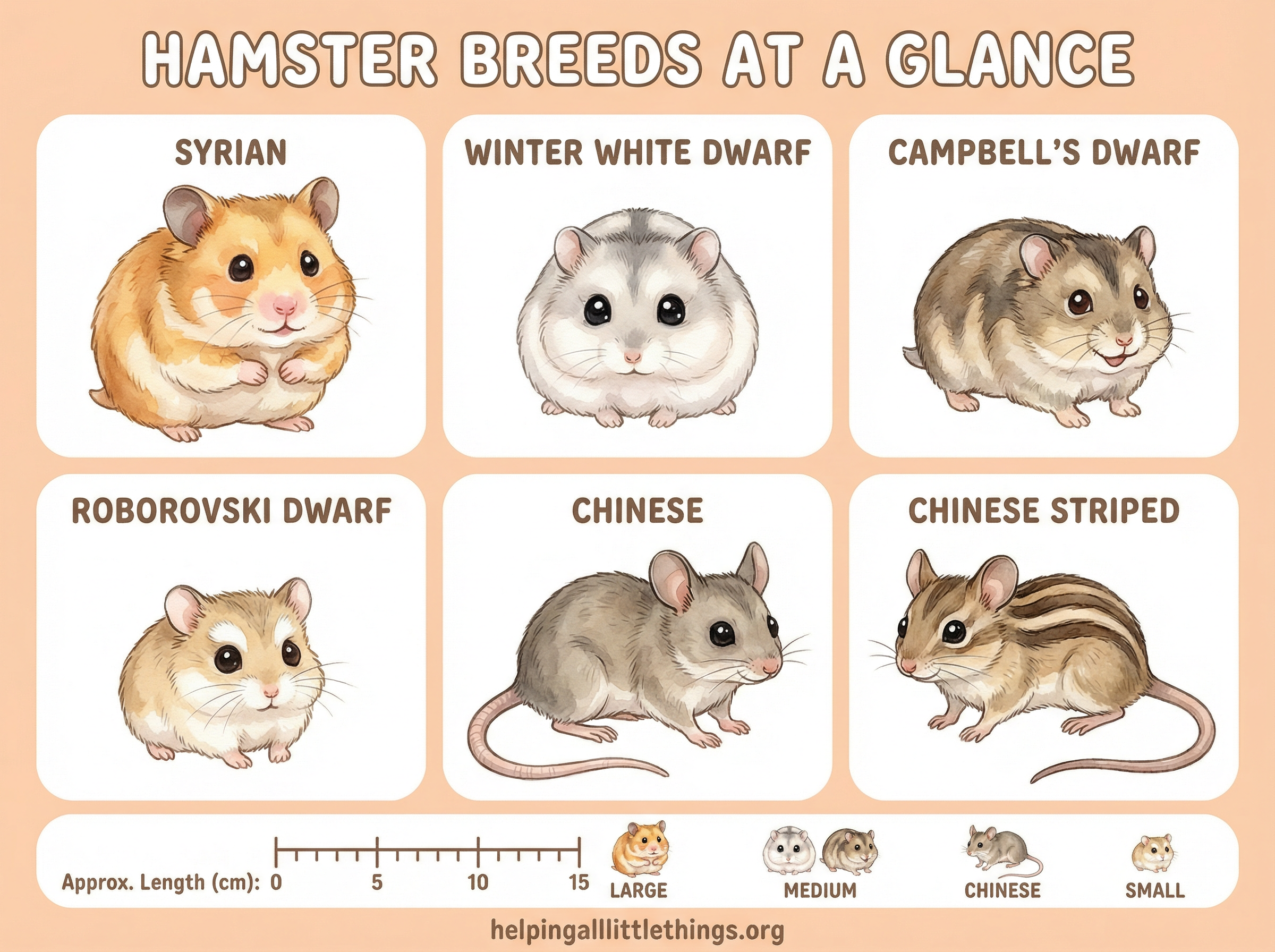
There are over 25 species of hamsters in the world, but only five are commonly kept as pets. Understanding the key differences between these species is crucial, as their care requirements, social needs, and temperaments vary significantly.
The Five Pet Hamster Species
1. Syrian Hamster (Mesocricetus auratus)
Also known as the Golden Hamster or Teddy Bear Hamster, the Syrian is the most popular pet hamster and the largest of the five species. They are generally the easiest to tame and handle, making them a great choice for first-time owners and families with older children. [1]
- Size: 5-7 inches
- Lifespan: 2-3 years
- Social Needs: Must be kept alone. Syrian hamsters are highly territorial and will fight to the death if housed with another hamster after 8-10 weeks of age. [2]
- Activity: Nocturnal
2. Dwarf Campbell's Russian Hamster (Phodopus campbelli)
One of the two most common dwarf hamsters, Campbell's are small, fast, and can be nippy if not well-socialized. Important note for US owners: the vast majority of Campbell's dwarf hamsters sold in the United States are hybrids — crosses between Phodopus campbelli and Phodopus sungorus (Winter White). Only a very small number of breeders work with verified purebred European lines. This hybridization makes it even harder to predict social compatibility, as hybrid temperament and tolerance for cohousing is less predictable than in purebred lines.
While Campbell's can technically be kept in same-sex pairs if introduced from a young age, fighting — sometimes fatal — is a very real risk that can occur suddenly even in pairs that have cohabited peacefully for months. HALT's recommendation is to house all hamsters individually. If you choose to attempt cohousing, you must be prepared to separate them permanently at any time, keep a spare fully-equipped cage ready, and monitor them closely every day.
- Size: 3-4 inches
- Lifespan: 1.5-2 years
- Social Needs: Recommended solo. Cohousing is high-risk and requires expert-level monitoring.
- Activity: Primarily nocturnal, but active at dawn and dusk
3. Dwarf Winter White Russian Hamster (Phodopus sungorus)
Very similar in appearance to the Campbell's, the Winter White can change its coat to white in winter months (though this rarely happens in captivity). They are generally considered slightly calmer than Campbell's, but this reputation does not reliably translate into safer cohousing. As noted above, most Winter Whites sold in the US are hybrids with Campbell's, making true purebred Winter Whites uncommon outside of specialist breeders. While Winter Whites are technically the more colony-oriented of the two Russian dwarf species in the wild, this does not mean captive pairs are low-risk — fatal fights between previously bonded pairs are well-documented.
HALT's recommendation is to house all hamsters individually. Cohousing should only be considered by very experienced owners who can recognise the early warning signs of conflict and who have a fully-equipped spare cage ready at all times.
- Size: 3-4 inches
- Lifespan: 1.5-2 years
- Social Needs: Recommended solo. Cohousing is high-risk and requires expert-level monitoring.
- Activity: Primarily nocturnal
4. Roborovski Dwarf Hamster (Phodopus roborovskii)
The smallest and fastest of all pet hamsters, Roborovskis are best suited for experienced owners who enjoy watching them rather than handling them. They are extremely quick and can be difficult to handle. Roborovskis are sometimes described as the most social of the dwarf species, but this reputation can be misleading: experienced keepers report fights to the death in Roborovski pairs and groups at rates comparable to other dwarf species. HALT's recommendation is to house all hamsters individually, including Roborovskis. [3]
- Size: 1.5-2 inches
- Lifespan: 3-3.5 years
- Social Needs: Recommended solo. Despite their reputation, fatal fighting in pairs and groups is well-documented.
- Activity: Primarily nocturnal
5. Chinese Hamster (Cricetulus griseus)
Despite sometimes being grouped with the dwarf species, the Chinese hamster is not a true dwarf hamster — it belongs to a different genus (Cricetulus) and has a wild social structure more similar to the Syrian hamster than to the Russian dwarfs. In the wild, Chinese hamsters are largely solitary. For this reason, Chinese hamsters should be treated as fully solitary animals and housed alone. Attempting to cohouse them carries the same risks as with Syrians.
- Size: 3-5 inches
- Lifespan: 2-3 years
- Social Needs: Must be kept alone. Wild social structure is solitary; cohousing is not recommended.
- Activity: Primarily nocturnal
Quick Comparison
| Species | Size | Lifespan | Social Needs | Handleability |
|---|---|---|---|---|
| Syrian | 5-7" | 2-3 yrs | Solitary (mandatory) | Excellent |
| Campbell's Dwarf | 3-4" | 1.5-2 yrs | Solo recommended (mostly hybrids in US) | Moderate |
| Winter White Dwarf | 3-4" | 1.5-2 yrs | Solo recommended (mostly hybrids in US) | Moderate |
| Roborovski Dwarf | 1.5-2" | 3-3.5 yrs | Solo recommended (fighting risk underestimated) | Challenging |
| Chinese | 3-5" | 2-3 yrs | Solitary (mandatory) | Good |
References
[1] Chewy. (2026). The Ultimate Guide to Hamster Species. https://www.chewy.com/education/small-pet/hamster/hamster-breeds
[2] California Hamster Association. (n.d.). Syrian vs. Dwarf. https://californiahamsterassociation.com/care-articles/f/syrian-vs-dwarf
[3] Oxbow Animal Health. (2019). Types of Hamster Breeds: Helpful Insights & Care Tips. https://oxbowanimalhealth.com/blog/hurray-for-hamster-breeds/
A Note on Hamster Breeding: Ethics and Welfare
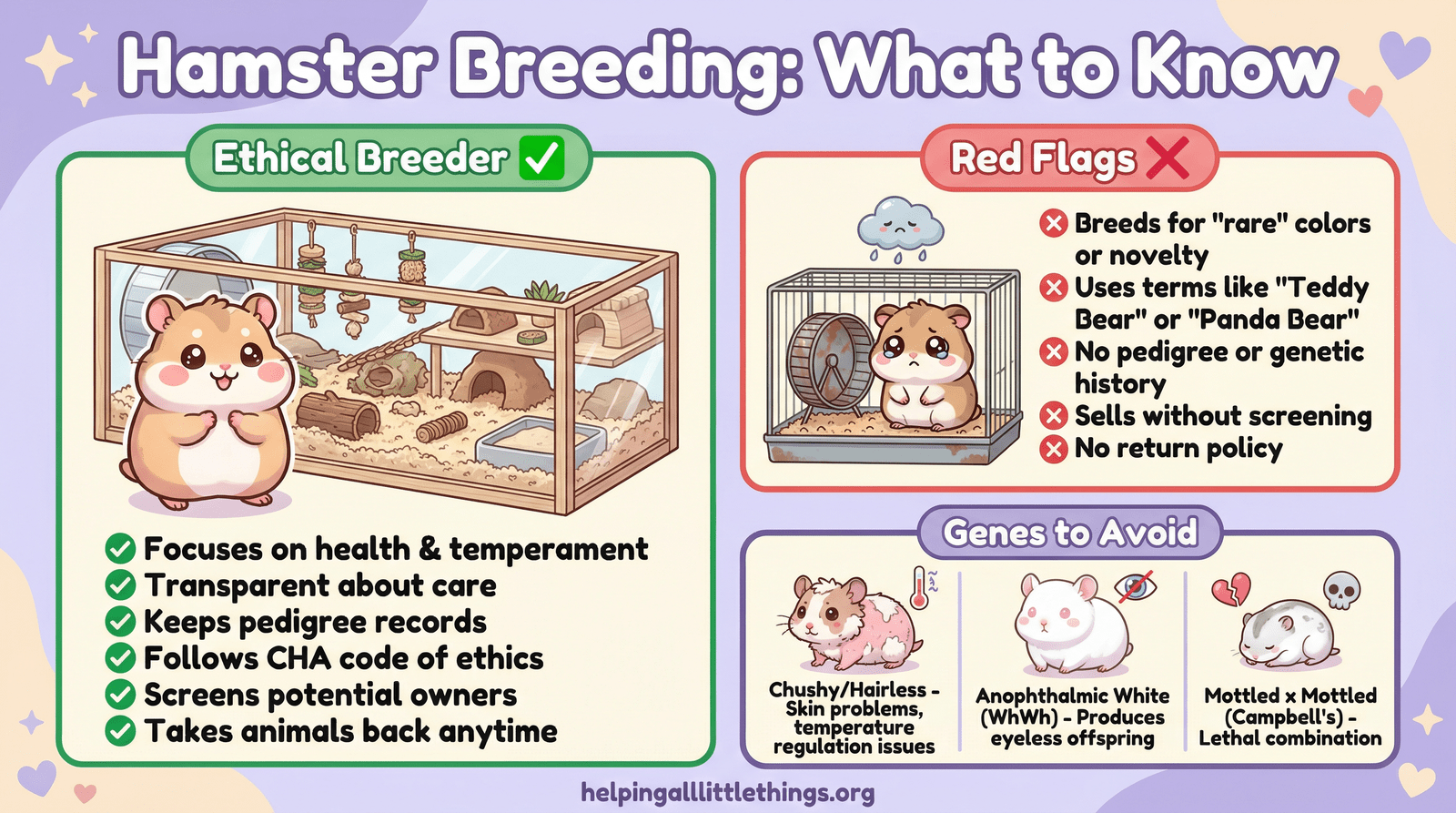

Understanding hamster breeds goes beyond just their appearance; it also involves recognizing the importance of ethical breeding practices that prioritize the health and well-being of the animals. When seeking a hamster, it is crucial to support breeders who adhere to high ethical standards and to be aware of dangerous genetic combinations and experimental breeds that can cause significant suffering.
Ethical vs. Unethical Breeding
An ethical breeder is committed to improving the hamster species, focusing on health, temperament, and conformation to established standards. An unethical breeder, often called a "backyard breeder," typically breeds for profit or novelty without regard for the animals' welfare. The California Hamster Association (CHA) and other reputable organizations provide clear guidelines for identifying responsible breeders. [4]
Here are some key differences to watch for:
| Ethical Breeder ✅ | Unethical Breeder ❌ |
|---|---|
| Focuses on health, temperament, and genetics. | Breeds for "rare" colors or novelty traits. |
| Is transparent about their housing and care practices. | Hides their setup or keeps animals in small, inadequate cages. |
| Keeps detailed pedigree records. | Cannot provide genetic history of their animals. |
| Follows a code of ethics (e.g., from CHA). | Has no affiliation with or knowledge of breed standards. |
| Asks potential owners about their setup and knowledge. | Sells to anyone without screening. |
| Will take back any animal they have bred, at any time. | Offers no support after the sale. |
| Uses correct genetic terminology for breeds and colors. | Uses marketing terms like "Panda Bear," "Teddy Bear," or "Black Bear." |
Problematic Genes and Experimental Breeds
Certain genetic mutations, while novel, result in significant health and welfare problems. Ethical breeders do not intentionally propagate these genes. Buyers should be aware of these and avoid supporting breeders who produce them.
| Gene/Breed | Species | Description & Health Issues |
|---|---|---|
| Anophthalmic White (Wh) | Syrian | The homozygous form (WhWh) results in an eyeless, all-white hamster. While not immediately lethal, breeding for a disability is considered unethical. The heterozygous form (Whwh) produces Roan or White-Bellied patterns. Breeding two Roans or White-Bellied hamsters together is strongly discouraged. [5] |
| Hairless / "Cushy" (Chushy) | Syrian | A dominant gene that results in a very thin, patchy, "wirey" coat and scaly skin. These animals have difficulty regulating body temperature and are prone to skin irritation and injury. Hairless females often cannot produce enough milk to feed a litter. This is considered a deleterious mutation and is not supported by ethical breeders. [6] [7] |
| Ruby-Eyed Mottled (Mi) | Campbell's Dwarf | The homozygous form (MiMi) is lethal, producing eyeless, toothless, all-white pups that do not survive past 2-3 weeks. This is avoided by never pairing two Mottled hamsters together. [5] |
"Breeding unethical and deleterious genes, for example: hairless or partial hairlessness, often called 'Chushy'. Hairless or partial hairlessness handicaps your hamster, they rely on their fur to regulate their body temperature. Additionally, their skin is prone to irritation, injury, and dryness." [6]
Choosing to support ethical breeders is a vote for the health and future of the species. It ensures that your pet has the best possible start in life and discourages the proliferation of genetic problems for the sake of novelty.
[4] California Hamster Association. (2023). Evaluating Breeders. https://californiahamsterassociation.com/care-articles/f/evaluating-breeders
[5] California Hamster Association. (2023). Breeding Pairings to Avoid. https://californiahamsterassociation.com/care-articles/f/breeding-pairings-to-avoid
[6] Poppy Bee Hamstery. (n.d.). Buyer Beware. https://poppybeehamstery.com/buyer-beware
[7] Hamster Genetics. (n.d.). Chushy. https://hamstergenetics.weebly.com/chushy.html