Hamster Coat Color and Genetics
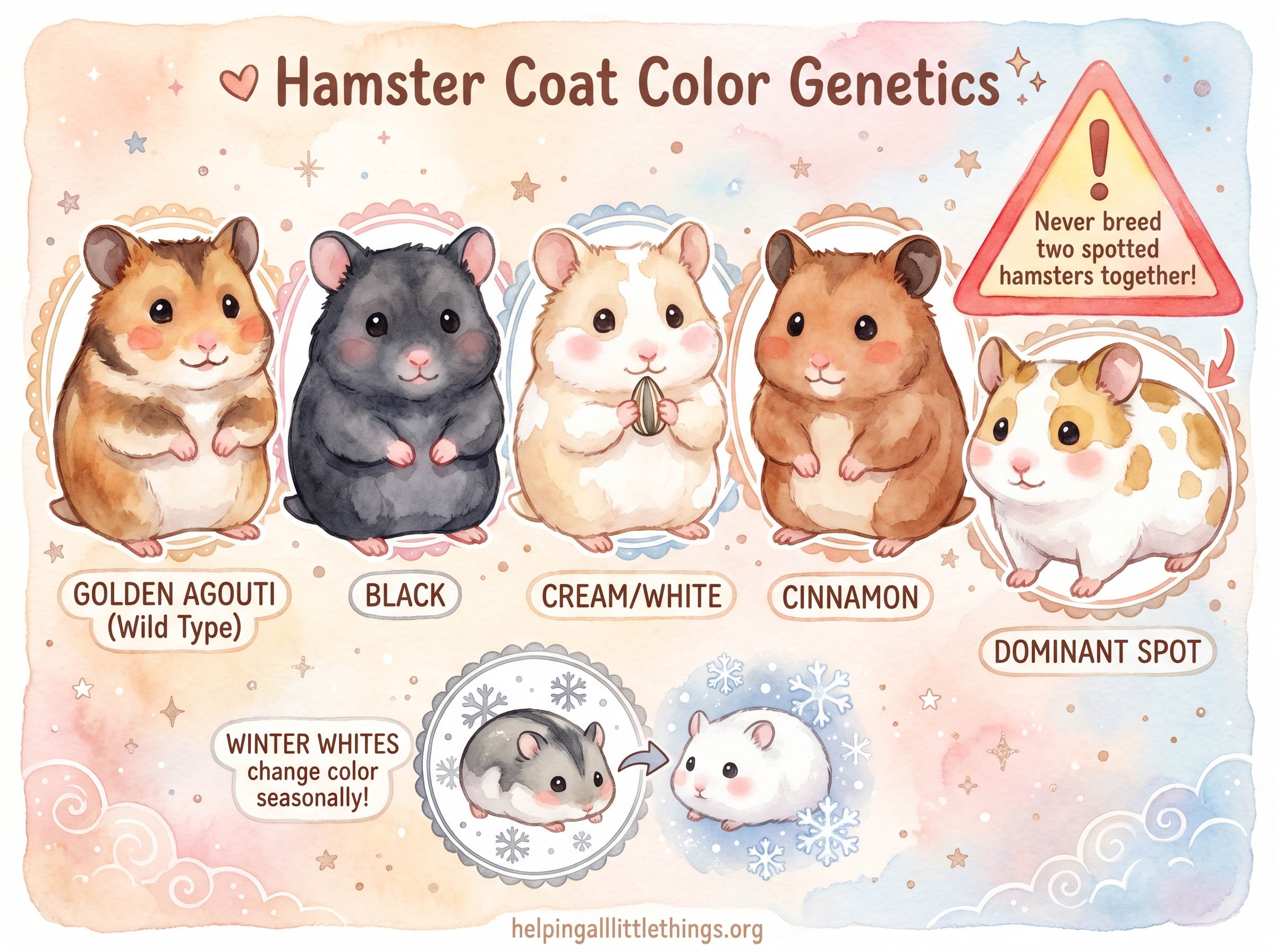
Hamsters display a remarkable diversity of coat colors and patterns, particularly in the Syrian (golden) hamster, which has been selectively bred in captivity since the 1930s. From the wild-type golden agouti to pure white, cream, cinnamon, sable, and tortoiseshell, the genetics underlying hamster coat color follow the same fundamental principles as other mammals — but with some species-specific variations worth understanding.
This article focuses primarily on Syrian hamsters, which have the most extensively documented coat genetics, with notes on dwarf species where relevant.
The Wild-Type Coat
The natural coat of a wild Syrian hamster is a golden agouti — a warm golden-brown on the back and sides, with a cream or white belly, and a distinctive dark stripe along each cheek. This pattern is produced by the interaction of the agouti signaling protein (ASIP) with the melanocortin 1 receptor (MC1R), the same fundamental mechanism that controls coat color in virtually all mammals.1
In captivity, mutations at multiple gene loci have been selectively bred to produce the wide range of colors and patterns seen in pet hamsters today.
Key Gene Loci in Syrian Hamsters
| Locus | Effect | Common Alleles |
|---|---|---|
| A (Agouti) | Controls banding pattern on individual hairs | Wild-type agouti vs. self (solid) |
| B (Black/Brown) | Determines eumelanin shade | Black vs. chocolate/cinnamon |
| C (Color) | Controls pigment intensity | Full color, dilute, albino |
| E (Extension) | Controls dark pigment extension | Full extension vs. yellow/cream |
| Dh (Dominant Spot) | Creates white spotting | See warning below |
| To (Tortoiseshell) | Creates tortoiseshell pattern | Sex-linked in some species |
The cinnamon color in Syrian hamsters is produced by a recessive mutation at the B locus, which shifts eumelanin from black to a warm reddish-brown. Cream and white colors involve mutations at the C and E loci that reduce or eliminate phaeomelanin (yellow/red pigment) or eumelanin respectively.1
The Dominant Spot Gene: A Welfare Concern
The most important genetic welfare concern in hamster breeding is the Dominant Spot (Dh) gene, which produces the white-banded or "dominant spot" pattern — white patches on an otherwise colored coat, often including a white band around the middle of the body.
Like the guinea pig's roan gene, the Dominant Spot gene is a dominant lethal when homozygous. A hamster with one copy of the gene (Dh+) displays the attractive spotted pattern. A hamster with two copies (DhDh) does not survive — embryos homozygous for Dominant Spot die in utero, resulting in smaller litter sizes when two spotted hamsters are bred together.2
This means that breeding two Dominant Spot hamsters together will always result in approximately 25% of embryos dying before birth. Responsible breeders and rescuers always pair a Dominant Spot hamster with a solid-colored (non-spotted) partner.
The Lethal Yellow Mutation
A separate welfare concern exists in hamsters that carry the yellow coat color allele. In some hamster lines, the yellow coat is produced by a mutation that also causes the agouti gene to be permanently switched on in all cells — not just in the skin. This constant agouti signaling leads to obesity, increased appetite, and a predisposition to diabetes and tumors in affected animals.2
Yellow hamsters should be monitored closely for weight gain and metabolic disease. A diet low in simple sugars and high in fiber is particularly important for these animals.
Dwarf Hamster Coat Colors
Dwarf hamster species — including the Winter White (Phodopus sungorus), Campbell's (Phodopus campbellii), and Roborovski (Phodopus roborovskii) — also display a range of captive-bred color varieties. Winter Whites are notable for their ability to change coat color seasonally, developing a white winter coat in response to shorter day lengths. This color change is triggered by photoperiod (light exposure) rather than temperature.3
Campbell's dwarf hamsters have been selectively bred for a wide range of colors including argente, blue, black, lilac, and platinum. Some color combinations in Campbell's dwarf hamsters are associated with health problems — in particular, the mottled/merle pattern in Campbell's is linked to eye defects and should not be bred.3
Coat Types
In addition to color, Syrian hamsters are bred for several coat types:
| Coat Type | Description | Notes |
|---|---|---|
| Short (standard) | The wild-type coat length | Most common |
| Long (teddy bear) | Significantly longer coat, particularly in males | Requires more grooming attention |
| Rex | Wavy or curly coat and whiskers | Recessive gene; double-rex may be nearly hairless |
| Satin | High-gloss, reflective coat | Associated with thinner coat and potential skin issues |
The satin coat type in hamsters is produced by the same hollow hair shaft mechanism as in guinea pigs and chinchillas, though satin syndrome (fibrous osteodystrophy) has not been as extensively documented in hamsters as in the other two species. Satin hamsters should be monitored for any signs of bone or metabolic problems.