
Gerbil Wheels and Saucers: Choosing the Right Exercise Option
Gerbils are naturally active, curious animals that spend much of their time in the wild digging, foraging, and running across semi-arid terrain. In captivity, a running wheel provides an important outlet for this energy — but only if it is the right size and the right type. An undersized or poorly designed wheel can cause spinal injury, foot wounds, and chronic discomfort.
How Big Does a Gerbil Wheel Need to Be?
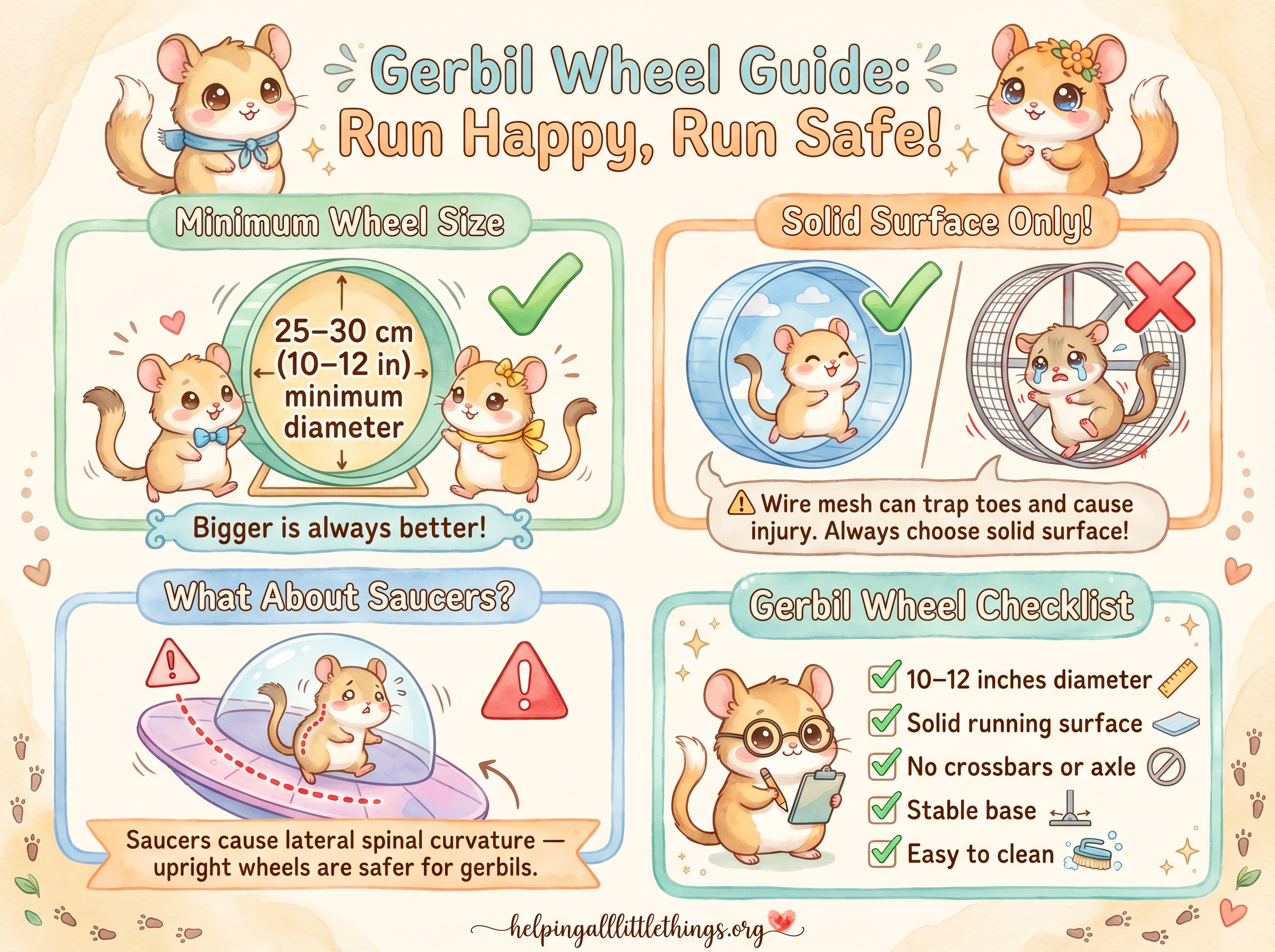
The most important factor in wheel selection is diameter. A wheel that is too small forces a gerbil to arch their back while running, placing sustained abnormal stress on the spine. Over time, this can cause permanent curvature and pain.
The Gerbil Forum, a long-established community resource for gerbil care, recommends a wheel diameter of 25–30 cm (10–12 inches), with a preference for the upper end of that range:
"A wheel for gerbils should generally have a diameter of 10–12 inches, or 25–30 cm. It is better to aim for the upper end of that range if you can."1
MN Pocket Pet Rescue's species-specific wheel guide similarly recommends 8–10 inches with a solid base as the minimum for gerbils, noting that larger is always preferable.2
The guiding principle is the same across all species: the gerbil should be able to run with their spine completely straight and their head level with their shoulders. If the back arches or the head tilts upward, the wheel is too small.
Solid Surface: Non-Negotiable
Regardless of diameter, the running surface must be completely solid. Wire mesh, bar rungs, and any surface with gaps pose a serious injury risk. Gerbils run at high speed, and a foot or toe caught in a gap can result in fractures, dislocations, or degloving injuries.
Always choose a wheel with a solid plastic or solid wood running surface. There should be no openings of any kind on the part of the wheel the gerbil runs on.
What About Flying Saucers?
Flying saucers — angled disc-shaped running platforms — are sometimes marketed for small rodents including gerbils. However, the angled running surface means the gerbil runs with their body twisted to one side, creating lateral spinal curvature. This is distinct from the upward arch caused by an undersized upright wheel, but it is equally problematic over time.2
Most gerbil care resources recommend upright wheels over saucers for this reason. If you choose to offer a saucer as supplemental enrichment alongside a proper upright wheel, ensure it is large enough that the lateral lean is minimal — but it should not replace the upright wheel as the primary exercise option.
What to Look for in a Good Gerbil Wheel
A safe gerbil wheel should have all of the following:
Diameter of 25–30 cm (10–12 inches). This is the minimum for adult gerbils. Larger is always better, and there is no disadvantage to going above this range.
Completely solid running surface. No mesh, no bars, no rungs. Solid plastic or solid wood only.
No central crossbar or axle. A central axle creates a pinch point where tails can be caught. Look for a rear-axle or axle-free design.
Stable base. The wheel must not tip or wobble during use. Gerbils run energetically and will destabilise a poorly balanced wheel.
Easy to clean. Gerbils will defecate while running. A wheel that cannot be fully disassembled and cleaned will harbour bacteria and odour.
Gerbil Pairs and Wheel Use
Gerbils are social animals and are typically kept in same-sex pairs or small groups. This means two gerbils may attempt to use the wheel simultaneously — a common and entertaining sight. Ensure the wheel is large enough to accommodate two gerbils running side by side without crowding, and that the design does not create a pinch hazard when two animals are present.