Gerbil Coat Color and Genetics
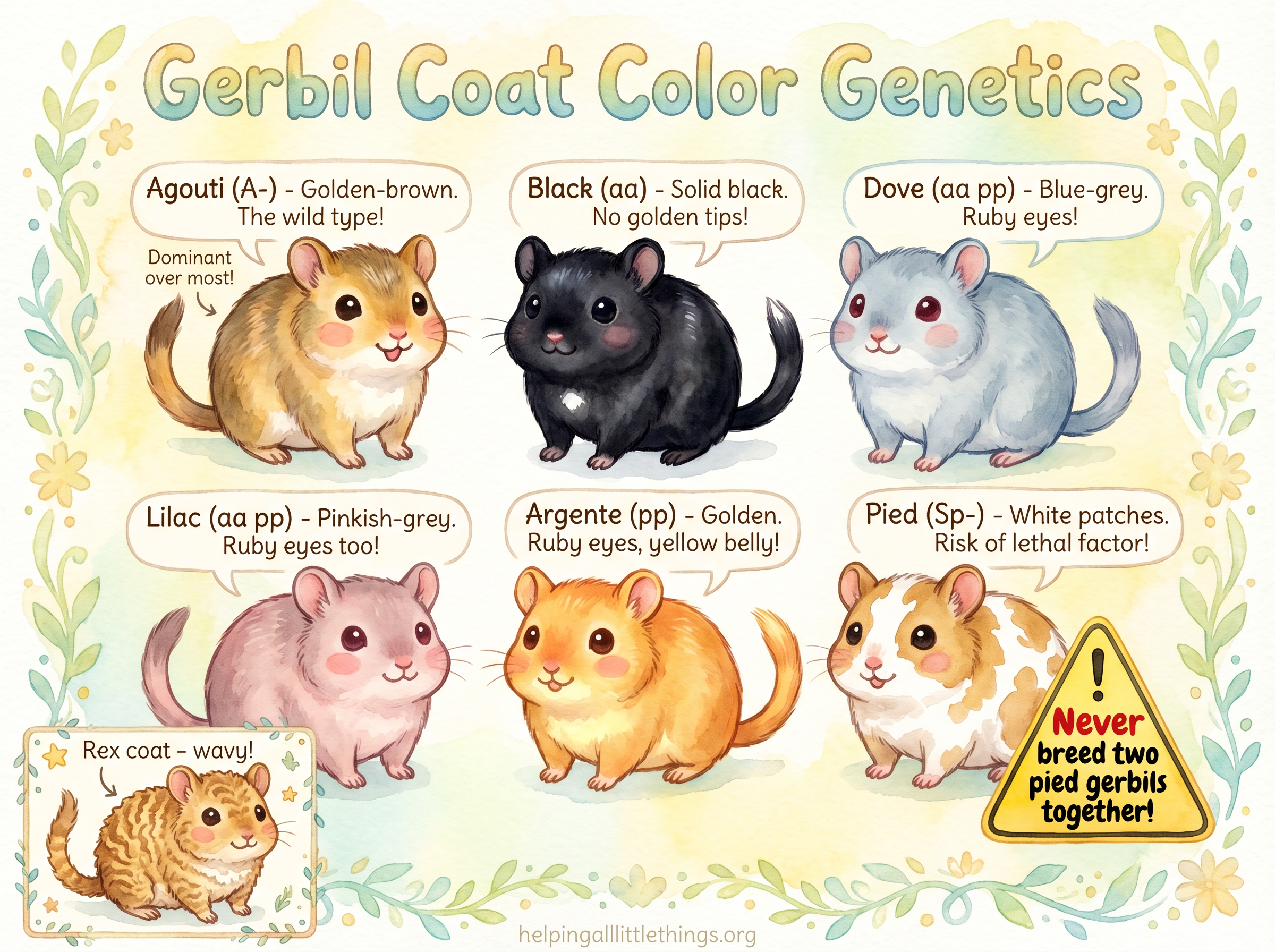
The Mongolian gerbil (Meriones unguiculatus) has been selectively bred in captivity since the 1960s, and today a wide range of coat colors and patterns is available. From the classic agouti of the wild type to pure black, dove grey, lilac, nutmeg, and the striking white spotting of the pied pattern, gerbil coat genetics follow the same fundamental mammalian principles — with one important welfare exception that every owner and rescuer should know.
The Wild-Type Coat
The natural coat of a wild Mongolian gerbil is agouti — a warm golden-brown with a cream or white belly and dark ticking on the dorsal surface. Each individual hair has alternating bands of dark eumelanin and lighter phaeomelanin, producing the characteristic ticked appearance. This is the same agouti pattern seen in wild rabbits, guinea pigs, and many other mammals.1
Key Gene Loci
| Locus | Effect | Common Alleles |
|---|---|---|
| A (Agouti) | Controls hair banding pattern | Agouti vs. non-agouti (solid) |
| B (Black/Brown) | Determines eumelanin shade | Black vs. chocolate |
| C (Color) | Controls pigment intensity | Full color, dilute, albino |
| D (Dense/Dilute) | Controls pigment density | Dense vs. dilute (grey, lilac) |
| E (Extension) | Controls dark pigment extension | Full extension vs. cream/yellow |
| Sp (Spotting) | Creates white patches | See Lethal Grey section below |
The black gerbil is produced by the non-agouti allele (aa) at the A locus combined with the dominant B allele, resulting in a uniformly black coat. Chocolate gerbils carry the recessive b allele at the B locus. Dove (blue-grey) and lilac colors result from dilution at the D locus acting on black and chocolate bases respectively. Argente (golden with a cream belly) results from the agouti pattern combined with dilution.1
The Lethal Grey (Gy) Gene: A Welfare Concern
The most important genetic welfare concern in gerbil breeding is the Lethal Grey (Gy) gene, also called the Grey Spotting or Dominant Spot gene. This gene produces the attractive pied (white-spotted) pattern — white patches on a colored coat — that is popular in pet gerbils.
Like the guinea pig's roan gene and the hamster's Dominant Spot gene, the Lethal Grey gene is lethal when homozygous. A gerbil with one copy of the gene (Gy+) displays the pied pattern and is healthy. A gerbil with two copies (GyGy) dies in utero, resulting in smaller litter sizes when two pied gerbils are bred together.2
Breeding two pied (spotted) gerbils together will always result in approximately 25% of embryos dying before birth. Responsible breeders and rescuers always pair a pied gerbil with a solid-colored partner.
Common Gerbil Color Varieties
| Color | Description | Key Genes |
|---|---|---|
| Agouti | Wild-type golden-brown with ticking | A_, B_, C_, D_ |
| Black | Solid black | aa, B_ |
| Chocolate | Warm brown | aa, bb |
| Dove (Blue) | Blue-grey | aa, B_, dd |
| Lilac | Pinkish-grey | aa, bb, dd |
| Argente Golden | Warm golden, cream belly | A_, bb or dilute |
| Argente Cream | Pale cream | Dilute + phaeomelanin |
| Nutmeg | Warm reddish-brown | A_, bb |
| Albino | Pure white, pink eyes | cc |
| Pied | White patches on any color | Gy+ |
Coat Types
In addition to color, gerbils may have one of several coat types:
- Standard (smooth): The normal short, dense coat.
- Rex: A wavy or curly coat produced by a recessive gene mutation. Rex gerbils may have curly whiskers as well. The coat is generally shorter and less dense than a standard coat.
Rex gerbils do not have the same welfare concerns as rex rats or double-rex rats. A single copy of the rex gene produces a wavy coat; two copies produce a tighter curl. Unlike in rats, the double-rex combination in gerbils does not typically result in hairlessness.1
Why This Matters for Rescue
Understanding gerbil coat genetics helps rescuers identify pied gerbils and advise adopters against pairing two pied animals together. It also helps caregiers recognize that albino gerbils — while visually striking — are not a separate species and have the same care needs as any other gerbil.
For a guide to gerbil varieties and their typical appearances, see our Know Your Gerbil Breeds article.