)
Ferret Exercise: Why Wheels Don't Work (And What Does)
Ferrets are highly active, curious animals that need substantial daily exercise to stay healthy and mentally stimulated. If you have kept other small animals before — hamsters, gerbils, or rats — you may be wondering whether a running wheel is an appropriate addition to your ferret's enclosure. The short answer is that wheels are generally not recommended for ferrets, and understanding why will help you provide better alternatives.
Why Wheels Are Problematic for Ferrets
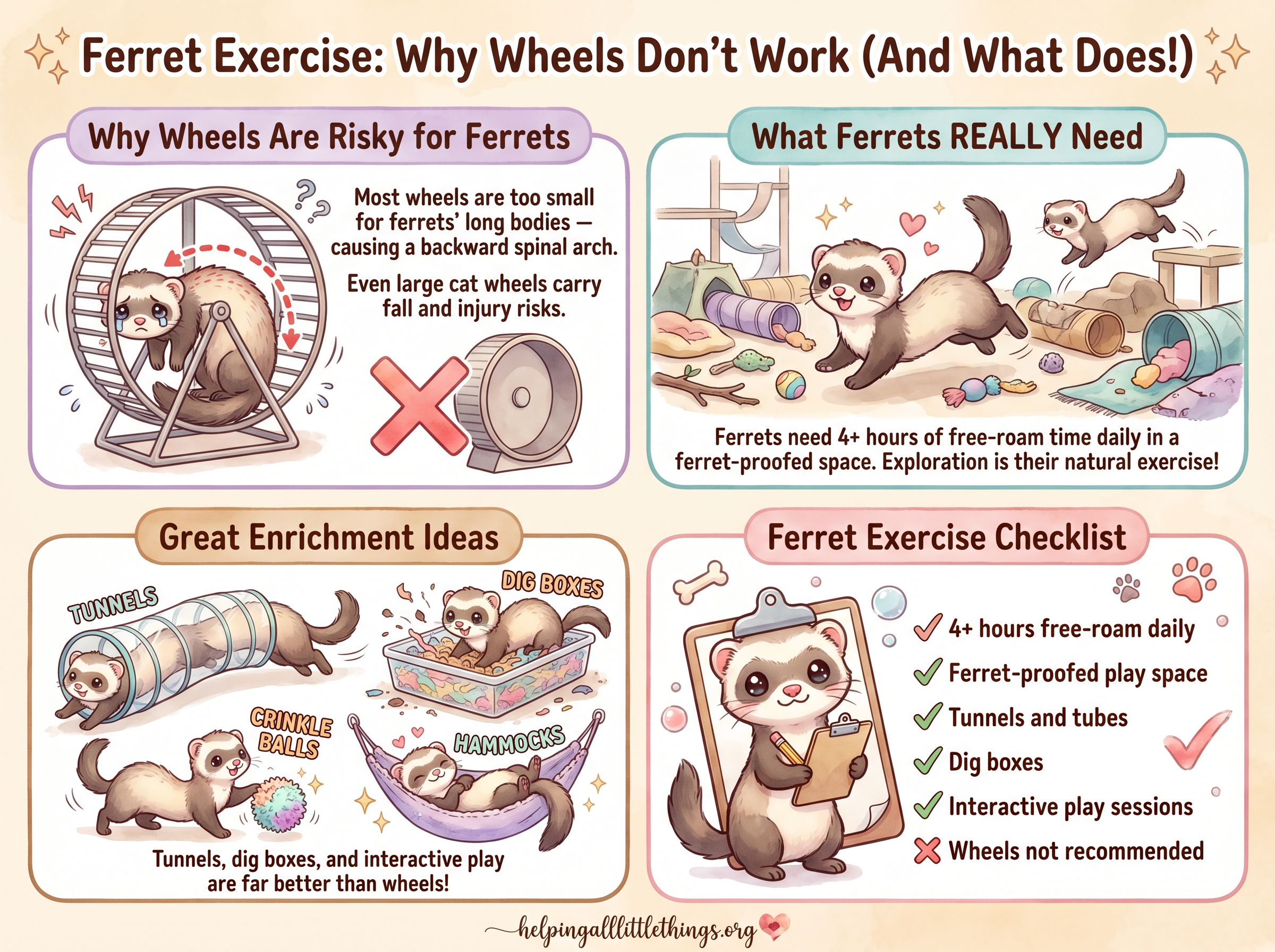
The fundamental problem is anatomy. Ferrets have long, flexible, slinky bodies — a body plan that is excellent for navigating tunnels and tight spaces, but poorly suited to the circular running motion of a wheel.
When a ferret runs on a standard exercise wheel, their long spine is forced into an unnatural backward arch to fit the curvature of the wheel. Unlike a hamster, whose spine curves gently forward in a wheel of the correct size, a ferret's body is simply too long for the geometry to work safely. The Holistic Ferret Forum, a long-established ferret care community, describes the problem directly:
"The large wheels on the market aren't big enough to accommodate the length of a ferret's body, causing it to put its spine in an unnatural backwards arch for the duration of the run."1
Some owners have experimented with very large cat exercise wheels — those with diameters of 40 inches or more — in an attempt to provide enough space for a ferret's body to run without arching. While some ferrets do use these wheels, the risks remain significant: ferrets can fall off the open running surface, become caught underneath the wheel, or develop repetitive strain from the unnatural motion. The consensus among experienced ferret owners and rescue organisations is that even large cat wheels are not a safe or appropriate exercise solution for ferrets.1 2
Exercise balls — the enclosed plastic spheres sometimes sold for small animals — are equally inappropriate for ferrets. They restrict airflow, prevent normal movement, and cause significant stress. Neither wheels nor balls should be used as ferret exercise equipment.
What Ferrets Actually Need: Free-Roam Time
Ferrets are not wheel runners by nature. Their exercise needs are met through exploration, play, and social interaction — activities that require space and variety rather than repetitive circular motion.
The standard recommendation from ferret care experts is a minimum of 4 hours of free-roam time daily in a ferret-proofed space outside the cage.2 This is not a suggestion — it is a baseline welfare requirement. A ferret that spends most of its life in a cage, even a large one, is not receiving adequate exercise or mental stimulation.
Free-roam time should take place in a space that has been thoroughly ferret-proofed: all gaps and holes sealed (ferrets can squeeze through openings as small as 1 inch), toxic plants and chemicals removed, electrical cords hidden or covered, and any areas where a ferret could become trapped or injured blocked off.
Enrichment That Actually Works
Within their free-roam space and enclosure, ferrets benefit enormously from enrichment that mimics their natural behaviours — tunnelling, digging, hunting, and exploring.
Tunnels and tubes are among the most popular and effective enrichment items for ferrets. Ferrets are natural tunnel dwellers, and a network of flexible or rigid tubes provides both exercise and mental stimulation. Dryer vent tubing, purpose-made ferret tunnels, and even cardboard tubes can all be used.
Dig boxes — containers filled with rice, dried beans, or crinkle paper — allow ferrets to express their natural digging behaviour. This is particularly valuable for ferrets who do not have access to outdoor spaces.
Interactive play sessions with their human companions are essential. Ferrets are highly social and bond strongly with their owners. Wand toys, crinkle balls, and hide-and-seek games provide both physical exercise and the social interaction ferrets need to thrive.
Hammocks and sleeping structures within the enclosure allow ferrets to rest comfortably between activity periods. Ferrets sleep for long stretches (up to 18–20 hours per day is normal) and need comfortable, enclosed sleeping spaces.
Multi-level enclosures with ramps, platforms, and climbing structures allow ferrets to exercise within their cage during the hours they are not free-roaming.
A Summary: Ferret Exercise Needs
| Exercise Type | Appropriate? | Notes |
|---|---|---|
| Running wheel (standard) | No | Causes backward spinal arch |
| Large cat wheel (40"+) | Generally not recommended | Fall risk; spine concerns remain |
| Exercise ball | No | Restricts airflow; causes stress |
| Free-roam time | Yes — essential | Minimum 4 hours daily |
| Tunnels and tubes | Yes | Highly recommended |
| Dig boxes | Yes | Excellent natural behaviour outlet |
| Interactive play | Yes — essential | Important for bonding and stimulation |