Know Your Ferret Colors & Patterns

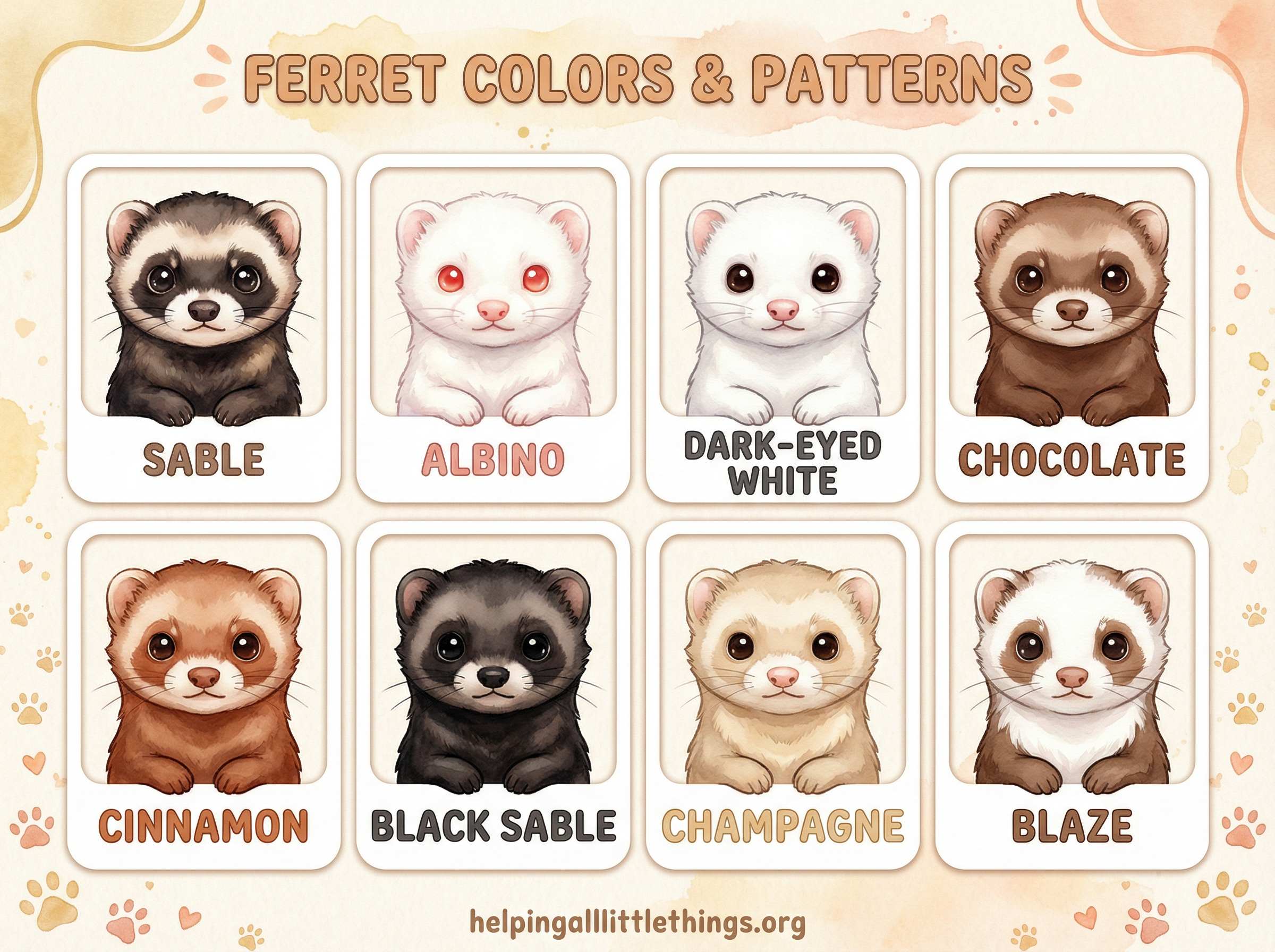
Unlike dogs or cats, ferrets are not divided into distinct "breeds" — all domestic ferrets (Mustela putorius furo) belong to a single domesticated species. What varies dramatically is their coat color and pattern, which are recognized and classified by the American Ferret Association (AFA). Understanding these distinctions helps you identify your ferret and appreciate the genetic diversity within the species.
AFA-Recognized Colors
The AFA recognizes eight standard colors based on the guard hair (the coarser outer coat) and undercoat combination:
| Color | Guard Hair | Undercoat | Eyes | Nose |
|---|---|---|---|---|
| Sable | Dark brown | White to cream | Dark brown/black | T-outline or speckled |
| Black Sable | Black | White to cream | Dark brown/black | T-outline or speckled |
| Chocolate | Warm milk-chocolate brown | White to cream | Dark brown/burgundy | Pink, beige, or T-outline |
| Champagne | Tan to light brown | White to cream | Burgundy | Pink or beige |
| Cinnamon | Reddish-brown | White to cream | Burgundy | Pink or beige |
| Black | Pure black | White to cream | Dark brown/black | Black |
| Dark-Eyed White | Pure white | White | Dark burgundy | Pink |
| Albino | Pure white | White | Pink/red | Pink |
Both are white ferrets, but they are genetically different. Albinos lack all pigment (pink eyes, pink nose). Dark-Eyed White ferrets carry the Waardenburg gene, which can be associated with deafness — always have a DEW ferret BAER-tested for hearing.
AFA-Recognized Patterns
Pattern refers to the distribution of color across the body, independent of the base color:
| Pattern | Description |
|---|---|
| Solid | Uniform color across the entire body with no markings |
| Standard (Roan) | 50–60% colored guard hairs mixed with white guard hairs |
| Point | Lighter body color with darker legs, tail, and mask (like a Siamese cat) |
| Blaze | White blaze stripe from forehead to shoulders; white bib; mitts on feet |
| Panda | White head, white bib, colored body, white mitts; often has a "saddle" of color |
| Mitt | White feet on an otherwise colored ferret |
| Mutt | Any combination that does not fit a recognized pattern |
Mask Patterns
The facial mask is described separately and adds another layer of variation:
- Full mask — Dark coloring covers both eyes and joins across the nose
- T-bar mask — A T-shaped stripe across the nose and eyes
- V-mask — A V-shaped marking between the eyes
- No mask — Absent in lighter-colored ferrets such as champagne or albino
Genetics & Health Considerations
Ferret coat color is controlled by multiple genes. Some color/pattern combinations carry health implications:
- Waardenburg Syndrome — Associated with the blaze and panda patterns. Affected ferrets may be deaf in one or both ears. Reputable breeders BAER-test all blaze and panda kits.
- Albinism — True albinos are homozygous for the albino gene and are not associated with deafness.
- Adrenal disease — Not color-linked, but common in ferrets generally; unrelated to coat genetics.