Know Your Degu Colors and Varieties
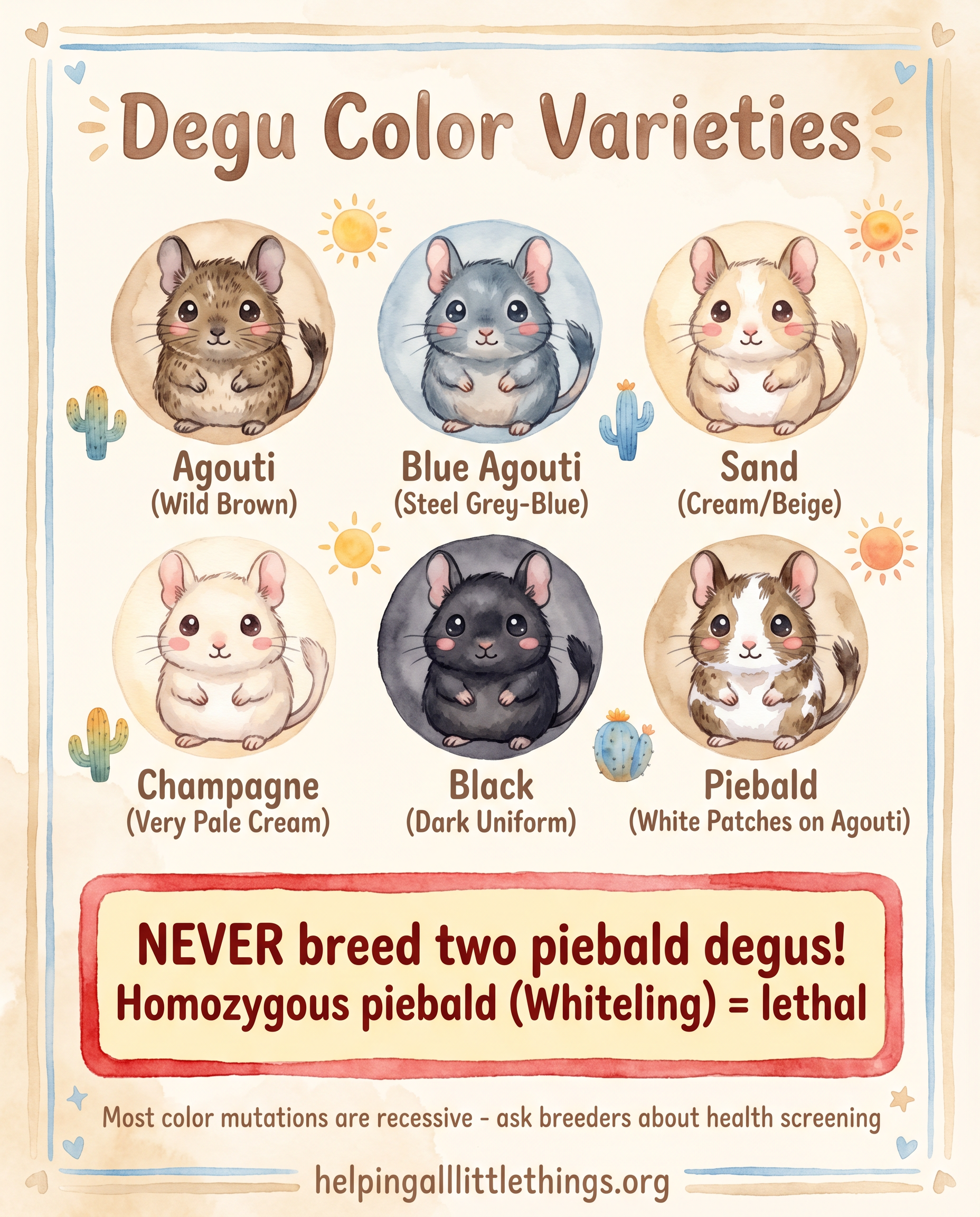
The common degu (Octodon degus) was long thought to come in only one color — the classic wild-type agouti. In recent decades, however, captive breeding programs, primarily in Germany and the Netherlands, have produced a range of color mutations that are now established in the pet degu population worldwide.1 Understanding degu color genetics helps owners identify their degu's variety and make informed decisions when selecting animals from breeders.
The agouti (wild-type) color remains the most genetically robust. Many color mutations in degus are recessive, meaning they were initially established through inbreeding. Responsible breeders now outcross color varieties with healthy agouti stock to maintain genetic diversity. When acquiring a colored degu, always ask about the breeder's health screening practices.1
Base Colors
Agouti (Wild-Type)
The natural, wild-type color of the degu. Agouti degus have ticked fur — each individual hair has at least two color bands, creating a brown-black appearance with a lighter belly. The fur around the eyes, ears, stomach, and neck is noticeably lighter. Eyes are black.1
Agouti is inherited dominantly, meaning a single copy of the agouti gene produces the wild-type appearance.
Genotype: A/- D/- E/- w/w
Blue Agouti (Blue / Silver / Grey)
Blue agouti degus carry a dilution mutation (d/d) that lightens the entire coat to an anthracite-grey to steel-blue color. The ticking pattern of the agouti is still visible, but in muted grey tones rather than brown-black. The lighter areas around the eyes, ears, and belly are retained.1
Blue is inherited recessively — both parents must carry the blue gene to produce blue offspring. Blue degus were among the first color mutations established in captivity and remain relatively rare.
Genotype: A/- d/d E/- w/w
Sand (Red / Beige / Yellow)
Sand-colored degus carry an extension mutation (e/e) that causes red pheomelanin to spread throughout the hair, masking the dark eumelanin. The result is a clay-colored to cream coat with only faint lighter areas around the eyes, ears, and belly.1
Sand is inherited recessively.
Genotype: A/- D/- e/e w/w
Champagne (Dove Agouti / Cream)
Champagne degus are produced by combining the blue dilution gene with the sand extension gene. The result is a coat lighter than sand-colored degus, reminiscent of champagne or pale cream. Notably, the coat darkens with age — young champagne degus are very pale, but the hair tips turn grey as they mature.1
Genotype: A/- d/d e/e w/w
Black (Non-Agouti)
Black degus carry a non-agouti mutation (a/a) that causes black eumelanin to spread throughout the hair from root to tip, eliminating the yellow pheomelanin banding. This produces a uniformly dark coat. Black degus that also carry recessive color genes (such as sand) may show slight rust-colored discoloration, which can indicate hidden carrier status.1
Genotype: a/a D/- E/- w/w
Chocolate (Cinnamon / Brown)
Chocolate degus are non-agouti animals that also carry the brown (b) gene, which dilutes black pigment to a dark brown. The chocolate color is most pronounced in young animals and may fade slightly with age.1
Genotype: a/a b/b D/- E/- w/w
Blue Non-Agouti (Slate Blue / BNA)
Blue non-agouti degus combine the non-agouti mutation with the blue dilution gene, producing a range of shades from very pale blue-grey to deep slate (sometimes called "British blue"). The variation in shade between individuals is due to modifier genes rather than different primary mutations.1
Genotype: a/a B/- d/d E/- w/w
Lilac
Lilac degus combine non-agouti, chocolate, and blue dilution genes, producing a shimmering, even grey-silver coat. True lilac should appear exactly between blue and chocolate — never matte, and never with a blue or brownish cast.1
Genotype: a/a b/b d/d E/- w/w
Piebald (Spotted) Patterns
In addition to base colors, degus can display piebald (white-spotted) patterns. Piebald is inherited dominantly — a single copy of the piebald gene produces spotting. The degree of white varies considerably:
| Pattern Name | White Coverage | Notes |
|---|---|---|
| Piebald (Schecke) | Any visible white | Smallest amount of white spotting |
| Strong Piebald (Starkschecke) | ~40–70% white | Moderate to heavy white coverage |
| Super Piebald (Superschecke) | ~80% or more white | Very high white coverage; residual color usually only around eyes, ears, and tail |
Never breed two piebald degus together. Homozygous piebald degus (W/W) — sometimes called "Whitelings" — are born with no pigmentation and have a very short life expectancy, typically dying shortly after birth. This is analogous to the lethal white syndrome seen in guinea pigs and double merle in dogs. Always breed piebald degus to non-piebald animals.1
Tricolor (Three-Colored)
Tricolor degus display three distinct colors — typically blue, sand, and white — in a patched pattern. The inheritance of tricolor is not yet fully understood, and tricolor degus appear as random occurrences in litters rather than as a predictable genetic outcome.1
Color Variety Summary Table
| Color | Inheritance | Key Feature |
|---|---|---|
| Agouti | Dominant | Wild-type; ticked brown-black fur |
| Blue Agouti | Recessive | Steel-blue to anthracite-grey ticking |
| Sand | Recessive | Clay to cream; faint lighter areas |
| Champagne | Recessive | Very pale cream; darkens with age |
| Black | Recessive | Uniform dark coat; no ticking |
| Chocolate | Recessive | Dark brown; most vivid in young animals |
| Blue Non-Agouti | Recessive | Pale to deep slate blue |
| Lilac | Recessive | Even grey-silver; between blue and chocolate |
| Piebald | Dominant | White spotting; homozygous is lethal |
A Note on Health and Color
Some color mutations in degus were established through inbreeding and may carry associated health risks. Blue degus were historically noted to be slightly smaller and less robust than agouti animals, though responsible outcrossing has improved this significantly.2 Always source colored degus from reputable breeders who prioritize health over color novelty, and ensure your degu has regular wellness checks with an exotic-savvy veterinarian.