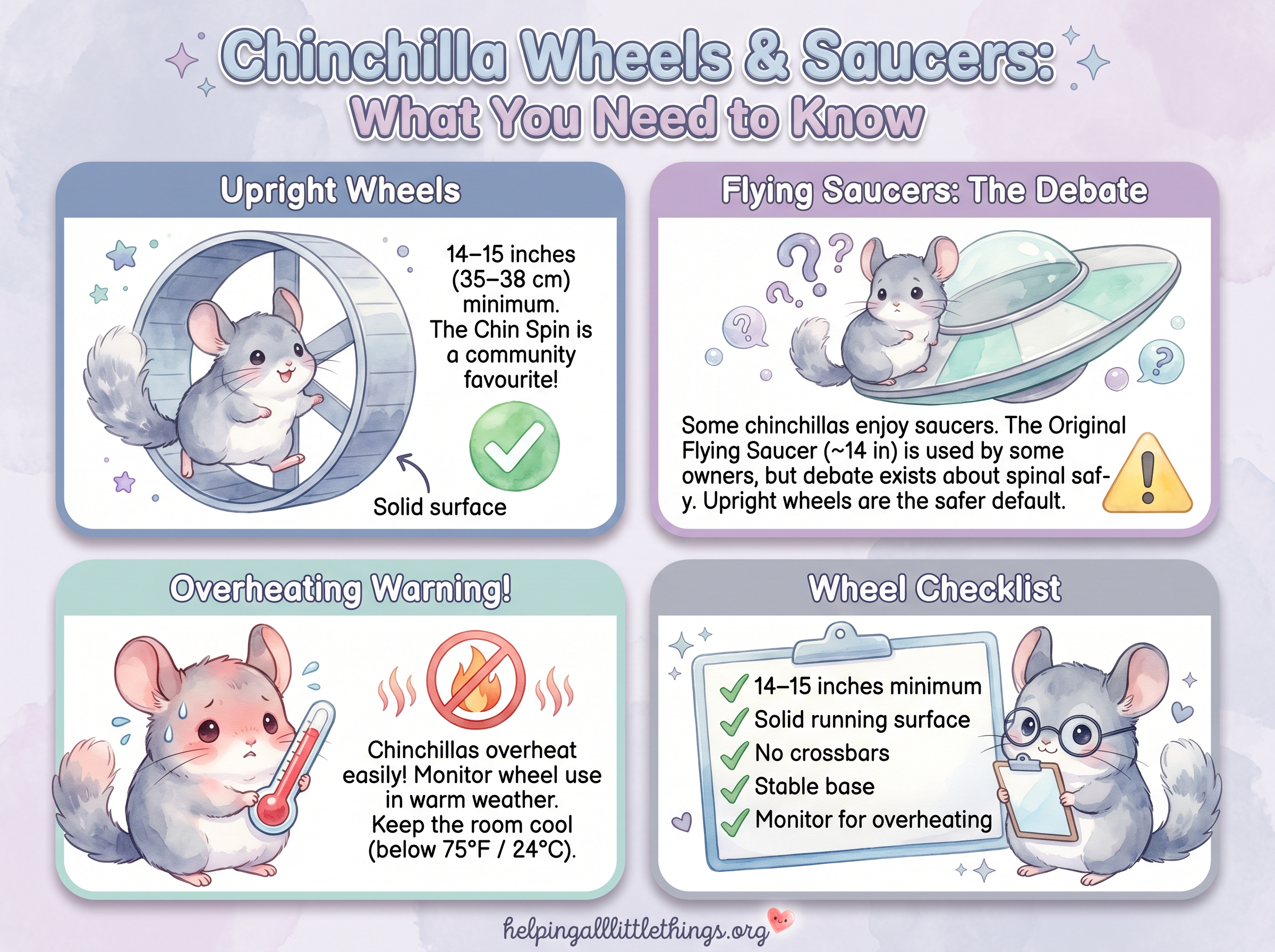

Chinchilla Wheels and Saucers: What You Need to Know
Chinchillas are energetic, agile animals that enjoy running, jumping, and climbing. While a wheel is not strictly essential for chinchillas in the way it is for hedgehogs or hamsters, many chinchillas use one enthusiastically and benefit from the additional exercise it provides. Choosing the right wheel — or deciding whether a flying saucer is appropriate — requires understanding both the size requirements and the unique health considerations that apply to chinchillas.
Do Chinchillas Need a Wheel?
Unlike hamsters, which are obligate runners with a strong biological drive to cover long distances nightly, chinchillas are more variable in their exercise preferences. Some individuals will use a wheel frequently; others will largely ignore it. A wheel is therefore best understood as valuable optional enrichment rather than a baseline requirement — provided the enclosure is large enough and sufficiently enriched with climbing structures, ledges, and hiding spaces to allow natural movement.1
That said, for chinchillas in smaller enclosures or those who show signs of restlessness or boredom, a wheel can be a meaningful addition to their environment.
Minimum Wheel Size: 14–15 Inches (35–38 cm)
Chinchillas are larger than most other small rodents kept as pets, and their wheel requirements reflect this. The minimum recommended diameter for a chinchilla wheel is 14 inches (approximately 35 cm), with 15 inches (38 cm) preferred.1 2
The community-favourite wheel for chinchillas is the Chin Spin, a solid-surface metal wheel available in 15-inch diameter that is widely regarded as the gold standard for chinchilla wheel safety and durability. MN Pocket Pet Rescue's wheel guide recommends 12–15 inches with a solid base of wood or metal only for chinchillas.2
As with all small animals, the guiding principle is that the chinchilla should be able to run with their spine completely straight and their head level with their shoulders. Any wheel that forces the back to arch is too small.
Chinchillas chew constantly, and plastic wheels present a serious ingestion hazard. Always choose a wheel made from solid wood or metal. Plastic components should be avoided entirely.
The Flying Saucer Debate
Flying saucers — angled disc-shaped running platforms — occupy a more contested space in chinchilla care than in the care of most other species. The debate centres on the Original Flying Saucer, which is approximately 14 inches in diameter and has been used by some experienced chinchilla owners as a supplemental exercise option.
The argument in favour of saucers for chinchillas is that their natural gait involves longer, bounding strides rather than the rapid, repetitive running of smaller rodents. Some owners and communities argue that the angled surface of a large saucer accommodates this stride pattern more naturally than a standard upright wheel.1
The argument against is the same as for all species: the angled surface creates lateral spinal curvature, and there is no saucer size that fully eliminates this concern. Most chinchilla care resources treat the upright wheel as the safer default, with saucers considered acceptable only as a secondary option for owners who have researched the debate and chosen to offer one alongside a proper upright wheel.1 2
Our recommendation: offer a correctly sized upright wheel as the primary exercise option. If you wish to add a saucer, use the largest available size and treat it as supplemental enrichment rather than a replacement.
The Overheating Risk
Chinchillas are uniquely sensitive to heat. Their dense fur, which evolved for the cold Andes mountains, provides almost no ability to dissipate heat in warm environments. Chinchillas can develop fatal heatstroke at temperatures above 75°F (24°C).
This has direct implications for wheel use. A chinchilla who runs vigorously on a wheel generates significant body heat. In a warm room, this can push their core temperature into dangerous territory. Monitor your chinchilla's wheel use during warmer months, ensure the room is kept cool, and be alert for signs of heat stress — laboured breathing, drooling, lethargy, or lying flat on a cool surface.3
If you suspect your chinchilla is overheating, move them to a cooler area immediately, offer cool (not ice cold) water, and contact a veterinarian. Do not place them directly on ice or in cold water, as rapid temperature changes can cause shock.
What to Look for in a Good Chinchilla Wheel
A safe chinchilla wheel should have all of the following:
Diameter of 14–15 inches (35–38 cm) minimum. The Chin Spin at 15 inches is the most widely recommended option.
Solid wood or metal running surface. No plastic, no mesh, no bar rungs. Chinchillas will chew plastic, and mesh can trap feet.
No crossbars. The interior should be completely open to allow free movement.
Stable, non-tipping base. Chinchillas are energetic runners and will destabilise a poorly balanced wheel.
Easy to clean. Chinchillas will defecate while running. A wheel that cannot be fully cleaned is a hygiene problem.