Playing with and Training Your Chinchilla
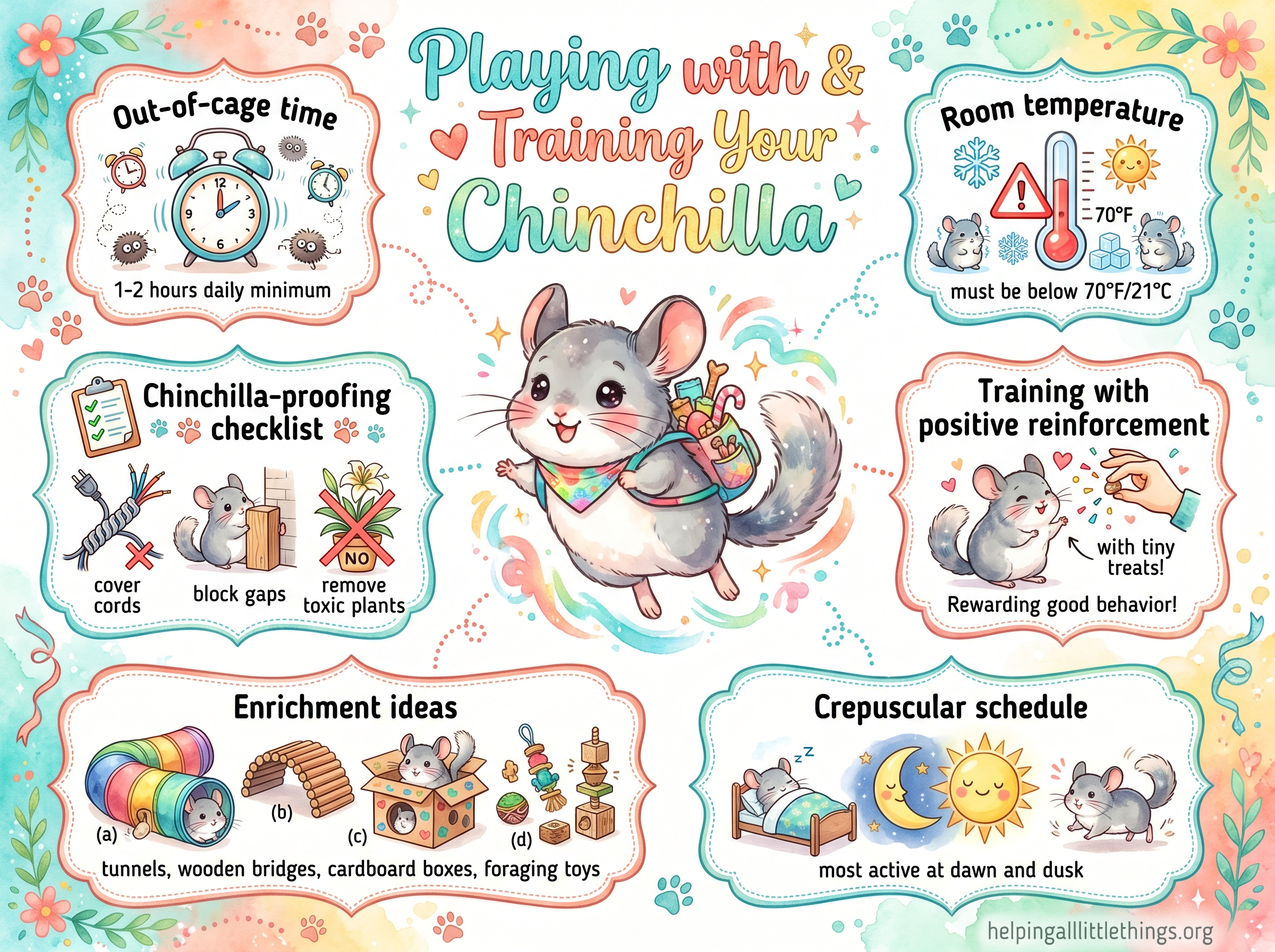

Chinchillas are extraordinarily athletic animals — in the wild, they leap between rocky outcrops at high altitude, covering several metres in a single bound. They are crepuscular (most active at dawn and dusk) and need daily opportunities to run, jump, and explore. Without adequate enrichment, chinchillas can develop stress-related behaviors and become difficult to handle.1
Temperature warning: Chinchillas are extremely heat-sensitive and must never be allowed to exercise in a room warmer than 21°C (70°F). Always check the room temperature before out-of-cage time. See our Heat Stroke article for more information.
Out-of-Cage Time
Chinchillas need at least 1–2 hours of out-of-cage time per day in a chinchilla-proofed room. They are agile escape artists and can squeeze through surprisingly small gaps, so the room must be thoroughly secured.2
Chinchilla-proofing:
- Cover all electrical cords
- Block gaps behind appliances and under doors
- Remove toxic houseplants (see our Dangerous Plants article)
- Remove anything they could chew that might be harmful (treated wood, rubber, plastic)
Enrichment Ideas
| Enrichment Type | Ideas |
|---|---|
| Climbing | Multi-level cage platforms, wooden shelves, branches (kiln-dried apple, willow, hazel) |
| Jumping | Ledges at varying heights — chinchillas love to leap between platforms |
| Chewing | Pumice stones, wooden chews, lava ledges |
| Hiding | Wooden hideouts, ceramic pots, cardboard boxes |
| Foraging | Scatter a small amount of hay-based treats in bedding |
| Dust bath | Blue cloud chinchilla dust, 2–3 times per week for 10–15 minutes |
Training Your Chinchilla
Chinchillas can learn simple behaviors through positive reinforcement. Because they are prey animals with a strong flight response, building trust is the essential first step. Never chase or corner a chinchilla — this causes significant stress and can trigger fur slip (a defense mechanism where they shed a patch of fur).3
Building trust:
- Sit quietly near the cage and let your chinchilla investigate you at their own pace.
- Offer a small treat (a tiny piece of dried rose hip or a single raisin — raisins are high in sugar so use sparingly) from your hand.
- Once they take treats from your hand reliably, begin gently offering your hand as a platform to step onto.
Simple behaviors to teach:
- Step up: Offer your hand as a platform with a treat on it. Reward when they step on.
- Target training: Use a small stick as a target. Reward when they touch it. Use the target to guide them through simple obstacle courses.
- Name recognition: Say their name and reward every time they look at you or approach.